Facts
The petitioner was enlisted as a Class ‘C’ contractor for military engineering services, with enlistment valid until 31 December 2015, and thereafter renewed until 31 December 2020.
Source reference: p.1–2, paras. 1–2For the subsequent five-year cycle, governed by the renewal policy dated 24 April 2020, the petitioner did not submit its renewal application within the prescribed time, attributing the delay to the serious illness of the partner managing the firm.
Source reference: p.2, para. 3The deadline, initially fixed as 31 July 2020, was extended on account of the COVID-19 pandemic and ultimately remained open until 31 March 2021.
Source reference: p.4, para. 11A show-cause notice was issued on 19 August 2021, after which the petitioner submitted its application/reply on 28 August 2021.
Source reference: p.2, para. 3; p.5, para. 14The renewal application was rejected on 8 February 2022. The petitioner’s departmental appeal and subsequent representations were also rejected. The petitioner challenged the final order under Article 226 of the Constitution, principally alleging that it was non-speaking and failed to provide adequate reasons for non-renewal.
Source reference: p.2–3, paras. 4–8Issues
1. Whether the respondents’ order rejecting the petitioner’s renewal application and representations was non-speaking, arbitrary, and liable to be set aside for failure to provide reasons?
Source reference: p.3–4, paras. 8–102. Whether the respondents’ refusal to condone the delay in submitting the renewal application, despite the petitioner’s reliance on the illness of one partner, disclosed perversity or warranted interference under Article 226?
Source reference: p.4–5, paras. 11–153. Whether the petitioner remained eligible to seek fresh enlistment notwithstanding the non-renewal?
Source reference: p.5–6, para. 16Law Applied
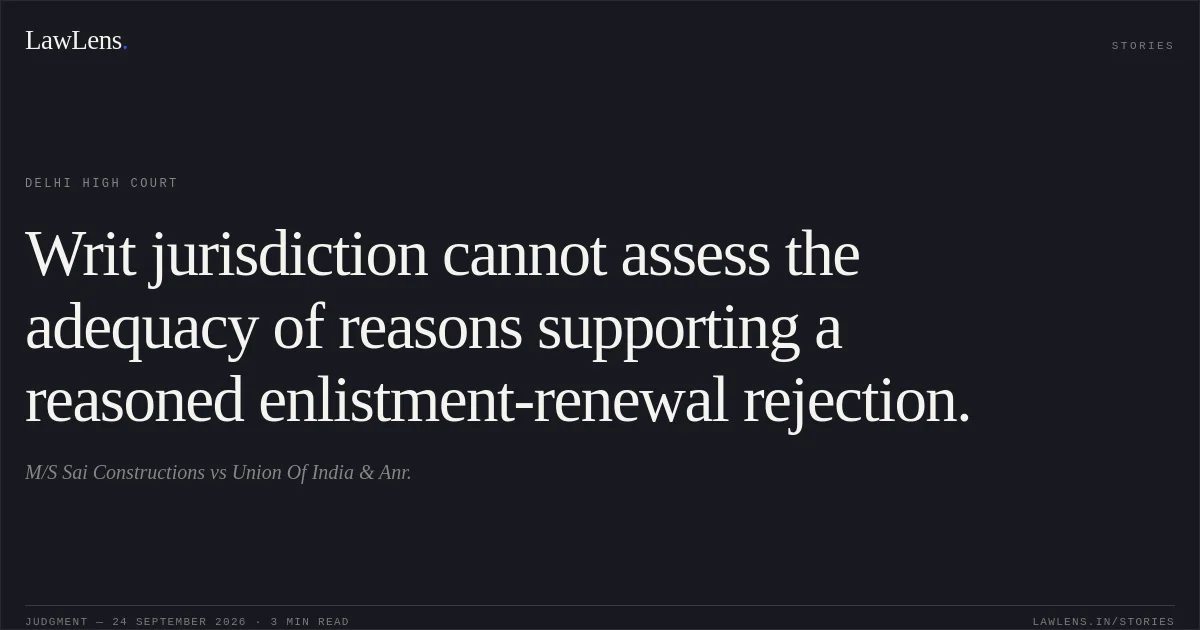
The Court applied the principles governing judicial review under Article 226 of the Constitution of India, holding that interference is warranted where an administrative decision is arbitrary, perverse, or suffers from non-application of mind, but that the Court will not reassess the adequacy or sufficiency of reasons where the decision reflects due consideration of the relevant material.
Source reference: p.5, paras. 13–15An administrative authority must provide reasons sufficient to demonstrate application of mind; however, the reasons need not satisfy a standard of exhaustive or elaborate reasoning.
Source reference: p.5, paras. 13–15The Court also applied the terms of the applicable enlistment-renewal policy, including the prescribed and subsequently extended deadlines for submission of renewal applications.
Source reference: p.4–5, paras. 11–14Reasoning
The Court found that the impugned order was not non-speaking. The respondents had recorded that the renewal process commenced after 24 April 2020, that the deadline was initially 31 July 2020, and that it was extended up to 31 March 2021 due to the COVID-19 pandemic.
Source reference: p.4, para. 11They had also considered the petitioner’s explanation that the delay resulted from the illness of one partner, but concluded that the firm had four partners and that the illness of one partner did not adequately explain the failure to apply within the extended period.
Source reference: p.4, para. 12Since the petitioner submitted its application only on 28 August 2021, after issuance of the show-cause notice on 19 August 2021, the Court held that the decision was based on a reasoned appreciation of the record and disclosed no perversity or jurisdictional error warranting interference under Article 226.
Source reference: p.5, paras. 13–15The Court further noted that non-renewal did not amount to blacklisting and did not bar the petitioner from seeking fresh enlistment.
Source reference: p.5–6, para. 16Holding
The Court held that the respondents had duly considered the petitioner’s representations and had provided sufficient reasons for rejecting the renewal application. The impugned order was neither arbitrary nor perverse, and no ground for interference under Article 226 was established.
The writ petition was accordingly dismissed, and the pending application was disposed of.
Source reference: p.6, para. 17The Court clarified that the petitioner’s non-renewal did not constitute blacklisting and that there was no embargo against its applying for fresh enlistment.
Source reference: p.5–6, para. 16Original Court PDF
M/S Sai ConstructionsvsUnion Of India & Anr.
Click to open original judgment
Original judgment, available to read, download and summarize on LawLens.in