Facts
The petitioner filed a Writ Petition (W.P. No. 3172/2009) seeking the quashing of an order dated 22-12-2008 regarding the appointment/regularization of respondent No. 4 and a direction for his own appointment/regularization with consequential benefits
Source reference: para. 2The writ petition was disposed of on the grounds that it involved disputed questions of fact that could only be decided through evidence and witness examination
Source reference: para. 2The State’s fact-finding report (Annexure R-8) alleged that the petitioner failed to complete a mandatory 25 km run, having used a motorcycle for a portion of the distance
Source reference: para. 3The petitioner sought a review of the disposal order, arguing that since the State did not specifically dispute the facts in their return, no disputed question of fact existed, and further contended that a civil suit is barred under Article 323-A of the Constitution
Source reference: para. 2Issues
1. Whether there is an error apparent on the face of the record warranting the exercise of review jurisdiction
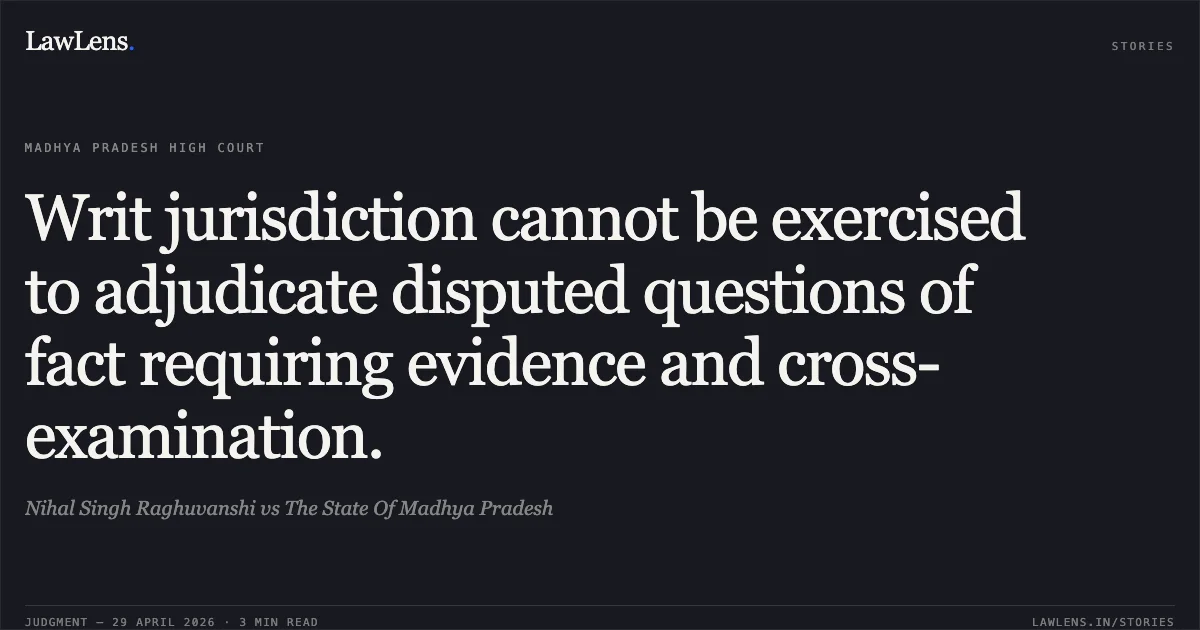
Source reference: para. 152. Whether the High Court can adjudicate disputed questions of fact under Article 226 of the Constitution when such facts rely on an inquiry report and witness testimony
Source reference: para. 7, 14Law Applied
The court applied the principles of review jurisdiction as established in Kamlesh Verma v. Mayawati, which limits review to the discovery of new evidence or errors apparent on the face of the record, excluding "appeals in disguise"
Source reference: para. 5It relied on State of West Bengal v. Kamal Sengupta, defining an "error apparent" as one that is prima facie visible without detailed examination
Source reference: para. 6Regarding writ jurisdiction, the court applied the doctrine from Chairman, GRIDCO v. Sukamani Das and Union of India v. Puna Hinda, which establishes that Article 226 is not the proper remedy for resolving "hotly disputed questions of facts" or tortious liabilities requiring evidence
Source reference: para. 8, 10, 11It cited M.P. Power Management Co. Ltd. v. Sky Power Southeast Solar India (P) Ltd. regarding the relegation of parties to civil suits when factual resolution is an indispensable prelude to relief
Source reference: para. 12Reasoning
The court reasoned that the scope of a review petition is strictly limited and cannot be used to re-argue the merits of the original case
Source reference: para. 5In this instance, the petitioner’s eligibility for regularization hinged on the validity of a fact-finding inquiry report (Annexure R-8), which accused the petitioner of using mechanical means (a motorcycle) to complete a physical fitness test
Source reference: para. 14The court found that the correctness of this report is a "purely disputed question of fact" that necessitates the examination and cross-examination of witnesses, a process unsuitable for summary writ proceedings
Source reference: para. 3, 14Since the petitioner failed to demonstrate any patent error or discovery of new material, and merely sought a rehearing of the original decision, the court determined that the move to a Civil Court was the correct legal path
Source reference: para. 15Holding
The court held that there was no error apparent on the face of the record and that the High Court should not exercise writ jurisdiction over disputed factual claims involving allegations of fraud or physical non-compliance
The court dismissed the review petition, affirming that such issues fall within the domain of the Civil Court to be decided after recording evidence
Source reference: para. 15-16Original Court PDF
Nihal Singh RaghuvanshivsThe State Of Madhya Pradesh
Click to open original judgment
Original judgment, available to read, download and summarize on LawLens.in