Facts
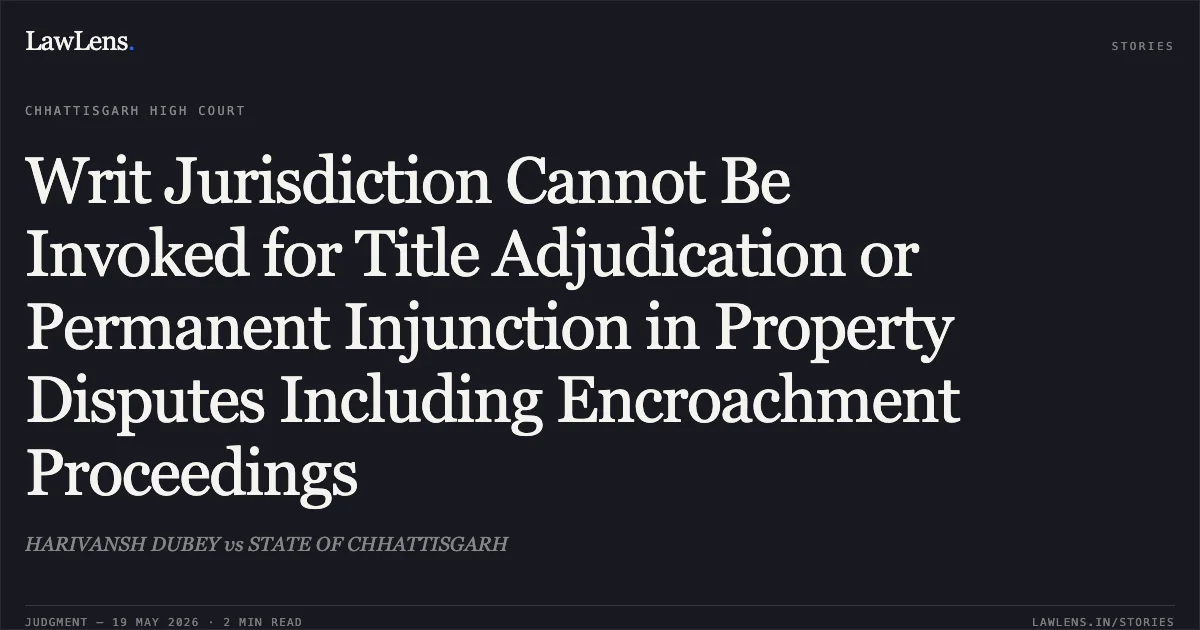
The appellants filed a Writ Appeal against a Single Judge's order dated 19.02.2026, which dismissed their writ petition (WPC No. 1966/2012).
Source reference: p. 2-3The appellants claimed that the subject land (Khasra No. 2009/1) was held by their forefathers prior to 1954 and that the Board of Revenue had ordered its settlement in their mother’s name in 1984.
Source reference: p. 3-4They sought a mandamus to restrain the State from interfering with their possession and from demolishing their houses.
Source reference: p. 3The Single Judge dismissed the petition, observing that the appellants were essentially seeking a decree for permanent injunction and declaration of title, which are matters for a Civil Court.
Source reference: p. 4-7Issues
1. Whether a writ petition under Article 226 of the Constitution is the appropriate remedy for resolving disputes involving questions of title and seeking permanent injunction against the State.
Source reference: p. 4 / para. 72. Whether the Single Judge’s order directing the parties to Civil Court was legally sound despite the appellants' reliance on revenue orders from 1984.
Source reference: p. 8-9 / para. 11Law Applied
property disputes involving "pure property matters" and disputed questions of title should not be entertained under writ jurisdiction.
Source reference: p. 4-5High Courts must not interfere in private property disputes or seeking essentially civil decrees under Articles 226 or 227 unless there is a clear infraction of a statute or collusion with a statutory authority.
Source reference: p. 4-7Reasoning
The Division Bench examined the reliefs sought by the appellants and noted that they were seeking a decree of permanent injunction and a declaration of title in the garb of a writ petition.
Source reference: p. 4the appellants relied on internal revenue proceedings from 1969 and 1981 to claim possession, they failed to present conclusive documents of title to prove they were not encroachers.
Source reference: p. 8-9since the title itself was in dispute, the adjudication required a factual inquiry and weighing of evidence that cannot be effectively performed in writ proceedings.
Source reference: p. 9-10the High Court’s summary jurisdiction is not a substitute for the exhaustive fact-finding process of a Civil Court.
Source reference: p. 9-10Holding
The Court held that the writ appeal was devoid of merit and affirmed the Single Judge's decision.
It concluded that where title is in dispute, the appropriate remedy is a civil suit.
Source reference: p. 9The appeal was dismissed, maintaining the liberty granted to the appellants to approach the Civil Court and the 30-day protection against coercive action (as granted by the Single Judge) to facilitate the filing of a civil suit. No order as to costs was made.
Source reference: p. 7, 10Acts & Sections Cited
1 provisions across 1 statute referred to in this judgment. Each provision opens on LawLens.
Code of Civil Procedure, 19081
Original Court PDF
HARIVANSH DUBEYvsSTATE OF CHHATTISGARH
Click to open original judgment
Original judgment, available to read, download and summarize on LawLens.in