Facts
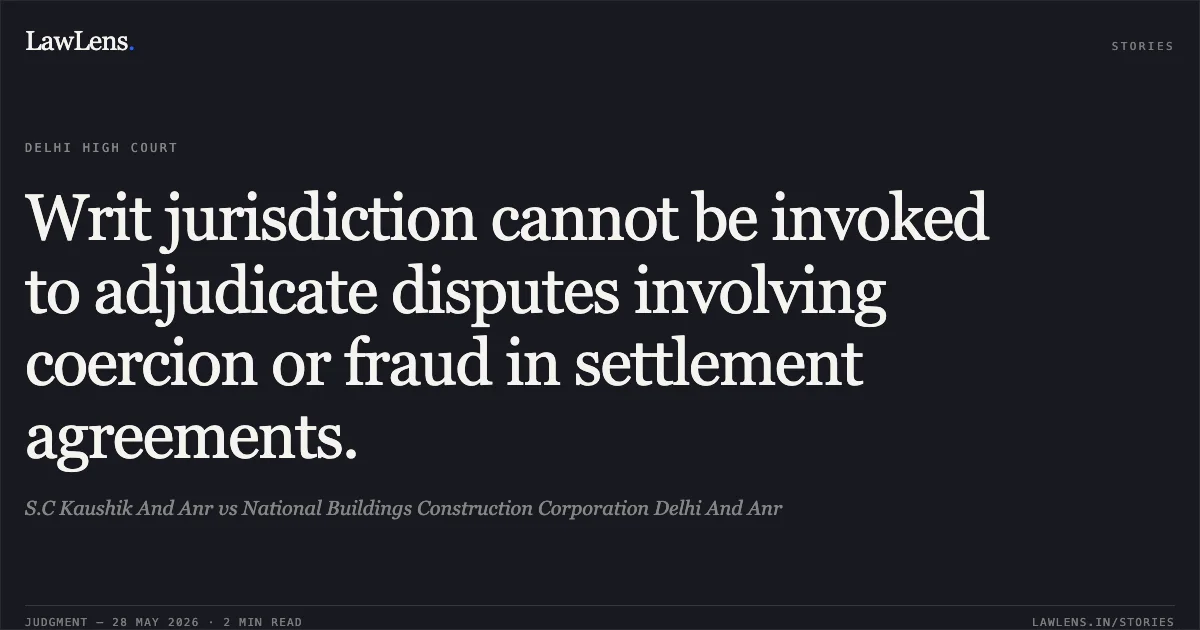
The Appellants, retired government employees, booked apartments in the "NBCC Green View Apartments" project in 2012, which were later declared structurally unfit for habitation by IIT Delhi in 2021.
Source reference: p. 3Following a vacation order by the District Magistrate/DDMA, Respondent No. 1 (NBCC) offered a buy-back policy. Although the Appellants initially objected to the terms, they eventually executed an "Acceptance-cum-Declaration Memorandum" in 2023, accepting a one-time full and final settlement, citing financial helplessness after NBCC ceased rent payments.
Source reference: p. 4-5Subsequently, in 2024, NBCC introduced a new policy offering reconstruction and re-allotment to other allottees.
Source reference: p. 5The Appellants filed Writ Petitions challenging this as discriminatory and seeking parity. A learned Single Judge dismissed the petitions on 13.01.2026, holding that the dispute involved contractual questions of fraud/coercion unsuitable for writ jurisdiction.
Source reference: p. 6Issues
1. Whether the High Court should exercise its writ jurisdiction under Article 226 of the Constitution to adjudicate a dispute arising from a private contract where a "full and final settlement" has already been executed.
Source reference: p. 8, para 252. Whether the Appellants can challenge a subsequent policy decision after having accepted a final settlement, without first establishing that said settlement was vitiated by fraud or coercion.
Source reference: p. 10, para 31Law Applied
The court primarily applied the principles governing Article 226 of the Constitution of India regarding the maintainability of writ petitions in matters involving disputed questions of fact.
Source reference: p. 7It relied on the doctrine of "Full and Final Settlement," which precludes parties from resiling from contractual obligations once consideration is accepted.
Source reference: p. 9Furthermore, it emphasized that while the "State" (under Article 12) must act non-arbitrarily, the determination of "fraud or coercion" in a contract is a factual inquiry requiring evidence and is thus reserved for a competent Civil Court rather than a summary writ proceeding.
Source reference: p. 10Reasoning
The Court reasoned that while the Appellants alleged the subsequent policy of re-allotment was discriminatory and violated the "Uniform Settlement Policy," their standing to challenge it was contingent upon the validity of the Memorandum they had signed.
Source reference: p. 9-10The Court observed that the Appellants received and accepted the settlement amount without immediate protest and only raised grievances after discovering the better terms offered to others.
Source reference: p. 9The Court affirmed the Single Judge's view that whether the Memorandum was signed under "helplessness" or "coercion" constitutes a disputed question of fact.
Source reference: p. 10Since the Appellants had voluntarily entered into a full and final settlement, the Court held that judicial review under Article 226 cannot be used to bypass the evidentiary process required to set aside a contract.
Source reference: p. 10Holding
The Court held that the Impugned Order suffered from no infirmity as allegations of fraud or coercion in a contractual settlement must be adjudicated by a Civil Court.
The Court dismissed the appeals, answering that writ jurisdiction was not the appropriate remedy while preserving the Appellants’ liberty to seek redressal through alternate legal remedies.
Source reference: p. 10, para 32Acts & Sections Cited
1 provisions across 1 statute referred to in this judgment. Each provision opens on LawLens.
Limitation Act, 19631
Original Court PDF
S.C Kaushik And AnrvsNational Buildings Construction Corporation Delhi And Anr
Click to open original judgment
Original judgment, available to read, download and summarize on LawLens.in