Facts
The Appellants, retired government employees, booked apartments in the ‘NBCC Green View Apartments’ project in 2012 and took possession in late 2017
Source reference: p.3, paras 5-6In October 2021, IIT Delhi declared the project structurally unsafe
Source reference: p.3, para 7Consequently, the District Disaster Management Authority (DDMA) ordered the evacuation of the project and directed Respondent No. 1 (NBCC) to refund the total consideration with interest
Source reference: p.3, para 7NBCC initially promised a "Uniform Settlement Policy" but later issued buy-back offers for the principal amount only
Source reference: p.3-4, paras 8-10Facing financial hardship and cessation of rent payments, the Appellants signed an "Acceptance-cum-Declaration Memorandum" in 2023 for a one-time full settlement and received payment
Source reference: p.5, paras 11-12; p.8-9, para 26Subsequently, NBCC offered reconstruction and re-allotment to other allottees, which the Appellants claimed was discriminatory
Source reference: p.5, para 13They filed Writ Petitions seeking parity, which were disposed of by the Single Judge on the grounds that the dispute was contractual and involved disputed facts
Source reference: p.6-7, paras 17-18Issues
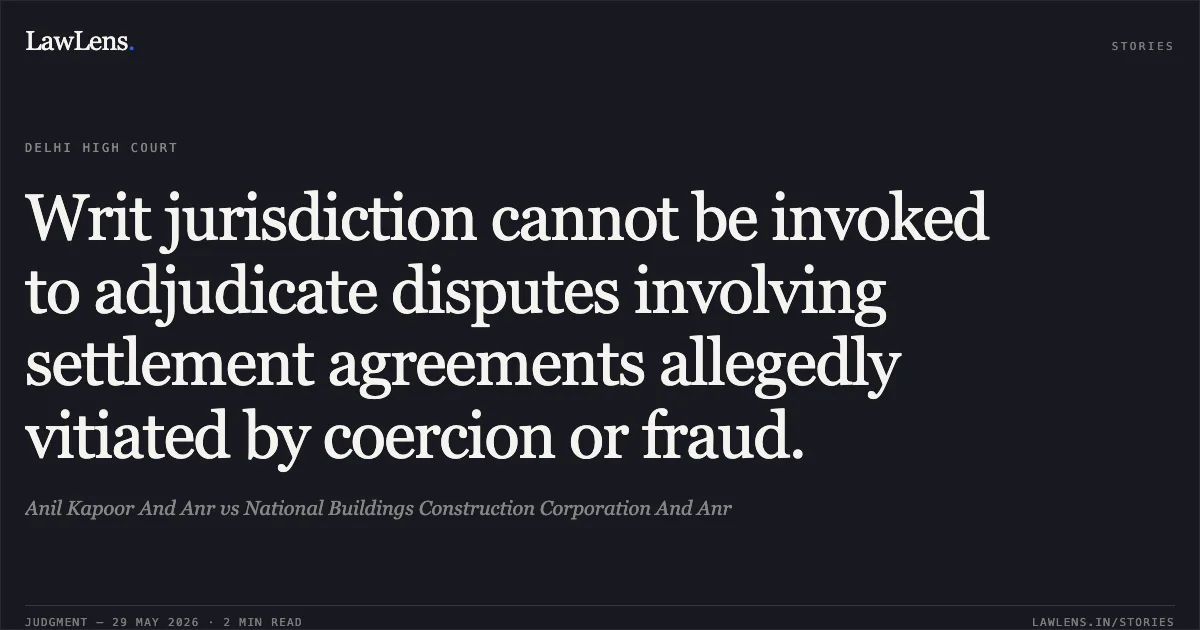
1. Whether the High Court, in the exercise of its writ jurisdiction under Article 226 of the Constitution, should adjudicate claims of coercion and fraud regarding a signed settlement memorandum
Source reference: p.8, para 25; p.10, para 312. Whether the Appellants, after accepting a full and final settlement, were entitled to challenge a subsequent policy change by the Respondent on grounds of discrimination
Source reference: p.9, para 29; p.10, para 30Law Applied
The court applied Article 226 of the Constitution of India regarding the scope of writ jurisdiction, emphasizing that writ courts typically avoid adjudicating "disputed questions of fact"
Source reference: p.6, para 17; p.10, para 31It referenced the legal principle that a party who executes a full and final settlement cannot resile from its terms unless the agreement is proven to be vitiated by fraud or coercion
Source reference: p.9, para 27; p.10, para 31Furthermore, for an entity to be held liable under the doctrine of "State" (Article 12), its policy shifts must be examined, but such examination is secondary to the validity of any existing private contractual settlement
Source reference: p.7, para 20; p.9-10, para 30Reasoning
The Court observed that the Appellants had voluntarily executed the Memorandum and received the settlement amount without raising immediate grievances of coercion
Source reference: p.9, paras 26-27The Appellants only alleged "coercion" after learning that other allottees were offered a more favorable policy of reconstruction and re-allotment
Source reference: p.9, para 29; p.10, para 30The Court reasoned that the Appellants' challenge to the "Uniform Settlement Policy" was contingent upon first invalidating the Memorandum
Source reference: p.10, para 31Since the allegations of fraud and coercion are factual in nature and contested by NBCC (who asserted the settlement was of "free will"), they require the leading of evidence for adjudication
Source reference: p.9, para 28; p.10, para 31Such a fact-intensive inquiry is beyond the scope of Article 226 and is more appropriately suited for a Civil Court
Source reference: p.10, para 31Holding
The Court held that the Appellants cannot challenge subsequent policies while a valid "Full and Final Settlement" exists, unless they prove in a competent Civil Court that the settlement was obtained by fraud or coercion
The Court dismissed the Appeals, holding that the Single Judge committed no error in refusing to exercise writ jurisdiction
Source reference: p.10, para 32The liberty reserved to the Appellants to seek alternative remedies in law was upheld
Source reference: p.10, para 32No order as to costs
Source reference: p.10, para 32Acts & Sections Cited
1 provisions across 1 statute referred to in this judgment. Each provision opens on LawLens.
Limitation Act, 19631
Original Court PDF
Anil Kapoor And AnrvsNational Buildings Construction Corporation And Anr
Click to open original judgment
Original judgment, available to read, download and summarize on LawLens.in