Facts
The petitioner, Manisha Sarthi, filed a writ petition seeking police protection and a direction to restrain the police and private respondents from interfering in her personal liberty.
Source reference: para. 2The petitioner is currently living separately from her husband (Respondent No. 5) and has initiated divorce proceedings in a Family Court.
Source reference: para. 3She alleged that Respondent No. 5, along with Respondents No. 4 and 6, was harassing her and making false allegations of an illicit relationship between her and one Satyavan.
Source reference: para. 4Furthermore, she contended that the local police (Respondents No. 2 and 3) were repeatedly summoning her to the police station without proper notice or preliminary inquiry, based on a complaint filed by Respondent No. 4, thereby violating her fundamental rights under Article 21.
Source reference: paras. 5-6The State argued that the police were merely conducting a lawful inquiry into a received complaint and that no coercive action had been taken.
Source reference: para. 7Issues
1. Whether the High Court should exercise its extraordinary writ jurisdiction under Article 226 of the Constitution to interfere in police inquiries arising out of private matrimonial disputes.
Source reference: paras. 9-102. Whether the repeated summoning of the petitioner by the police for inquiry constitutes a violation of fundamental rights warranting judicial intervention.
Source reference: para. 10Law Applied
The Court primarily relied on the principles governing the exercise of extraordinary jurisdiction under Article 226 of the Constitution of India, which is reserved for addressing violations of fundamental rights or the failure of statutory authorities to perform legal duties.
Source reference: para. 10The Court also referenced the protections of life and personal liberty under Article 21 of the Constitution.
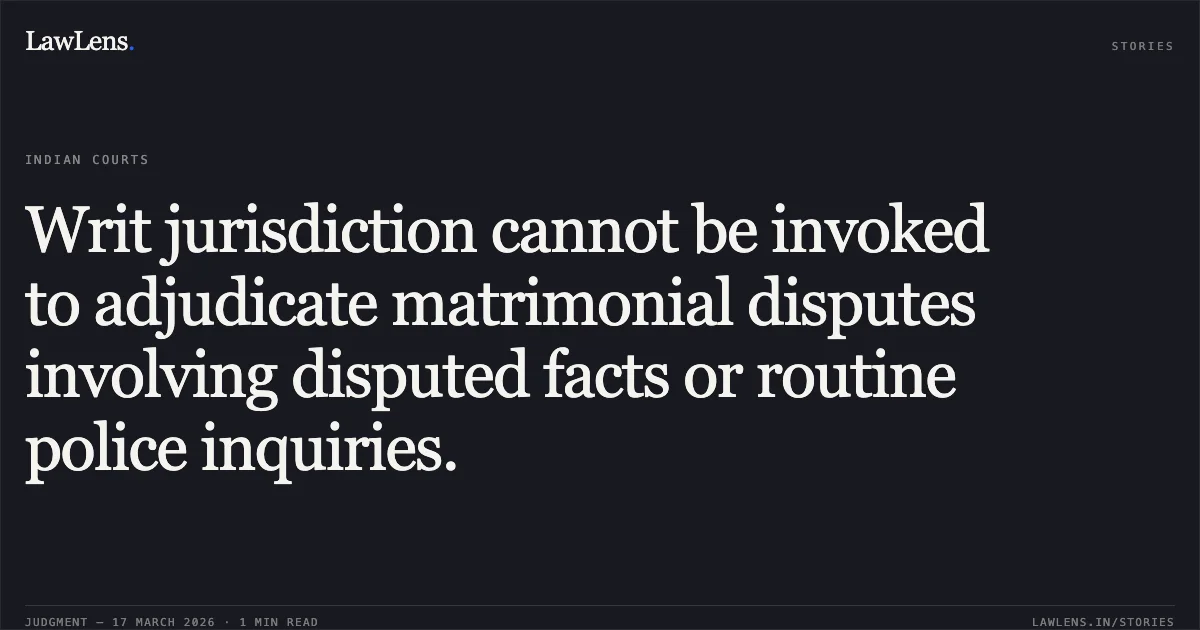
Source reference: para. 5The Court applied the settled legal principle that writ jurisdiction cannot be used to adjudicate disputed questions of fact arising from private or matrimonial discords, nor can it be used to interfere with the legitimate investigative domain of the police unless an abuse of process is clearly demonstrated.
Source reference: para. 10Reasoning
The Court observed that the crux of the dispute was a matrimonial conflict between the petitioner and Respondent No. 5, leading to secondary allegations by private parties.
Source reference: para. 9The Bench reasoned that the petitioner’s grievances involved "disputed questions of fact" regarding personal relationships and harassment, which are not suitable for adjudication in a writ proceeding.
Source reference: para. 10Regarding the police conduct, the Court found that merely summoning a person for inquiry pursuant to a complaint is a standard part of investigative procedure and is not per se illegal or arbitrary, provided no coercive measures are employed.
Source reference: para. 10Since the State confirmed no coercive action was taken, the Court determined there was no evidence of a clear abuse of process or a violation of law that necessitated the invocation of its extraordinary powers.
Source reference: para. 10Holding
The High Court dismissed the writ petition, holding that the matter was premature and lacked merit for interference under Article 226.
The Court held that grievances arising from matrimonial disputes and police inquiries should be addressed by availing appropriate statutory remedies before competent forums rather than through a writ petition.
Source reference: para. 11The Court granted the petitioner liberty to approach the appropriate authorities or competent courts for relief as permitted by law.
Source reference: para. 13Original Court PDF
MANISHA SARTHIvsSTATE OF CHHATTISGARH
Click to open original judgment
Original judgment, available to read, download and summarize on LawLens.in