Facts
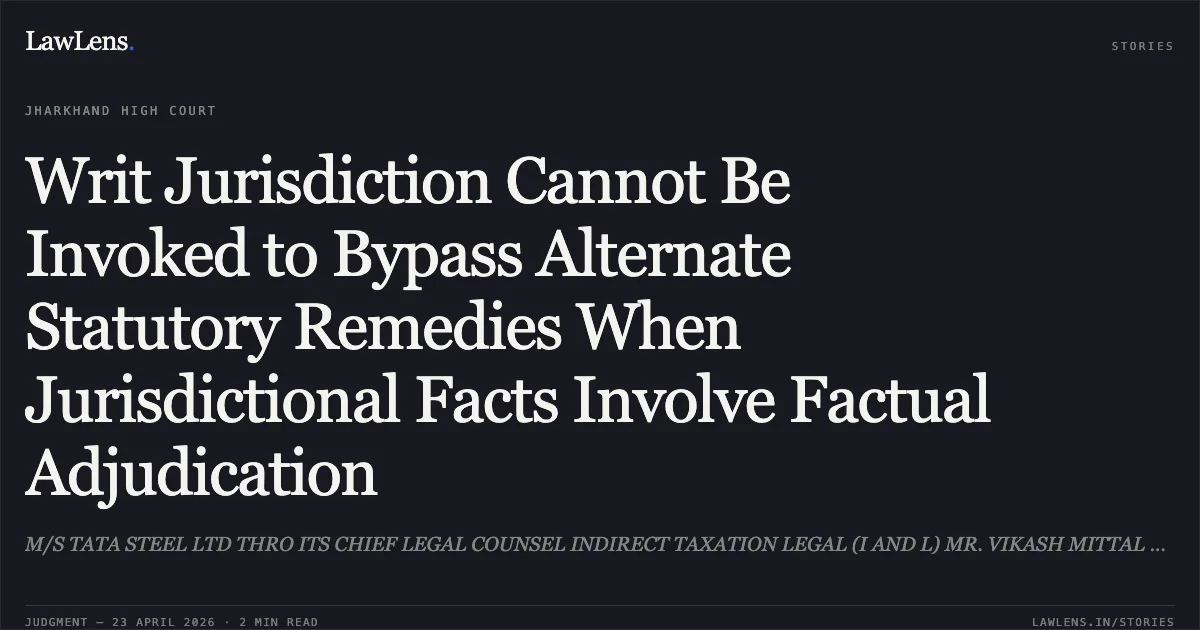
The Petitioner, Tata Steel Limited, challenged an Order-In-Original dated 26.12.2025 passed under Section 74 of the CGST Act, 2017
Source reference: p. 1-3The Petitioner admitted the existence of an alternative statutory remedy (appeal) but sought to invoke the High Court’s writ jurisdiction under Article 226
Source reference: para. 2The Petitioner contended that the jurisdictional parameters of Section 74 (fraud, willful misstatement, or suppression) were absent and that the proceedings, based on a contested audit report, violated principles of natural justice
Source reference: para. 3The Revenue argued that the Petitioner must exhaust statutory remedies, as the order was passed with due consideration of the Petitioner's response and merits
Source reference: para. 6Issues
1. Whether the High Court should entertain the writ petition bypassing the alternative statutory remedy provided under the CGST Act, 2017?
Source reference: para. 2, 92. Whether the impugned Order-In-Original was passed without jurisdiction or in patent violation of the principles of natural justice?
Source reference: para. 3, 10Law Applied
The Court primarily applied the doctrine of "exhaustion of alternative remedy" as established in Whirlpool Corporation v. Registrar of Trade Marks, which permits writ intervention despite alternative remedies only if the action is wholly without jurisdiction, violates natural justice, or challenges the vires of a statute
Source reference: para. 2, 10Section 74 of the CGST Act, 2017 was the substantive law governing the tax demand
Source reference: para. 11State of Maharashtra v. Greatship (India) Limited, emphasizing that Article 226 is not meant to circumvent statutory procedures
Source reference: para. 17Thansingh Nathmal v. Superintendent of Taxes, which cautioned that the High Court should not act as a court of appeal to correct errors of fact under Article 226
Source reference: para. 20-21Reasoning
The Court observed that the Petitioner’s challenge regarding the non-fulfillment of Section 74 ingredients (fraud or suppression) involved disputed questions of fact that require evaluation of evidence—a task best suited for an appellate authority rather than a writ court
Source reference: para. 12-15The Court rejected the argument of "absolute want of jurisdiction," noting that the proper officer had considered the Petitioner's response and made a determination on merits
Source reference: para. 12, 16Regarding natural justice, the Court found no patent breach since a show-cause notice was issued and the Petitioner’s replies were considered
Source reference: para. 23The Court held that assigning a matter to a "Call Book" is an administrative convenience and its recall does not necessitate a hearing
Source reference: para. 25Consequently, the matter did not fall within the narrow exceptions carved out in Whirlpool
Source reference: para. 22, 26Holding
The Court dismissed the writ petition, declining to entertain it due to the availability of an efficacious alternative statutory remedy
The Court held that the jurisdictional and factual issues raised must be adjudicated by the Appellate Authority
Source reference: para. 29acknowledging the Petitioner’s bona fide pursuit of the writ, the Court granted liberty to file a statutory appeal within four weeks, directing the Appellate Authority to decide the matter on merits without adverting to the issue of limitation
Source reference: para. 32-33Acts & Sections Cited
1 provisions across 1 statute referred to in this judgment. Each provision opens on LawLens.
Central Goods and Services Tax Act, 20171
Original Court PDF
M/S TATA STEEL LTD THRO ITS CHIEF LEGAL COUNSEL INDIRECT TAXATION LEGAL (I AND L) MR. VIKASH MITTALvsUNION OF INDIA, THRO THE SECRETARY, MINISTRY OF FINANCE, DEPARTMENT OF REVENUE
Click to open original judgment
Original judgment, available to read, download and summarize on LawLens.in