Facts
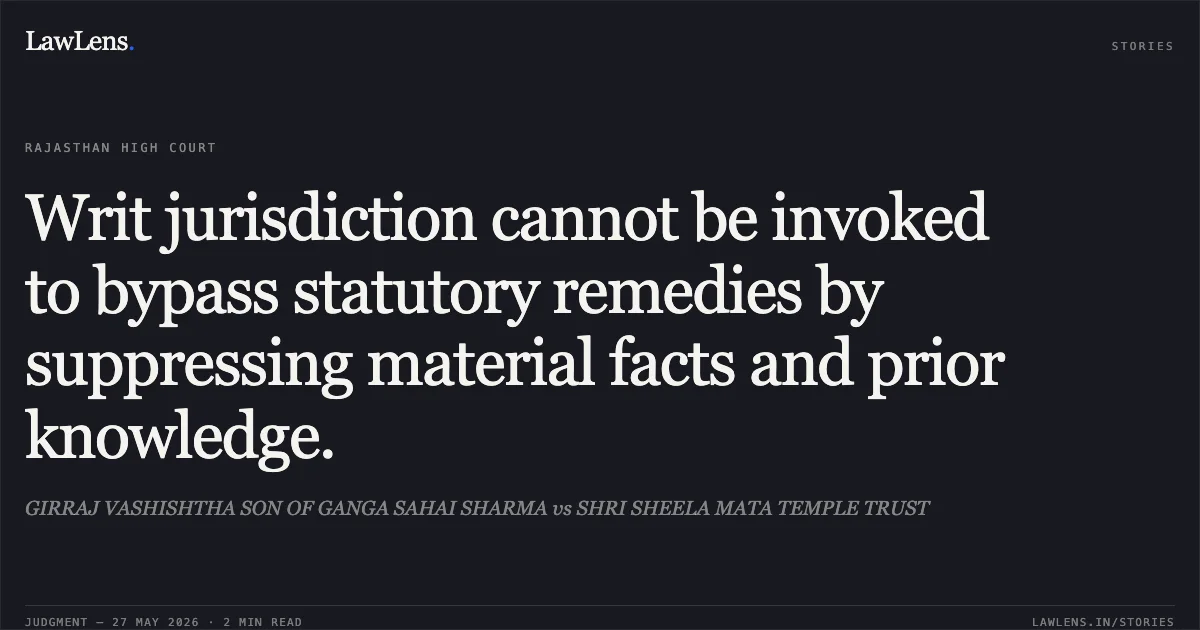
The petitioner, claiming to be a shebait of Jamwai Mata Temple, challenged an order dated 30.04.2010 passed by the Assistant Commissioner, Devasthan.
Source reference: para 1The 2010 order, passed under Section 23 of the Rajasthan Public Trust Act, 1959, accepted "Form 8" changes regarding trustees and immovable properties of respondent No. 1 Trust.
Source reference: para 2.1-2.3The petitioner appealed this order in 2019 (Appeal No. 13/2019) before the Commissioner, Devasthan (Appellate Authority), which was dismissed on 21.04.2022 due to an inordinate delay of 10 years.
Source reference: para 2.4-2.5The petitioner then invoked Article 226 of the Constitution, alleging that the 2010 proceedings were void ab initio for lack of notice to interested persons.
Source reference: para 4Respondents countered that the petitioner suppressed material facts, including prior knowledge of the Trust via letters signed in 2017 and the existence of a parallel civil suit filed by family members.
Source reference: para 7Issues
Whether the Appellate Authority erred in dismissing the appeal on the grounds of limitation given the alleged lack of knowledge of the 2010 order.
Source reference: para 11Whether the writ petition is maintainable despite the concealment of material facts and the availability of an alternative statutory remedy.
Source reference: para 13, 15Law Applied
Rajasthan Public Trust Act, 1959, specifically Section 23 regarding inquiries into changes of entries, Section 20 regarding appeals, and Section 22, which mandates that any person aggrieved by an entry must institute a civil suit for cancellation or modification.
Source reference: para 8, 14Dalip Singh v. State of U.P. (2010) and K.D. Sharma v. SAIL (2008), which hold that a litigant who suppresses material facts or bases a case on falsehoods is not entitled to extraordinary relief.
Source reference: para 13Reasoning
The Court found the Appellate Authority’s dismissal on limitation to be well-reasoned and rejected the petitioner’s claim of "sudden discovery" of the 2010 order in 2019, noting that correspondence from 2017 (to which the petitioner was a signatory) irrefutably established prior knowledge.
Source reference: para 12The Court emphasized that the petitioner approached the Writ Court with "unclean hands" by suppressing these 2017 letters and the fact that a parallel suit (No. 7/2018) had already been filed by other shebaits for identical relief.
Source reference: para 13Furthermore, since the entries had already been amended in the register, Section 23(4) read with Section 22 of the Act provides a specific, efficacious statutory remedy via a civil suit.
Source reference: para 14-15The Court determined it was inappropriate to resolve complex, contested historical facts regarding temple properties and shebait rights in a writ jurisdiction when a statutory civil remedy exists.
Source reference: para 15Holding
The Court dismissed the writ petition, holding that the petitioner failed to demonstrate any illegality or jurisdictional error in the impugned orders.
The Court found the appeal was rightly dismissed as time-barred due to the 10-year delay and the petitioner's dishonest narrative regarding his knowledge of the proceedings.
Source reference: para 16The petitioner’s conduct in suppressing the 2017 letters and the parallel civil litigation disentitled him to equitable relief.
Source reference: para 13The petitioner is at liberty to pursue the alternative statutory remedy under Section 22 of the Act, but the present petition was dismissed without costs.
Source reference: para 19-20Acts & Sections Cited
5 provisions across 1 statute referred to in this judgment. Each provision opens on LawLens.
Rajasthan Public Trust Act 19595
Original Court PDF
GIRRAJ VASHISHTHA SON OF GANGA SAHAI SHARMAvsSHRI SHEELA MATA TEMPLE TRUST
Click to open original judgment
Original judgment, available to read, download and summarize on LawLens.in