Facts
The petitioner, a final-year LL.B. student, challenged the action of Respondent No. 3 (HDFC Bank) in placing a hold/lien on ₹45,000 in his savings account following an email notification dated 03.12.2025.
Source reference: para. 2The hold was initiated based on a National Cyber Crime Reporting Portal (NCRP) acknowledgment (No. MHA 32111250039178) on directions from the Cyber Crime Coordination Centre (I4C) regarding a suspected fraud involving over ₹60,00,000.
Source reference: para. 2, 5The petitioner contended he was neither an accused nor named in an FIR, and that the amount was a legitimate transaction received on behalf of an elderly acquaintance.
Source reference: para. 3, 5Despite representations to various Cyber Cells and bank authorities over a period exceeding 103 days, the hold was not lifted.
Source reference: para. 7-8Issues
1. Whether the imposition of a lien/hold on a bank account based on an NCRP acknowledgment, without the petitioner being named as an accused in an FIR, is legally sustainable under Article 226 of the Constitution.
Source reference: para. 10-112. Whether the failure to provide prior notice or a specific statutory order before freezing the funds violates the principles of natural justice and Article 300A.
Source reference: para. 123. Whether the High Court should exercise its extraordinary writ jurisdiction to adjudicate disputed facts regarding the nexus of the funds to a cyber-offence.
Source reference: para. 13-14Law Applied
The court primarily considered the investigative powers under the Bharatiya Nagarik Suraksha Sanhita (BNSS) regarding the freezing of accounts by Investigating Officers.
Source reference: para. 8Temporary restraint of suspected proceeds of crime is a recognized investigative measure intended to preserve the subject matter of an inquiry.
Source reference: para. 10The doctrine of "Alternative Efficacious Remedy" posits that writ jurisdiction should not be exercised when specialized forums or criminal courts are available to resolve disputed questions of fact.
Source reference: para. 14-15Reasoning
The court reasoned that the absence of a formal FIR or the fact that the petitioner is not currently an accused does not render the investigative hold illegal, as cyber-fraud investigations require the preservation of suspected funds while transactions are traced.
Source reference: para. 10Regarding natural justice, the court held that prior notice is not mandatory in such investigative measures to prevent the "dissipation of the subject matter".
Source reference: para. 12The court emphasized that it cannot act as an investigating agency to verify the "nexus" or "source" of the ₹45,000 credit, as these are disputed factual matters requiring evidence.
Source reference: para. 13The court found that the proper forum for relief is the jurisdictional criminal court rather than the High Court under Article 226.
Source reference: para. 14Holding
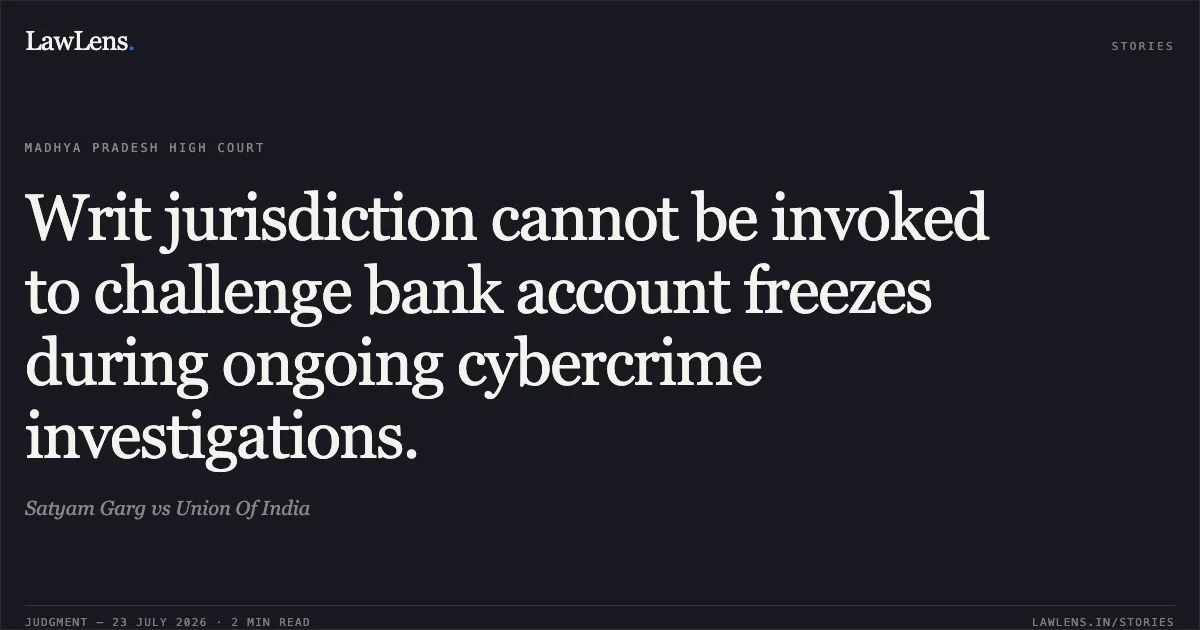
The court answered that the investigative hold is a valid measure and the petitioner must seek relief through the proper statutory channels.
The Court dismissed the writ petition, directing the petitioner to exercise the efficacious remedy of approaching the Investigating Officer or the jurisdictional criminal court to seek the release or defreezing of the amount.
Source reference: para. 14-16Original Court PDF
Satyam GargvsUnion Of India
Click to open original judgment
Original judgment, available to read, download and summarize on LawLens.in