Facts
The petitioner challenged an Assessment Order dated June 4, 2025, and a Show Cause Notice dated March 17, 2025, issued by the UP GST department.
Source reference: para. 2The petitioner had previously filed a writ petition in January 2026, which was withdrawn with liberty to file a fresh petition with better particulars.
Source reference: para. 5Despite having filed a reply to the original notice and being granted an opportunity for a hearing, the petitioner approached the High Court under Article 226 almost a year after the assessment order was passed.
Source reference: para. 3, 4The petitioner sought to quash the orders on jurisdictional grounds after the statutory limitation period for filing an appeal under Section 107 of the GST Act had expired.
Source reference: para. 6, 8Issues
1. Whether a writ petition under Article 226 is maintainable to challenge an assessment order when the petitioner has bypassed the statutory appellate remedy and the limitation period for such appeal has expired.
Source reference: para. 6, 92. Whether the High Court, in its writ jurisdiction, can condone delay beyond the maximum period prescribed by a special statute (GST Act).
Source reference: para. 10, 11Law Applied
The Court applied Section 107 of the GST Act, which prescribes a three-month limitation for filing an appeal, extendable by only one month upon showing sufficient cause.
Source reference: para. 6It relied on the precedent in Singh Enterprises v. C.C.E., Jamshedpur (2008), which established that when a statute provides a specific maximum period for condonation of delay, the authorities cannot extend it further, effectively excluding Section 5 of the Limitation Act.
Source reference: para. 6This principle was reinforced by Commissioner of Customs and Central Excise v. Hongo India Private Limited (2009).
Source reference: para. 7The court applied the maxim quando aliquid prohibetur ex directo, prohibetur et per obliquum (what cannot be done directly cannot be done indirectly) and the doctrine of laches.
Source reference: para. 9, 11The court followed Atlantis Intelligence Ltd. vs. Union of India (2025), holding that Article 226 cannot be used to render statutory limitation provisions otiose.
Source reference: para. 10Reasoning
The Court reasoned that since the petitioner participated in the original proceedings by filing a reply and attending a hearing, there was no violation of natural justice or a patent jurisdictional error that warranted extraordinary intervention.
Source reference: para. 3, 12The Court observed that the petitioner was a "fence sitter" who slept over their rights for nearly a year.
Source reference: para. 9The Court held that while Article 226 powers are broad, they must be exercised consistent with substantive statutory laws and public policy.
Source reference: para. 10The Court determined that entertaining the petition would allow the petitioner to circumvent Section 107 of the GST Act, thereby undermining the legislative intent of strict limitation periods in tax laws.
Source reference: para. 6, 11It noted that the petitioner failed to provide a sufficient explanation for the delay or the failure to utilize the statutory appellate forum within the prescribed "3+1" month window.
Source reference: para. 11Holding
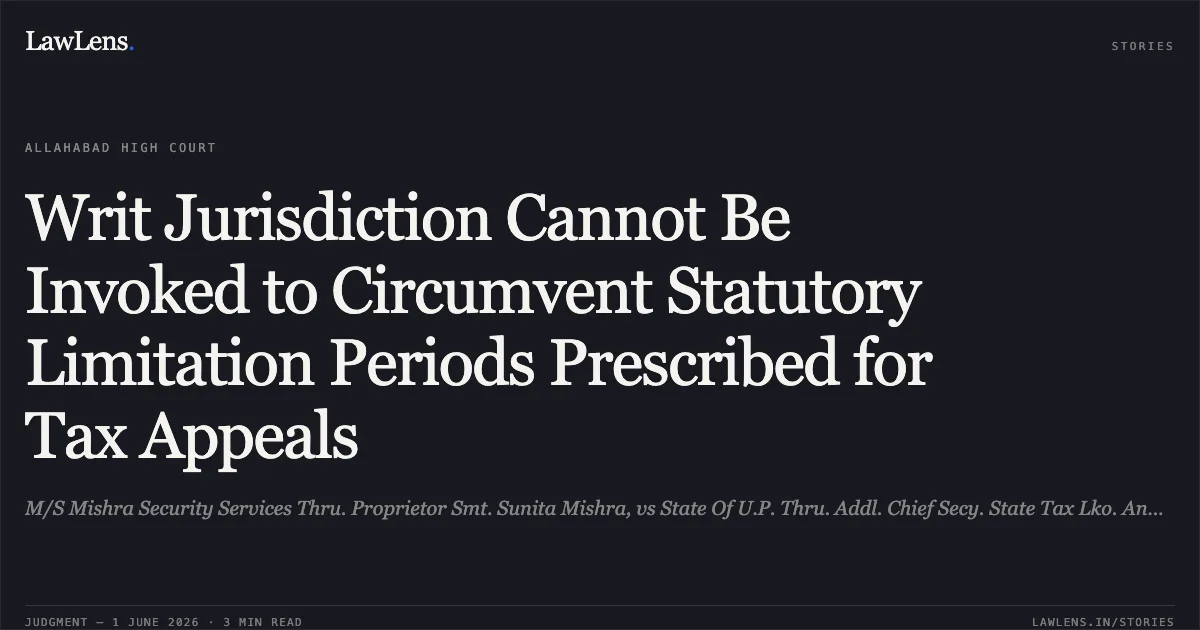
The Court dismissed the writ petition, holding that writ jurisdiction cannot be invoked to undermine a statutory regime or bypass the limitation period provided in a special statute.
The Court found no gross violation of natural justice or patent illegality to justify interference.
Source reference: para. 12The Court granted the petitioner liberty to proceed in accordance with law, clarifying that these observations should not prejudice the decision of an appellate forum if an appeal is filed.
Source reference: para. 13Acts & Sections Cited
8 provisions across 3 statutes referred to in this judgment. Each provision opens on LawLens.
Central Goods and Services Tax Act, 20173
Central Excise Act, 19441
Limitation Act, 19634
Original Court PDF
M/S Mishra Security Services Thru. Proprietor Smt. Sunita Mishra,vsState Of U.P. Thru. Addl. Chief Secy. State Tax Lko. And 2 Others
Click to open original judgment
Original judgment, available to read, download and summarize on LawLens.in