Facts
The petitioner, claiming to be an authorized representative of Dargah Gaib Shah Wali, challenged an order dated 07/04/2026 passed by the District Collector, Shajapur.
Source reference: para 1The petitioner sought to quash the allotment of land (Survey No. 321/5) for the construction of a Police Chowki, claiming the land was Waqf property and that a Dargah already exists on part of it.
Source reference: para 1, 4The State countered that the document relied upon by the petitioner (P-4) was forged and fabricated, noting that the disputed survey number was not included in the official Gazette list of Waqf properties.
Source reference: para 6The State further argued that the petitioner failed to prove legal locus standi or registration under the Waqf Act and that the land was required for public safety and police amenities.
Source reference: para 7Issues
1. Whether the disputed land (Survey No. 321/5) is a registered Waqf property or Government land available for public purposes.
Source reference: para 6, 92. Whether the High Court can exercise its writ jurisdiction under Article 226 when there are significant disputed questions of fact regarding the authenticity of documents and title.
Source reference: para 9, 103. Whether the petitioner has the locus standi to maintain the petition on behalf of the Dargah.
Source reference: para 7, 9Law Applied
The court applied the principle that the scope of writ jurisdiction under Article 226 of the Constitution of India is limited and cannot be used to adjudicate complex disputed questions of fact or title.
Source reference: para 9It relied on the doctrine that public purpose (such as law and order and police amenities) outweighs private claims, especially when the claimant's title is not established by undisputed evidence.
Source reference: para 10The court considered the statutory requirements of the M.P. Land Revenue Code (Sections 115 and 248) and the necessity of proving authorization/registration for entities seeking legal relief.
Source reference: para 5, 7Reasoning
The Court observed that the petitioner’s claim rested on an entry in the Waqf Board register made as recently as 14.08.2024, for which the petitioner’s counsel could provide no underlying supporting documentation.
Source reference: para 9Conversely, the State produced an official Gazette and an ERP-uploaded Collector's order from 2024 showing that Survey No. 321/5 no longer exists or is not listed as Waqf property.
Source reference: para 6, 9The Court reasoned that since the authenticity of the petitioner’s documents was under serious doubt and the identity of the land itself was contested, these issues necessitated a full-fledged trial through appropriate civil proceedings rather than summary writ proceedings.
Source reference: para 10The Court also noted the State's assurance that any eventual demolition would follow due process of law.
Source reference: para 7Holding
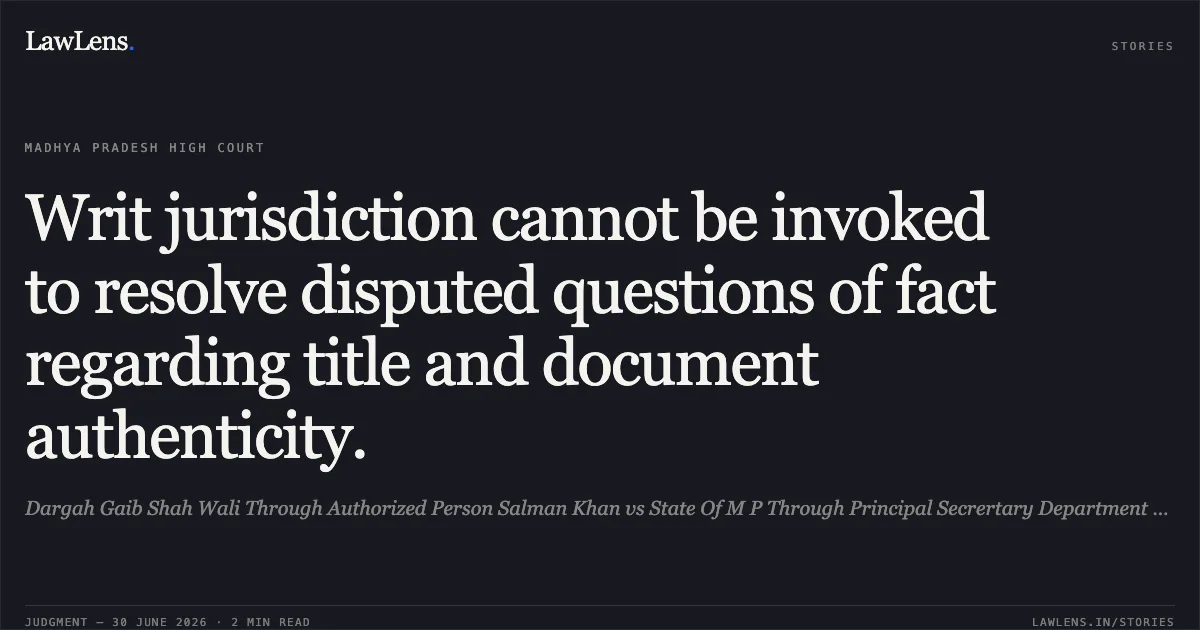
The Court dismissed the petition, holding that it could not exercise jurisdiction under Article 226 due to the presence of disputed facts regarding document veracity and land title.
The interim status-quo order dated 27.05.2026 was vacated and the Court granted the petitioner the liberty to pursue alternative legal remedies (such as a civil suit) where these facts could be established through trial.
Source reference: para 12Acts & Sections Cited
1 provisions across 1 statute referred to in this judgment. Linked provisions open on LawLens.
M.P. Land Revenue Code, 19591
Original Court PDF
Dargah Gaib Shah Wali Through Authorized Person Salman KhanvsState Of M P Through Principal Secrertary Department Of Revenue
Click to open original judgment
Original judgment, available to read, download and summarize on LawLens.in