Facts
The petitioners, acting as Managers/In-charges of various Paddy Procurement Centers (Cooperative Societies), challenged the state authorities’ refusal to grant an allowance for "dryness shortage" (weight loss due to moisture evaporation) in procured paddy.
Source reference: no citationThe petitioners claimed that while rice millers received a 5% allowance for such loss, procurement centers were denied it, despite shortages arising from "natural driage" caused by delayed lifting and transportation of paddy by the state agencies.
Source reference: p. 9, 11The petitioners sought protection from coercive recovery actions and FIRs initiated by district collectors intended to achieve "Zero Shortage" status.
Source reference: p. 9The matters were clubbed due to commonality of facts and issues.
Source reference: p. 7Issues
1. Whether the High Court can grant a "dryness shortage" allowance to Cooperative Societies in the absence of such a provision in the State Paddy Procurement Policy 2025-2026?
Source reference: p. 102. Whether the petitioners are entitled to relief under writ jurisdiction when the underlying agreement contains a dispute resolution/arbitration mechanism?
Source reference: p. 12Law Applied
Paddy Procurement Policy 2025-2026, specifically Clauses 15.9 and 16.3, which stipulate that no dryage is generally permitted and that if the Marketing Federation (MARKFED) fails to transport paddy, the Societies themselves are responsible for arranging transportation.
Source reference: p. 11-12Clauses 5.6 and 13 of the Agreement executed between the parties; Clause 5.6 empowers the state to recover shortages under the Chhattisgarh State Cooperative Societies Act, 1960 and Clause 13 mandates that disputes related to the agreement be resolved via Arbitration before the District Collector.
Source reference: p. 12Reasoning
The court found that the petitioners' grievances regarding weight reduction were rooted in factual disputes concerning "natural dryage" and logistics.
Source reference: p. 11By examining Clause 16.3 of the Policy, the court determined that the responsibility for timely transportation shifted to the Societies if MARKFED failed to provide facilities, thereby nullifying the petitioners' argument that the state was solely liable for delayed lifting.
Source reference: p. 11-12The court observed that since the Procurement Policy expressly disallowed dryage benefits, judicially granting such relief would bypass the policy terms.
Source reference: p. 12The court applied the principle of exhaustion of alternative remedies, noting that Clause 13 of the signed Agreement provided a specific forum (Arbitration) to resolve these exact grievances.
Source reference: p. 12-13Holding
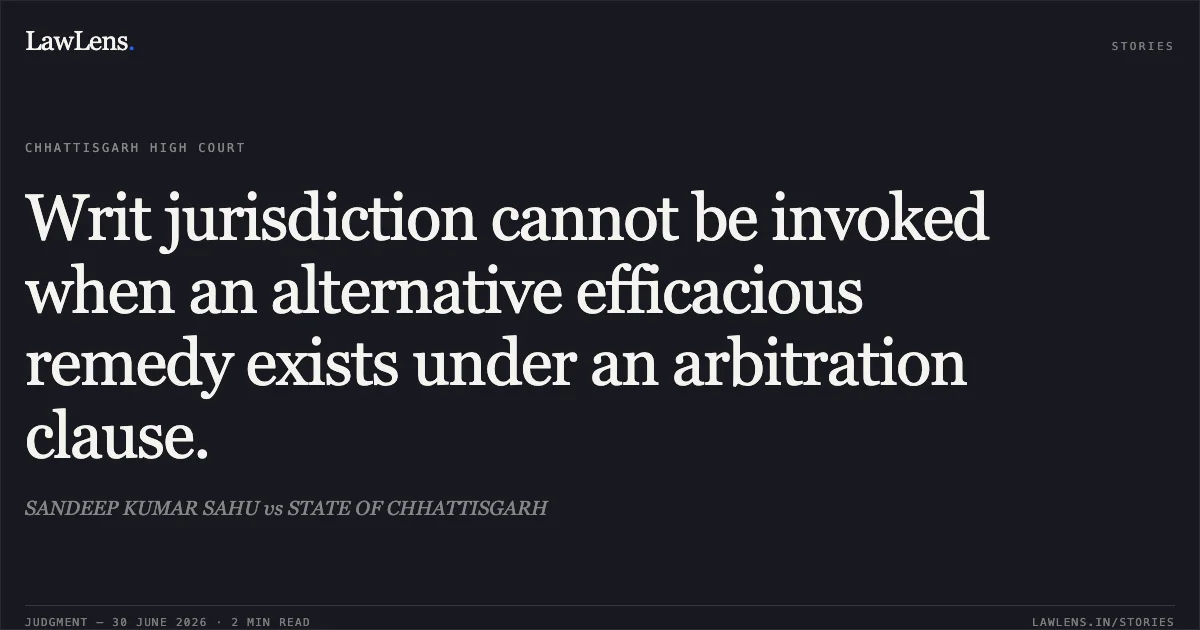
The Court held that it would not entertain the writ petitions as an "alternative and efficacious remedy exists by invoking arbitration Clause 13 of the Agreement".
The petitions were disposed of, and the petitioners were relegated to raising their disputes before the appropriate arbitral authority (District Collector) in accordance with the law.
Source reference: p. 13The Court clarified that it expressed no opinion on the merits of the shortages and directed the concerned authorities to adjudicate the disputes via a reasoned order after hearing the petitioners.
Source reference: p. 13Acts & Sections Cited
4 provisions across 2 statutes referred to in this judgment. Linked provisions open on LawLens.
State Government2
Agreement between petitioner and respondents2
Original Court PDF
SANDEEP KUMAR SAHUvsSTATE OF CHHATTISGARH
Click to open original judgment
Original judgment, available to read, download and summarize on LawLens.in