Facts
The petitioner, a farmer, owned agricultural land in Village Kekati, District Bilaspur, which was acquired by the State under an award dated 28-11-2016.
Source reference: p. 2The compensation was calculated using a multiplier of '1' based on a 2014 Central Government notification.
Source reference: p. 2-3The petitioner challenged this, seeking a multiplier of '2' and rehabilitation subvention with 12% interest, citing a subsequent Division Bench judgment (Smt. Anita Agrawal v. State of C.G.) and a 2019 State Gazette notification.
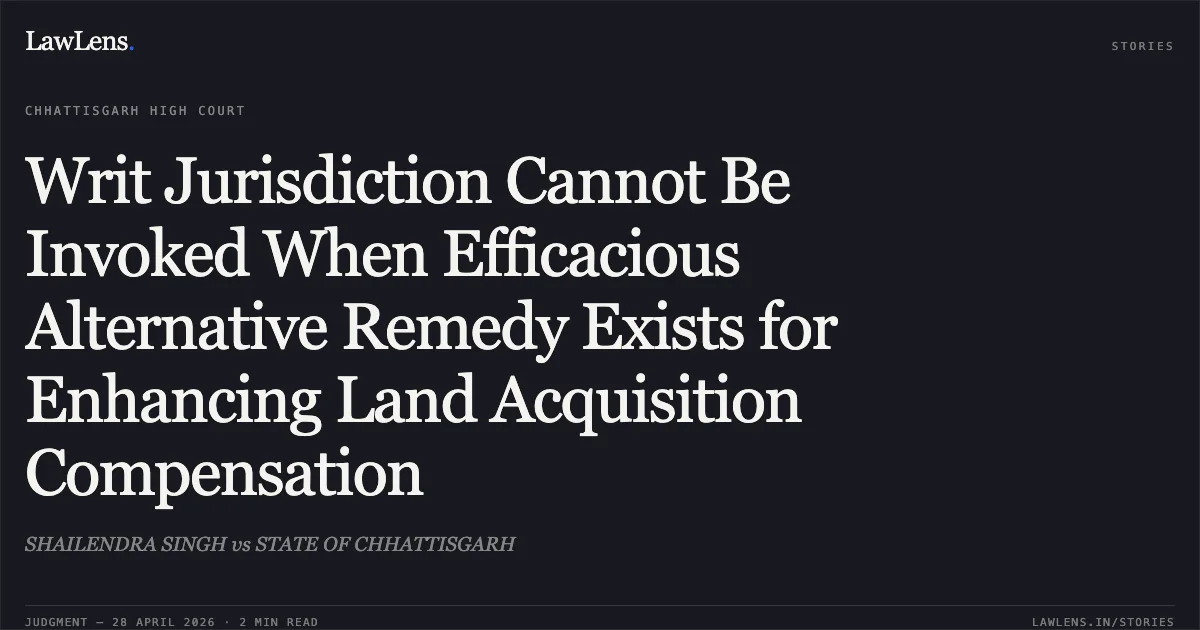
Source reference: p. 3The State contested the petition on the grounds of maintainability, arguing that the petitioner failed to exhaust the efficacious alternative remedy available under Section 64 of the Act, 2013.
Source reference: p. 3Issues
1. Whether the writ petition under Article 226 is maintainable when an alternative statutory remedy for enhancement of compensation exists under the relevant Act.
Source reference: p. 4-52. Whether the petitioner is entitled to a direction for the amendment of the award to reflect a '2' multiplier and rehabilitation subvention.
Source reference: p. 5Law Applied
Section 64 of the Right to Fair Compensation and Transparency in Land Acquisition, Rehabilitation and Resettlement Act, 2013, which provides a mechanism for referring disputes regarding compensation to the Authority.
Source reference: p. 3, 5Leelavathi N. and Others v. State of Karnataka and Others {2025 SCC OnLine SC 2253}, which held that High Courts should not entertain writ petitions under Article 226 if an effective alternative remedy is available, except in exceptional circumstances such as violation of natural justice or lack of jurisdiction.
Source reference: p. 4-5Reasoning
The Court observed that the petitioner’s grievance centered on the adequacy of compensation and the application of the correct multiplier.
Source reference: p. 2While the petitioner relied on the 2019 notification to justify the '2' multiplier, the Court noted that during the hearing, the petitioner admitted to not availing the remedy provided under Section 64 of the Act, 2013.
Source reference: p. 4Following the Supreme Court’s mandate in Leelavathi N., the Court reasoned that land acquisition disputes involving quantum of compensation fall squarely within the domain of statutory Tribunals/Authorities.
Source reference: p. 5Therefore, the Court found no "exceptional circumstances" to bypass the statutory machinery provided by the legislature.
Source reference: p. 4However, to ensure equity, the Court took note of the time spent in litigation (since 2020) while directing the petitioner toward the appropriate forum.
Source reference: p. 5-6Holding
The Court disposed of the writ petition without interfering with the impugned award, holding that the petitioner must avail the alternative remedy under Section 64 of the Act, 2013.
The Court directed that if the petitioner files an application for enhancement of compensation before the concerned Authority, it shall be considered pragmatically, accounting for the pendency of this writ petition since 08-12-2020.
Source reference: p. 6The Authority was further directed to decide the application expeditiously, preferably within 90 days of receipt.
Source reference: p. 6Acts & Sections Cited
2 provisions across 1 statute referred to in this judgment. Each provision opens on LawLens.
Right to Fair Compensation and Transparency in Land Acquisition, Rehabilitation and Resettlement Act, 20132
Original Court PDF
SHAILENDRA SINGHvsSTATE OF CHHATTISGARH
Click to open original judgment
Original judgment, available to read, download and summarize on LawLens.in