Facts
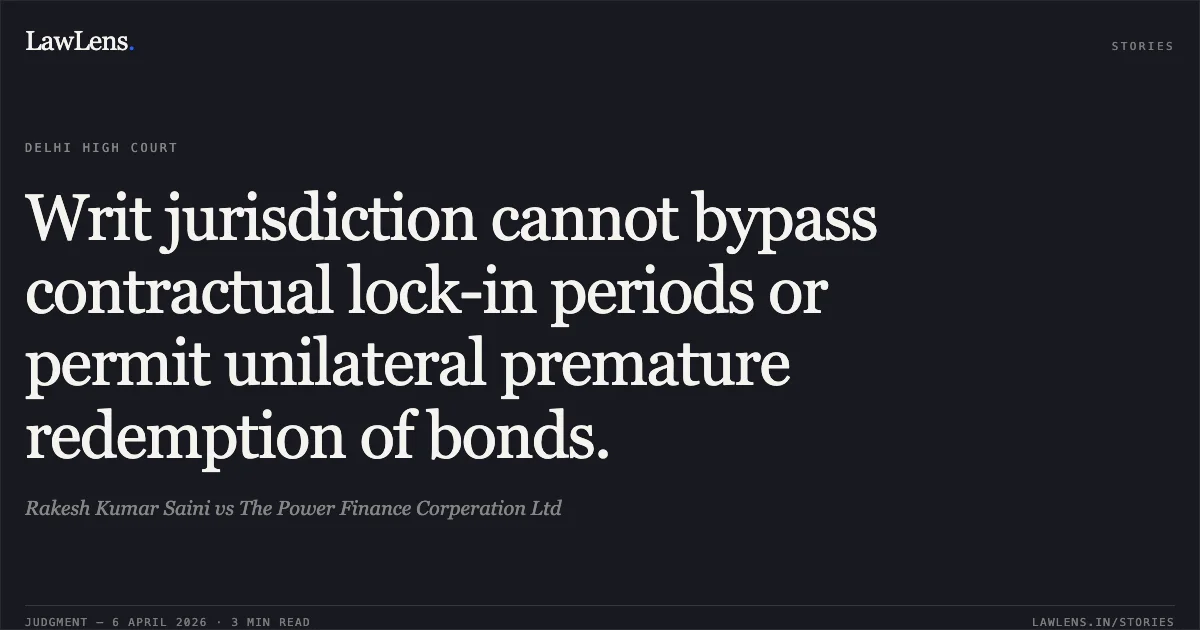
The Appellant invested ₹48,00,000 in Bonds issued by the Respondent on 19.06.2024.
Source reference: para. 19Shortly thereafter, via letter dated 16.07.2024, the Appellant requested the cancellation of the Bonds and a refund, asserting he had received misguided financial advice regarding Capital Gains Tax exemptions under Section 54EC of the Income Tax Act and did not actually require the exemption.
Source reference: para. 2, 5The Respondent refused the cancellation.
Source reference: para. 3The Appellant’s Writ Petition was dismissed by a Single Judge on 07.11.2024, holding that the rights were governed by contractual terms and "mistake of fact" regarding financial advice did not create an enforceable right under Writ Jurisdiction.
Source reference: para. 3A subsequent Letters Patent Appeal (LPA) was dismissed on 02.12.2024, on the grounds that the Court cannot unilaterally modify Bond terms, which included a five-year lock-in period.
Source reference: para. 4, 9The Appellant then filed the present Review Petition alleging errors apparent on the face of the record.
Source reference: para. 1Issues
1. Whether the Appellant's failure to avail of tax benefits or the allegation of receiving "misguided advice" constitutes an "error apparent on the face of the record" justifying a review of the order dismissing the LPA.
Source reference: para. 9, 162. Whether the Court, in the exercise of its Writ Jurisdiction, can direct the premature redemption of Bonds in contravention of agreed contractual and statutory terms.
Source reference: para. 13, 15Law Applied
The Court applied Order XLVII Rule 1 read with Section 151 of the Code of Civil Procedure, 1908, which limits the scope of review to errors apparent on the face of the record and prohibits a review from becoming an "appeal in disguise".
Source reference: para. 1, 18It relied on Parsion Devi v. Sumitri Devi, Sajjan Singh v. State of Rajasthan, and Arun Dev Upadhyaya v. Integrated Sales Service Limited, establishing that review power cannot be used to re-heat or correct an erroneous decision through a long-drawn process of reasoning.
Source reference: para. 18The Court also considered Section 54EC of the Income Tax Act, 1961, which provides for capital gains exemptions subject to specific investment durations, noting the statutory intent of long-term capital allocation.
Source reference: para. 10, 11Reasoning
The Court observed that the Appellant was attempting to re-argue the merits of the case under the pretext of a review.
Source reference: para. 9It reasoned that the previous bench had already considered and rejected the arguments regarding financial difficulties and the lack of tax benefit utilization.
Source reference: para. 9, 12The Court emphasized that once a contract is concluded by accepting Bond terms—specifically the five-year lock-in period—the Appellant possesses no unilateral right to seek premature redemption.
Source reference: para. 13, 19The Court dismissed the reliance on Major Amandeep Singh v. University of Delhi, clarifying that while Article 226 allows for relief to serve the ends of justice, it cannot be used to help a party renege on a contract due to "ill-advice".
Source reference: para. 15Finally, the Court noted that directing premature redemption would not only violate contractual terms but also cause financial distress to the Respondent, thereby failing the test of equity.
Source reference: para. 20Holding
The Court held that there was no error or infirmity in the original Order dismissing the LPA.
The Review Petition cannot be used to re-agitate conclusively decided issues or to convert the proceedings into a re-hearing of the case on merits.
Source reference: para. 17, 22Consequently, the Court dismissed the Review Petition, affirming that the five-year lock-in period is binding and the Appellant's claim of "misguided advice" is not a valid ground for judicial intervention in a purely contractual matter.
Source reference: para. 19, 23No order as to costs was made.
Source reference: para. 23Acts & Sections Cited
1 provisions across 1 statute referred to in this judgment. Each provision opens on LawLens.
Code of Civil Procedure, 19081
Original Court PDF
Rakesh Kumar SainivsThe Power Finance Corperation Ltd
Click to open original judgment
Original judgment, available to read, download and summarize on LawLens.in