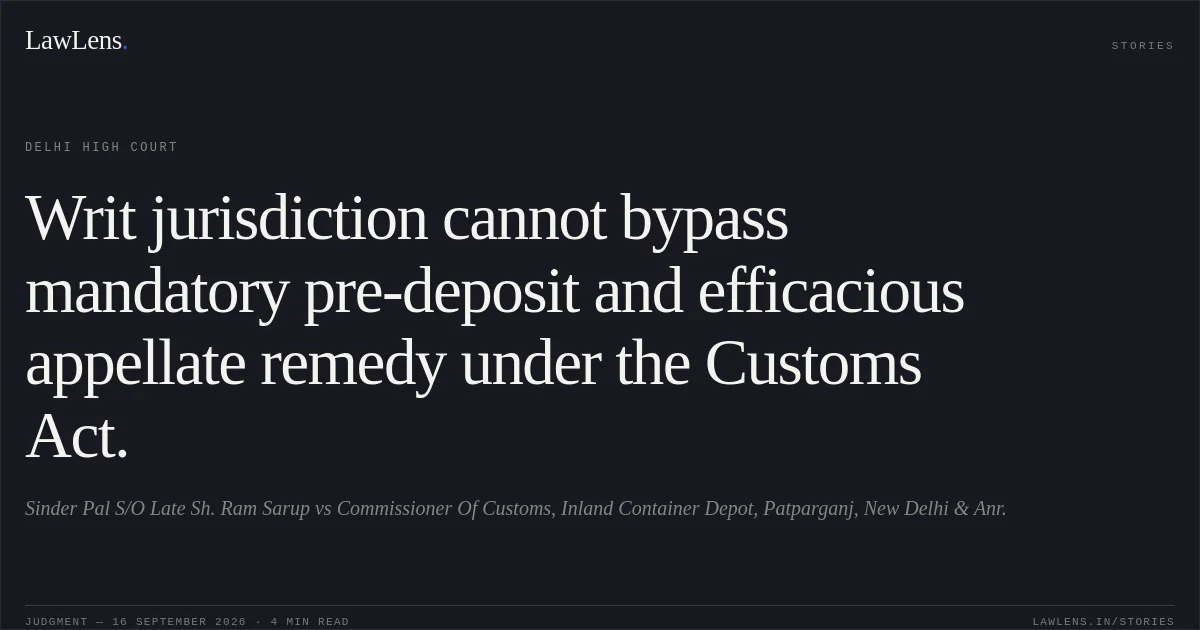
Facts
The Directorate of Revenue Intelligence intercepted a container declared to contain carpets and allegedly recovered 142 logs of red sanders wood weighing approximately 4.43 metric tonnes, concealed beneath the carpets.
Source reference: p. 2–3Searches conducted at premises in Gannaur, Haryana allegedly resulted in the seizure of further red sanders wood, carpets and a truck. Statements of several persons, including Sukhwinder Singh, Gurpreet Singh and Chandeep Singh, as well as the Petitioner’s statement dated 14 March 2015, were recorded under Section 108 of the Customs Act, 1962.
Source reference: p. 3–4A show-cause notice was issued proposing penalty against the Petitioner under Section 114 of the Customs Act. The Petitioner disputed his involvement, challenged reliance on the statements of other persons and sought their cross-examination. The adjudicating authority nevertheless passed the Order-in-Original dated 26 March 2018, imposing a penalty of ₹3 crore, while relying, inter alia, on the statements recorded during investigation and the Petitioner’s own statement.
Source reference: p. 3–4The Petitioner’s appeal under Section 128 of the Customs Act was rejected by the Commissioner (Appeals) on 10 December 2020 because the mandatory 7.5% pre-deposit under Section 129E had not been made. The Petitioner then invoked Articles 226 and 227 of the Constitution, challenging both orders and seeking adjudication on the merits, including his request for cross-examination.
Source reference: p. 4–5Issues
Whether the High Court should exercise its extraordinary jurisdiction under Articles 226 and 227 to examine the merits of the Order-in-Original when an efficacious statutory appellate remedy before the CESTAT is available under Section 129A of the Customs Act?
Source reference: p. 1, para. 1; pp. 8–12, paras. 16–29Whether the alleged denial of cross-examination, challenge to the evidentiary value of statements under Section 108, alleged retraction of the Petitioner’s statement, and challenge to confiscation and penalty warranted bypassing the statutory appellate mechanism?
Source reference: pp. 5–6, para. 12; pp. 9–12, paras. 18–27Whether the Petitioner could avoid the statutory pre-deposit requirement under Section 129E on the ground of financial hardship by invoking writ jurisdiction?
Source reference: pp. 6–7, paras. 12.6 and 13.1–13.3; pp. 10–11, paras. 20–24Law Applied
The Court applied the statutory appellate framework under the Customs Act, 1962: Section 114 concerning penalty for acts rendering goods liable to confiscation; Section 128 providing an appeal to the Commissioner (Appeals); Section 129A providing a further appeal to the CESTAT; and Section 129E prescribing mandatory pre-deposit of the stipulated percentage of duty or penalty as a condition for entertaining an appeal.
Source reference: pp. 2, 4, 8–10, paras. 2, 8, 15–21The Court also considered Section 138B concerning the circumstances in which statements recorded during inquiry or investigation may be relied upon in adjudication.
Source reference: p. 5, para. 12.2The governing constitutional principle was that availability of an alternative remedy does not impose an absolute bar on the exercise of jurisdiction under Article 226; however, writ jurisdiction is ordinarily not exercised where an efficacious statutory remedy exists, particularly when the dispute involves examination of facts, evidence and the merits of a statutory order.
Source reference: p. 9, paras. 16–17Allegations of breach of natural justice do not automatically require exercise of writ jurisdiction where the alleged breach is intertwined with the merits and can be examined by the competent appellate forum.
Source reference: pp. 10–12, paras. 25–27Reasoning
The Court held that the Petitioner’s objections concerning cross-examination, the admissibility and evidentiary value of statements under Section 108, the alleged retraction of his statement, the absence of independent evidence, confiscation and the quantum of penalty all required examination of the factual record and the adjudicating authority’s findings.
Source reference: pp. 9–10, paras. 18–19These matters fell within the jurisdiction of the statutory appellate authorities and were not appropriate for initial determination in writ proceedings.
Source reference: pp. 9–10, paras. 18–19The Petitioner had already invoked the first appellate remedy, but his appeal was not considered on merits because he failed to fulfil the mandatory pre-deposit requirement under Section 129E.
Source reference: p. 10, paras. 20–23Financial hardship, by itself, could not justify bypassing the statutory condition or permitting the High Court to undertake a first-instance merits review.
Source reference: pp. 10–11, paras. 22–24The alleged denial of cross-examination also did not constitute an exceptional circumstance warranting writ intervention because its legal consequence depended upon assessment of the evidence and the circumstances of the adjudication.
Source reference: p. 11–12, paras. 25–26Holding
The High Court dismissed the writ petition on the ground that the Petitioner had an efficacious alternate statutory remedy under the Customs Act, including an appeal before the competent appellate forum under Section 129A.
It declined to express any opinion on the merits of the Order-in-Original or the Order-in-Appeal.
Source reference: p. 12, paras. 27–29The Petitioner was granted liberty to pursue the available statutory remedy in accordance with law.
Source reference: pp. 12–13, paras. 29–31All issues—including cross-examination, reliance on statements under Section 108, the alleged retraction, applicability of Section 138B, confiscability of the goods, and the legality and quantum of penalty—were expressly left open for independent consideration by the appellate forum.
Source reference: pp. 12–13, paras. 29–31Acts & Sections Cited
4 provisions across 1 statute referred to in this judgment. Each provision opens on LawLens.
Customs Act,19624
Original Court PDF
Sinder Pal S/O Late Sh. Ram SarupvsCommissioner Of Customs, Inland Container Depot, Patparganj, New Delhi & Anr.
Click to open original judgment
Original judgment, available to read, download and summarize on LawLens.in
![Non-submission of online self-appraisal cannot automatically disqualify an employee from EPP financial upgradation.. Ashok Kumar Sahu vs Bharat Sanchar Nigam Limited. CAT - ['Jabalpur']. LawLens](/stories/thumbnails/non-submission-of-online-self-appraisal-cannot-automatically-disqualify-an-employee-from-e-211b98f9eb684a569412a8a970828971.webp)