Facts
The Respondent-Bank sanctioned credit facilities to a principal borrower, for which the Petitioners served as guarantors and mortgagors
Source reference: para 3.1, 3.2After the loan account was classified as a Non-Performing Asset (NPA) on 31.01.2025, the Bank issued a demand notice under Section 13(2) of the SARFAESI Act on 18.08.2025
Source reference: para 3.2, 3.3The Petitioners contended that the notice was issued in the names of two mortgagors who had died in May 2024, despite the Bank having prior knowledge of their demise
Source reference: para 3.6, 3.7, 3.8The Bank proceeded to obtain possession orders under Section 14 and issued auction notices
Source reference: para 3.9, 3.10The Petitioners challenged these measures before the Debts Recovery Tribunal (DRT), Ahmedabad, via Securitization Application No. 32 of 2026
Source reference: para 3.11On 12.02.2026, the DRT rejected the Petitioners’ prayer for interim relief, observing that the estate of the deceased was sufficiently represented and the dues were substantial
Source reference: para 9Consequently, the Petitioners approached the High Court under Article 226/227
Source reference: para 2, 3.12Issues
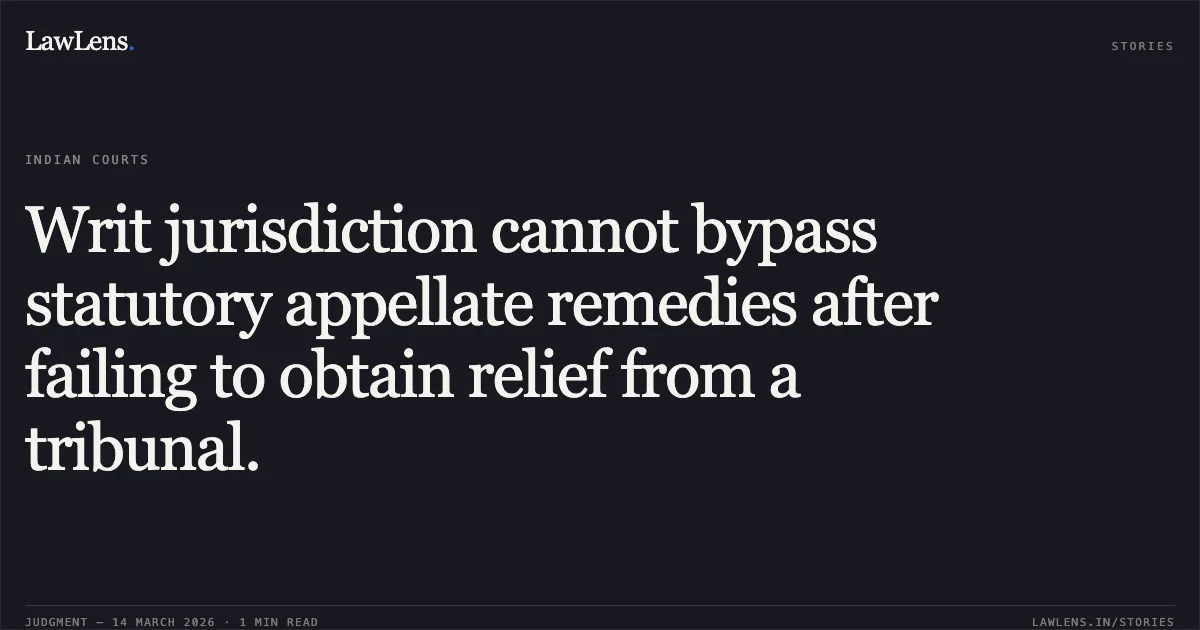
1. Whether a party, having already availed the statutory remedy under Section 17 of the SARFAESI Act and failed to obtain interim relief, can invoke the writ jurisdiction of the High Court under Article 226 to bypass the statutory appellate remedy?
Source reference: para 7Law Applied
The Court primarily applied Sections 17 and 18 of the SARFAESI Act, 2002, which establish a complete statutory mechanism for redressing grievances against recovery measures, including an appeal to the Debts Recovery Appellate Tribunal (DRAT)
Source reference: para 8, 11.1It adhered to the principle of exhaustion of alternative remedies, noting that while Article 226 jurisdiction may be invoked against actions that are a nullity or without jurisdiction, such discretion is restricted once a litigant elects to pursue a statutory forum
Source reference: para 11.1, 13The Court also referenced the Supreme Court's observation in Shivsankara & Anr. v. SP Vedvyasa regarding the representation of a deceased’s estate by legal heirs
Source reference: para 9Reasoning
The Court observed that the Petitioners had already consciously elected to invoke the statutory remedy under Section 17 by approaching the DRT
Source reference: para 11The DRT had specifically examined and assigned reasons for rejecting the "deceased person" contention, effectively adjudicating the issue on its merits for the purpose of interim relief
Source reference: para 10The High Court reasoned that allowing a writ petition at this stage would permit the Petitioners a "second inning" and enable them to treat the High Court as an alternative forum of appeal, which is impermissible
Source reference: para 11.2, 12The Court distinguished the precedents cited by the Petitioners—which held that notices to deceased persons are nullities—by noting that in those cases, the parties had generally approached the constitutional court directly, whereas here, the Petitioners had already submitted to the jurisdiction of the DRT and were now attempting to circumvent the statutory hierarchy of Section 18
Source reference: para 13Holding
The Court held that the writ petition did not merit consideration as the Petitioners failed to exhaust the specific appellate mechanism provided under Section 18 of the SARFAESI Act
The petition was dismissed without costs
Source reference: para 14The Court granted the Petitioners liberty to avail the statutory remedy of appeal before the Debts Recovery Appellate Tribunal (DRAT) in accordance with the law
Source reference: para 12Acts & Sections Cited
5 provisions across 2 statutes referred to in this judgment. Each provision opens on LawLens.
Securitisation and Reconstruction of Financial Assets and Enforcement of Security Interest Act, 20024
Recovery Of Debts And Bankruptcy Act, 19931
Original Court PDF
PRAKASHBHAI BALDEVBHAI PATELvsCANARA BANK
Click to open original judgment
Original judgment, available to read, download and summarize on LawLens.in