Facts
The petitioner was appointed as an Operation Executive by the respondent on 24 December 1991 and promoted as Assistant Manager (Operations) from 1 January 1994.
Source reference: pp. 2–3He claimed that, despite the designation, he continued to perform only workman-level duties and had no managerial or supervisory authority.
Source reference: pp. 2–3He alleged that, on 7 October 1996, he was coerced into signing an apology and resignation letter after being accused of consuming alcohol at the workplace.
Source reference: pp. 2–3After receiving a demand for repayment of outstanding housing and car loans, he challenged the resignation and alleged that his services had been illegally terminated.
Source reference: pp. 2–3The respondent maintained that the resignation was voluntary and had been accepted on the same day, and that the subsequent termination letter dated 3 March 1997 was issued by way of abundant caution.
Source reference: pp. 2–3The Labour Court held that the petitioner was not a “workman” under Section 2(s) of the Industrial Disputes Act, 1947, and that he had voluntarily resigned; it accordingly dismissed his claim.
Source reference: pp. 3–4The petitioner challenged the award under Article 226 of the Constitution.
Source reference: p. 1Issues
Whether the petitioner was a “workman” within the meaning of Section 2(s) of the Industrial Disputes Act, 1947, notwithstanding his designation as Assistant Manager.
Source reference: p. 3Whether the resignation dated 7 October 1996 was voluntarily tendered or was obtained through coercion.
Source reference: pp. 3, 5–6Whether the petitioner’s services were illegally or unjustifiably terminated by the respondent.
Source reference: p. 1Whether the petitioner was entitled to reinstatement, back wages, withheld salary, or reimbursement of rent.
Source reference: pp. 2, 6Law Applied
The Court applied Section 2(s) of the Industrial Disputes Act, 1947, under which the status of a workman depends on the actual nature of duties performed rather than merely the nomenclature of the post.
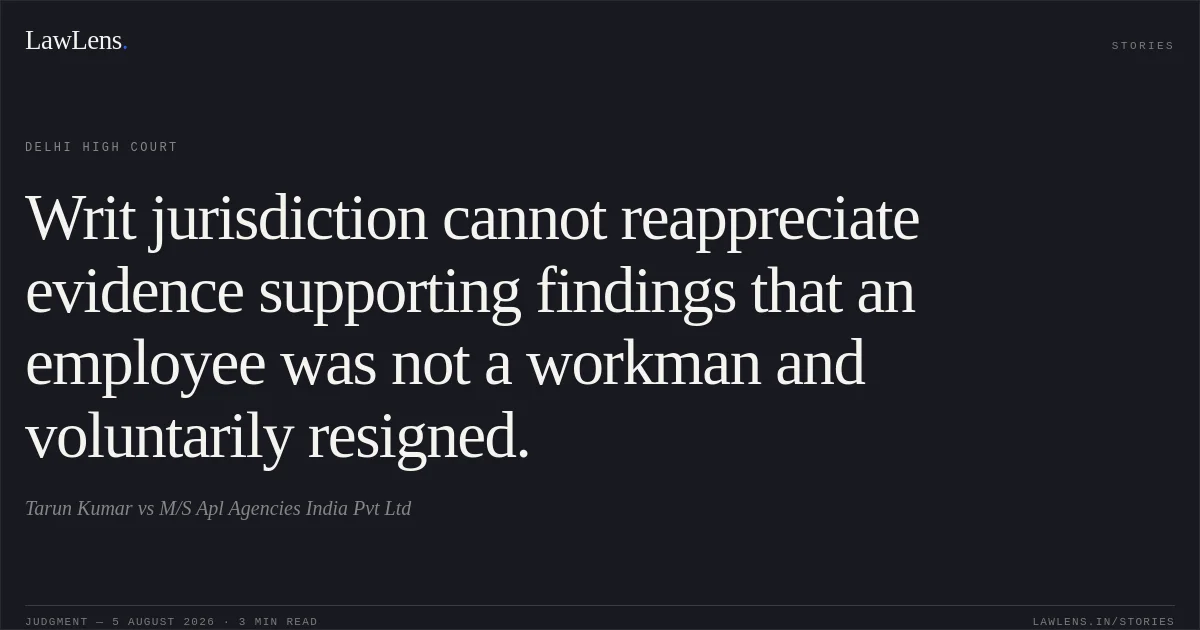
Source reference: no citationIt also applied the settled limits of judicial review under Article 226, holding that a writ court does not sit as an appellate court over findings of fact and may interfere only where the decision is without jurisdiction, perverse, contrary to the evidence, or violative of natural justice.
Source reference: p. 4In this regard, the Court relied on Syed Yakoob v. K.S. Radhakrishnan, 1963 SCC OnLine SC 24; International Airport Authority of India v. International Air Cargo Workers’ Union, (2009) 13 SCC 374; and Ritz Theatre Pvt. Ltd. v. Ramesh Chandra, 2024 SCC OnLine Del 3633.
Source reference: p. 4The Court further applied the principle that a plea of coercion must be assessed against the party’s conduct and the surrounding circumstances, including the promptness of any protest.
Source reference: pp. 5–6Reasoning
The Court found no basis to disturb the Labour Court’s conclusion that the petitioner had failed to establish that he performed workman-level duties.
Source reference: p. 5The Labour Court had considered his appointment in the Senior Executive Cadre and subsequent promotion as Assistant Manager (Operations), as well as the fact that neither his initial representation nor his civil-suit pleadings disclosed that he was performing workman functions.
Source reference: p. 5The petitioner admitted writing and signing the resignation and apology letters, but did not lodge any immediate complaint with a superior authority or the police.
Source reference: pp. 5–6His first allegation of coercion was made approximately four months later and only after the respondent demanded repayment of ₹1,75,000 in outstanding loans, supporting the inference that the plea was raised to avoid financial liability.
Source reference: pp. 5–6The Court also held that reinstatement was impracticable after nearly thirty years, particularly since the petitioner had crossed the general age of superannuation.
Source reference: p. 6His monetary claims were additionally weakened by his admitted failure to repay the housing and car loans, sale of the hypothecated vehicle, and subsequent gainful employment from July 1999 to November 2002.
Source reference: p. 6These findings were based on evidence and disclosed no patent error, perversity, jurisdictional defect, or violation of natural justice warranting writ interference.
Source reference: pp. 4, 6Holding
The Court held that the petitioner had not established that he was a “workman” under Section 2(s) of the Industrial Disputes Act, 1947, or that his resignation was coerced.
It found no legally sustainable basis to treat the respondent’s conduct as an illegal or unjustified termination and no entitlement to reinstatement or monetary relief.
Source reference: pp. 6–7The writ petition was accordingly dismissed, and the Labour Court’s award dated 22 April 2017 was upheld.
Source reference: pp. 6–7Original Court PDF
Tarun KumarvsM/S Apl Agencies India Pvt Ltd
Click to open original judgment
Original judgment, available to read, download and summarize on LawLens.in