Facts
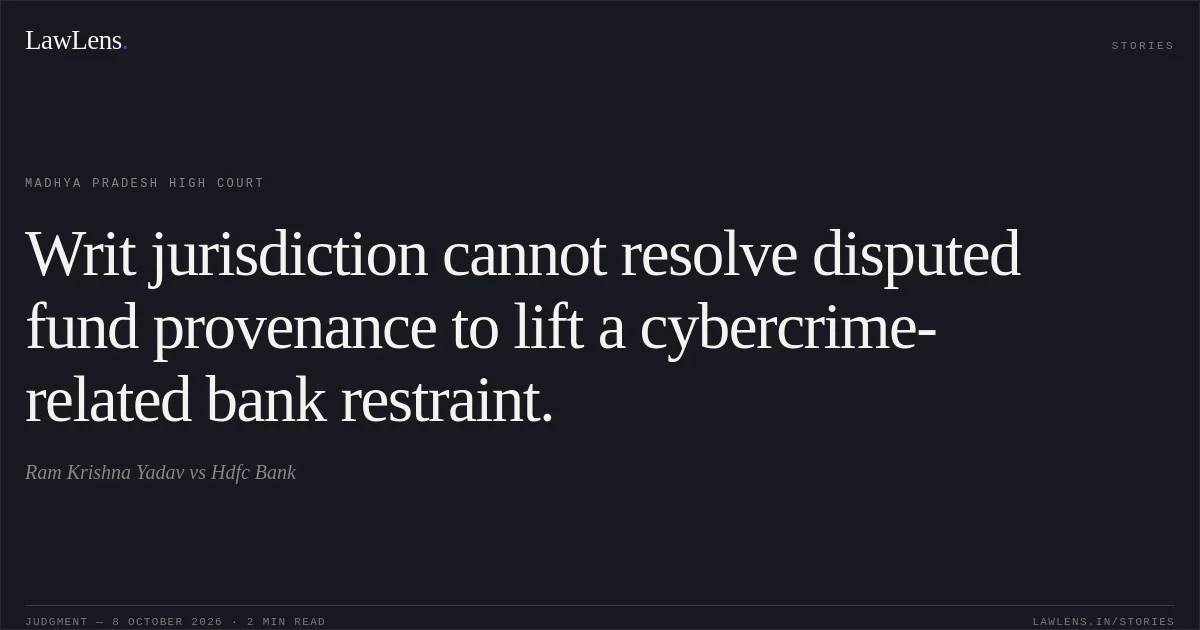
The petitioner sought a direction under Article 226 to remove a debit restriction over ₹91,297.32 in his HDFC Bank account.
Source reference: p.1He claimed the amount arose from ordinary business transactions connected with his work as an online shop operator and Business Correspondent Agent, and that he had already paid the corresponding cash to customers.
Source reference: p.1The restriction had been imposed following a request from Cyber Crime/Police Authorities, and the bank stated that it could not release the amount without further directions from those authorities.
Source reference: pp.2–3The petitioner asserted that he had received no notice or summons and that no criminal proceeding had been initiated against him; he also relied on the Ministry of Home Affairs/Indian Cyber Crime Coordination Centre Standard Operating Procedure.
Source reference: pp.2–3The Court dismissed the petition.
Source reference: p.6Issues
1. Whether the Court should direct the bank to remove the debit restriction and release the disputed amount when the restriction was imposed at the request of Cyber Crime/Police Authorities and the transaction’s source and nature remained disputed.
Source reference: pp.3–52. Whether the absence of notice, summons, or an identified criminal proceeding against the petitioner rendered the continued restriction unlawful and justified writ relief under Article 226.
Source reference: pp.3–5Law Applied
Article 226 empowers the High Court to issue writs, but the Court declined to determine disputed factual questions requiring examination of transaction records and investigative material in this proceeding.
Source reference: pp.3–5The Court reasoned that a bank acting on a communication from a competent Cyber Crime/Police Authority cannot independently release funds subject to that restriction.
Source reference: p.4It also held that the petitioner’s non-accused status and lack of notice or summons did not, by themselves, establish that the restriction was unlawful during an ongoing investigation; the petitioner could submit evidence of the funds’ lawful source to the investigating authority.
Source reference: pp.4–5The Court considered the petitioner’s constitutional claims under Articles 14, 19(1)(g), 21 and 300A, and his reliance on the MHA/I4C Standard Operating Procedure, but found neither established a basis for direct release on the record before it.
Source reference: p.5Reasoning
The Court treated the amount’s provenance, transaction trail, connection to the alleged cyber crime, and the petitioner’s knowledge as factual matters requiring investigation.
Source reference: p.4Since it could not determine the bona fides of the transaction from the petitioner’s assertions alone, it declined to adjudicate those matters in writ jurisdiction.
Source reference: pp.4–5The bank had acted on a request from the competent authorities and could not independently lift the restriction; moreover, the absence of notice or summons did not, on its own, invalidate a restraint imposed in the course of an investigation.
Source reference: p.4The petitioner’s constitutional and SOP-based arguments did not warrant a different result, though he could place his supporting material before the investigating authority.
Source reference: p.5Holding
The Court answered the questions against the petitioner, finding no sufficient ground to order release of ₹91,297.32 while the transaction remained under investigation and its factual basis unresolved.
The writ petition was dismissed as devoid of merit.
Source reference: p.6Original Court PDF
Ram Krishna YadavvsHdfc Bank
Click to open original judgment
Original judgment, available to read, download and summarize on LawLens.in