Facts
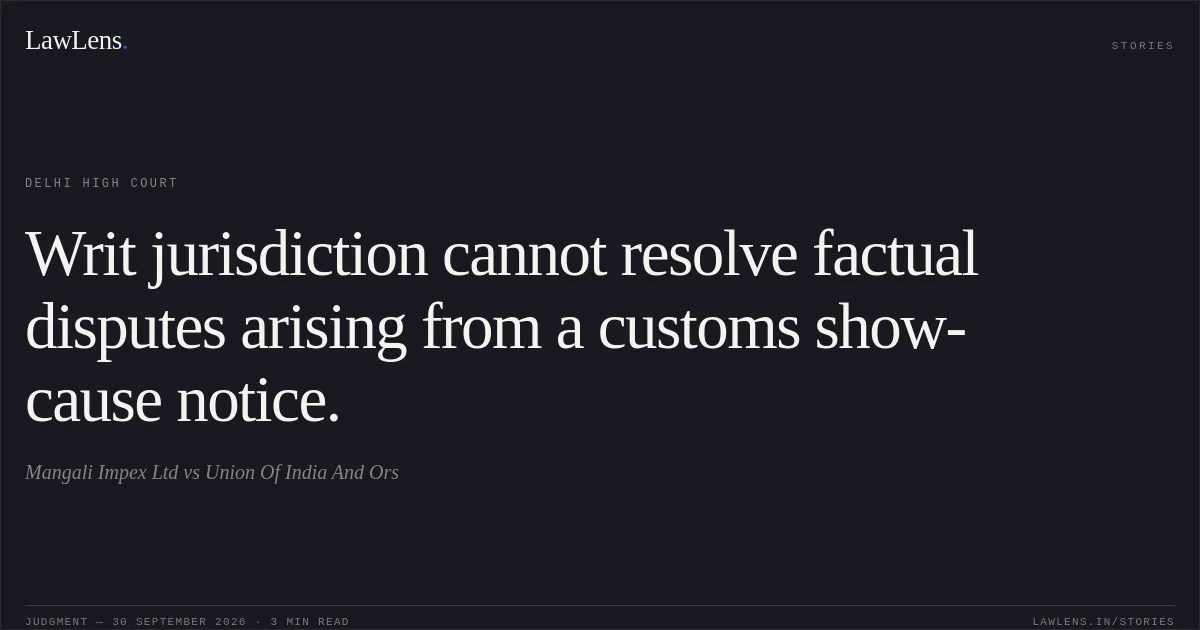
Mangali Impex Ltd. exported 27 consignments declared as calcium stearate.
Source reference: p. 3After an initial laboratory report identified the goods as calcium stearate, Customs conducted a re-test; the later report identified them as calcium carbonate coated with a salt of fatty acid.
Source reference: p. 3–4Following an investigation, the Commissioner of Customs issued a show-cause notice (SCN) dated 31 October 2003 under Sections 28 and 124 of the Customs Act, 1962.
Source reference: p. 4A CBI closure report was accepted by the Special Judge in 2006, but the Customs SCN remained pending.
Source reference: p. 5The petitioner challenged the SCN, principally arguing that the issuing officer was not the proper officer and that the CBI proceedings undermined the basis for continuing the SCN.
Source reference: p. 5–6Issues
1. Whether the SCN was issued by an officer lacking authority as the “proper officer” under the Customs Act.
Source reference: p. 1–3, 5–62. Whether acceptance of the CBI closure report required the SCN to be discontinued, or whether that issue could be determined in writ proceedings before the SCN was adjudicated.
Source reference: p. 5–83. Whether the High Court should exercise writ jurisdiction at the SCN stage, including in light of the petitioner’s challenge to the validity and application of the amended Section 28.
Source reference: p. 1–3, 5–6, 9–10Law Applied
Section 28 of the Customs Act governs recovery of duties not levied, short-levied or erroneously refunded; Section 28(11), inserted by the Customs (Amendment and Validation) Act, 2011, deems specified officers appointed under Section 4(1) before 6 July 2011 to have been proper officers for Section 28, while Explanation 2 addresses pre-assent cases.
Source reference: p. 1–3The Supreme Court’s decision in Commissioner of Customs v. Canon India Pvt. Ltd., (2025) 4 SCC 509, resolved the proper-officer jurisdiction issue in the Department’s favour in the circumstances considered by the High Court.
Source reference: p. 5Under Whirlpool Corpn. v. Registrar of Trade Marks, (1998) 8 SCC 1, the availability of an alternative remedy does not ordinarily bar writ jurisdiction where fundamental rights are implicated, natural justice is violated, proceedings are wholly without jurisdiction, or the vires of an enactment is challenged.
Source reference: p. 9Questions requiring factual determination and evidence are not ordinarily decided in writ proceedings at the notice stage.
Source reference: p. 6–8Reasoning
The parties accepted that Canon India had resolved the jurisdictional objection concerning the proper officer in favour of the Department, so that objection did not establish a basis for writ intervention.
Source reference: p. 5The SCN had not yet been adjudicated, and the underlying factual questions—including the nature and value of the exported goods, entitlement to DEPB credits, the genuineness of purchase transactions, and the effect of the CBI closure report—remained for determination by the competent authority on evidence.
Source reference: p. 6–8The Court therefore declined to decide those matters in the writ petition and held that the case did not fall within the relevant Whirlpool exceptions at that stage.
Source reference: p. 9Holding
The High Court disposed of the writ petition without adjudicating the merits of the SCN.
It granted the petitioner liberty to file a fresh response to the SCN within eight weeks; the Department was directed to proceed in accordance with law after giving the petitioner an opportunity of hearing.
Source reference: p. 9–10The petitioner remained at liberty to pursue remedies available in law if aggrieved by the eventual decision.
Source reference: p. 9–10Acts & Sections Cited
9 provisions across 4 statutes referred to in this judgment. Each provision opens on LawLens.
Customs Act,19626
Indian Penal Code, 18601
Prevention of Corruption Act, 19881
Code of Criminal Procedure, 19731
Original Court PDF
Mangali Impex LtdvsUnion Of India And Ors
Click to open original judgment
Original judgment, available to read, download and summarize on LawLens.in