Facts
The petitioner obtained an agricultural loan of ₹2,98,000 from Madhya Bihar Gramin Bank on 26 May 2006 for purchasing a tractor, secured by mortgage/hypothecation documents.
Source reference: p. 3, para. 2He claimed to have repaid approximately ₹32,000 and believed that the remaining loan had been waived under a government policy.
Source reference: p. 3, para. 2On 12 February 2017, the Bank allegedly seized the tractor from his residence in his absence, without prior notice or legal proceedings.
Source reference: p. 3, para. 3According to information obtained under the RTI Act, the tractor was subsequently sold in an open auction on 5 July 2017 for ₹1,11,000.
Source reference: p. 3, para. 3The Bank thereafter issued a notice dated 30 August 2017 demanding ₹2,89,437, together with interest, and threatening coercive recovery measures.
Source reference: p. 4, para. 4The petitioner sought restoration of the tractor, cancellation of the auction sale, replacement or compensation, and quashing of the recovery notice.
Source reference: no citationThe Bank contended that the petitioner had defaulted, that the loan documents authorised possession and sale of the hypothecated tractor, and that notice of the proposed auction had been issued.
Source reference: pp. 6–8, paras. 8–12The auction purchaser asserted that he had purchased the tractor bona fide, received a sale certificate, and subsequently sold it to another person; the tractor was therefore no longer available.
Source reference: pp. 8–9, paras. 13–14Issues
Whether the High Court should exercise its jurisdiction under Article 226 to adjudicate the petitioner’s disputes concerning the seizure, notice, auction, valuation, and sale of the hypothecated tractor.
Source reference: pp. 10–12, paras. 16–21Whether the petitioner could be granted restoration of the tractor or cancellation of the auction sale after third-party rights had been created and the tractor had allegedly been transferred onward.
Source reference: pp. 10–11, paras. 16–19Whether the petitioner was entitled to relief concerning reconciliation or settlement of the outstanding loan account.
Source reference: pp. 11–12, paras. 20–23Law Applied
The Court applied the principle that writ jurisdiction under Article 226 of the Constitution is discretionary and is ordinarily inappropriate for adjudicating seriously disputed questions of fact, particularly where determination would require examination of evidence concerning possession, service of notice, auction procedure, valuation, and loan-account calculations.
Source reference: p. 10, para. 17The Court also applied the principle that relief affecting existing third-party rights cannot conveniently be granted in writ proceedings, especially where the auction purchaser has obtained a sale certificate and the property has subsequently been transferred.
Source reference: pp. 10–11, paras. 16, 18–19The Court considered the principle stated in Dhananjy Seth v. Union of India & Ors., 2023 SCC OnLine Pat 1393, under which, where a seized vehicle cannot be restored after sale to a third party, the financial institution may be liable for the vehicle’s value, subject to adjustment against the outstanding loan and determination before an appropriate forum; however, the Court left that remedy open to the petitioner.
Source reference: p. 11, para. 20; p. 5, para. 7Reasoning
The Court found that the petitioner’s allegations regarding forcible seizure, absence or inadequacy of notice, legality of the auction, valuation of the tractor, and the amount outstanding were contested by the Bank and could not be resolved merely on the writ pleadings.
Source reference: p. 10, para. 17Although the petitioner disputed the Bank’s conduct, the Bank relied on the loan and hypothecation documents and asserted that the tractor had been taken possession of and sold pursuant to contractual authority and applicable procedure.
Source reference: pp. 6–8, paras. 9–12Further, the auction purchaser had obtained a sale certificate and claimed that the tractor had subsequently been sold to another person, creating intervening third-party rights.
Source reference: pp. 10–11, paras. 16, 18In these circumstances, restoration of the tractor or annulment of the auction could not conveniently be ordered in the writ proceeding.
Source reference: no citationNevertheless, the Court preserved the petitioner’s liberty to seek reconciliation of the loan account and pursue any other remedy available in law, including remedies potentially arising from the principles recognised in Dhananjy Seth.
Source reference: p. 11, para. 20; p. 12, para. 23Holding
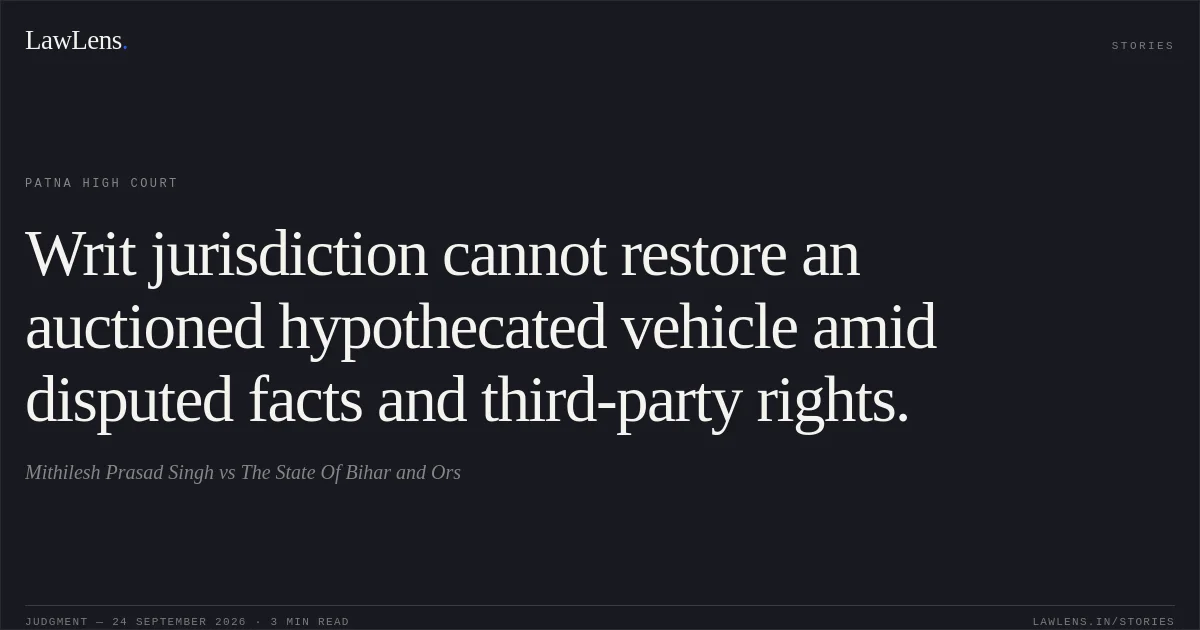
The Court declined to exercise its writ jurisdiction because the matter involved disputed questions of fact and the auction had resulted in third-party rights, followed by an alleged onward transfer of the tractor.
The writ petition was accordingly dismissed.
Source reference: p. 12, para. 22No order was made restoring the tractor, cancelling the auction, or granting compensation.
Source reference: no citationHowever, the dismissal was expressly made without prejudice to the petitioner’s right to approach the Bank for reconciliation and settlement of the loan account and to pursue any other remedy available in accordance with law.
Source reference: p. 12, para. 23Any pending interlocutory applications were disposed of.
Source reference: p. 12, para. 24Original Court PDF
Mithilesh Prasad SinghvsThe State Of Bihar and Ors
Click to open original judgment
Original judgment, available to read, download and summarize on LawLens.in