Facts
The claimant sought compensation for injuries sustained as a pillion rider in a 2008 motor accident involving a lorry owned by VRL Logistics Ltd.
Source reference: no citationThe Tribunal initially awarded compensation of ₹46,000 and placed liability on the owner because it had not produced evidence that the lorry’s driver held a valid licence.
Source reference: para. 7–8The owner’s appeal resulted in a remand for examination of its assertion that the driver had a valid licence.
Source reference: para. 10On remand, the owner did not participate effectively or produce the relevant documents before the Tribunal made the decision challenged in the writ proceedings.
Source reference: para. 12–14The owner’s writ petition was dismissed as not maintainable, with liberty to pursue an appropriate first appeal. It appealed that order, arguing that Section 173(2) of the Motor Vehicles Act barred an appeal because the compensation was below ₹1,00,000.
Source reference: para. 1–5Issues
Whether the Tribunal’s decision awarding compensation of ₹46,000 was appealable under Section 173(2) of the Motor Vehicles Act, as amended.
Source reference: para. 4–6Whether the absence of a statutory appeal required the High Court to entertain a writ petition under Article 226, notwithstanding the owner’s failure to participate effectively in the remand proceedings.
Source reference: para. 6, 12–15Law Applied
Section 173(2) of the Motor Vehicles Act, 1988, as amended with effect from 1 April 2022, bars an appeal where the amount in dispute is less than ₹1,00,000.
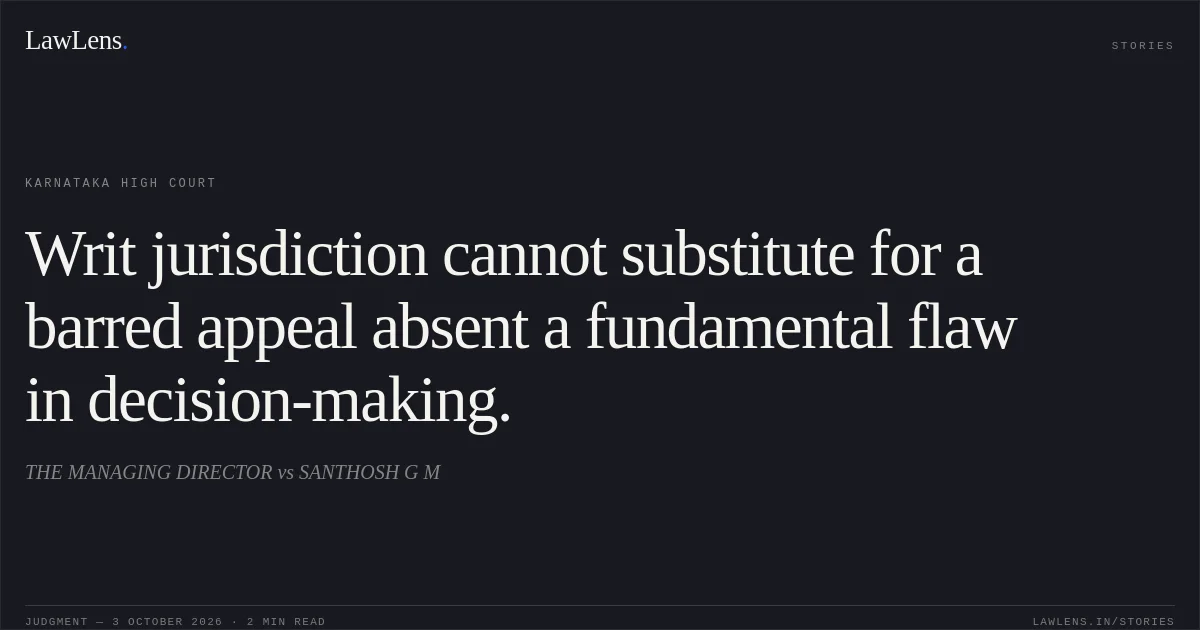
Source reference: para. 4The High Court held that Article 226 proceedings are not a substitute for a first appeal; where the statute makes the Tribunal’s decision final for disputes below the threshold, a writ petition should not be entertained absent a fundamental flaw in the decision-making process.
Source reference: para. 6Reasoning
The Court accepted that the compensation of ₹46,000 fell below the statutory threshold and that the Tribunal’s decision was therefore not appealable under Section 173(2).
Source reference: para. 5–6It held, however, that this restriction did not itself entitle the owner to challenge the decision by writ.
Source reference: para. 6The record showed that, despite the remand and repeated opportunities to appear, the owner failed to participate effectively and did not produce the relevant licence documents before the Tribunal’s decision.
Source reference: para. 12–14In those circumstances, the Court found no basis to treat the case as one involving a fundamental flaw in the decision-making process and considered the writ petition and ensuing appeal an unjustifiable use of judicial time.
Source reference: para. 6, 15Holding
The Court dismissed the writ appeal. It affirmed that the Tribunal’s decision was not appealable under Section 173(2), but held that this did not warrant entertaining a writ petition in the circumstances of the case.
The appellant was ordered to pay costs of ₹10,000 to the Karnataka State Legal Services Authority within two weeks.
Source reference: para. 15Acts & Sections Cited
2 provisions across 2 statutes referred to in this judgment. Each provision opens on LawLens.
KARNATAKA HIGH COURT ACT, 19611
Motor Vehicles Act, 19881
Original Court PDF
THE MANAGING DIRECTORvsSANTHOSH G M
Click to open original judgment
Original judgment, available to read, download and summarize on LawLens.in