Facts
The petitioner claimed ownership and possession of freehold land comprised in Khasra Nos. 8/2 and 8/3, Village Madhotal, Jabalpur.
Source reference: para. 2In 2020, the Municipal Corporation issued a communication acknowledging his ownership and proposing development of the SR-1 municipal road, requesting surrender of the required land in exchange for Floor Area Ratio benefits under the Madhya Pradesh Transferable Development Rights Rules, 2018.
Source reference: para. 2The petitioner subsequently obtained layout approval for a residential project in September 2023 and final colony development permission in March 2024.
Source reference: para. 2He alleged that, in 2026, the respondents entered upon the approved project site and constructed a cemented public road over his land without acquisition proceedings, compensation, or consent.
Source reference: para. 2The writ petition sought, inter alia, a declaration that the construction violated Article 300A, a direction to initiate acquisition and pay compensation under the Right to Fair Compensation and Transparency in Land Acquisition, Rehabilitation and Resettlement Act, 2013, or, alternatively, removal of the road and restoration of the land.
Source reference: para. 1Issues
Whether the High Court should exercise writ jurisdiction to determine the petitioner’s claim that the respondents had encroached upon and constructed a public road over his private land without acquisition or compensation.
Source reference: paras. 4, 7Whether the petitioner was required to pursue his remedy before the Civil Court, particularly in view of the disputed civil rights and alleged encroachment.
Source reference: para. 4Whether the delay between the respondents’ 2020 communication and the filing of the writ petition in 2026 disentitled the petitioner from relief under Article 226.
Source reference: paras. 5–6Law Applied
The Court applied the principle that writ jurisdiction is discretionary and ordinarily should not be exercised where the dispute involves contested questions of private title, possession, encroachment, or other civil rights for which an efficacious remedy before the Civil Court is available.
Source reference: paras. 4, 7Although the petitioner invoked Article 300A and alleged deprivation of property without lawful acquisition, the Court did not adjudicate the constitutional or acquisition merits because the underlying dispute was considered civil in nature.
Source reference: no citationThe Court also relied on the petitioner’s awareness of the respondents’ proposal since 2020 and the substantial delay before approaching the High Court.
Source reference: paras. 5–6No specific judicial precedent was cited in the judgment.
Source reference: no citationReasoning
The Court treated the petitioner’s allegation that the respondents had occupied his land and constructed the SR-1 road as involving a disputed civil claim requiring factual determination.
Source reference: para. 4Since the petitioner alleged encroachment and sought protection/restoration of private property, the Court held that the appropriate remedy was to institute civil proceedings, including a claim for injunction, rather than seek adjudication through a writ petition.
Source reference: para. 4The Court further noted that the administrative process concerning the proposed road had originated in 2020 and that the petitioner had remained silent for a considerable period before filing the petition in 2026.
Source reference: paras. 5–6In these circumstances, the Court declined to examine the alleged violation of Article 300A or direct acquisition and compensation under the 2013 Act in writ jurisdiction.
Source reference: para. 7Holding
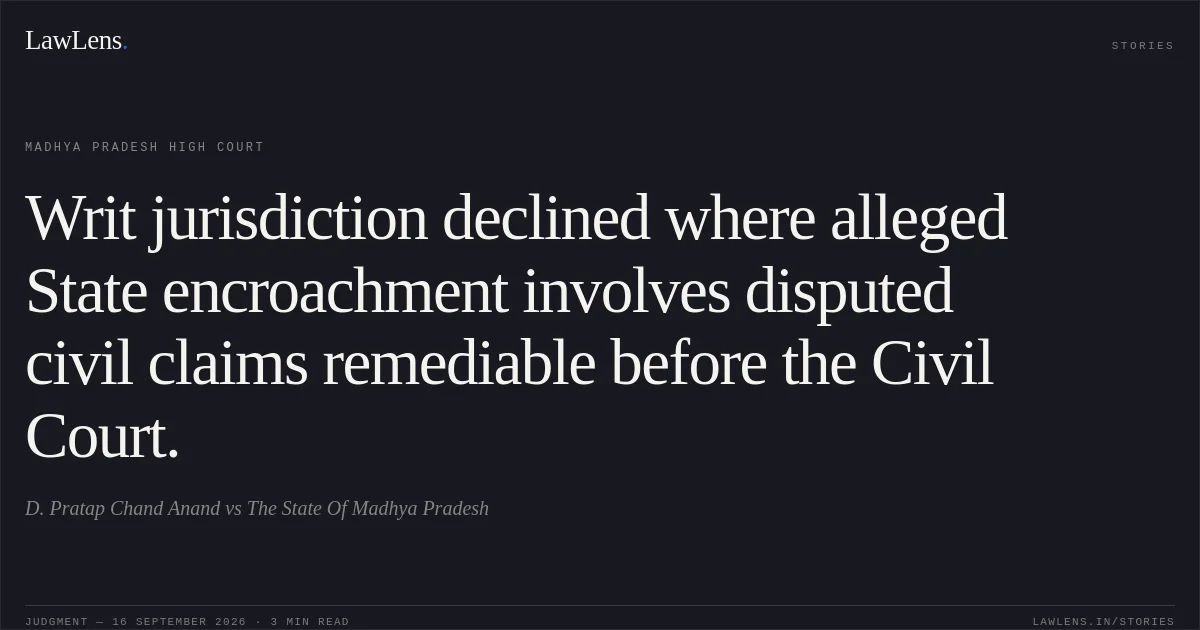
The High Court declined to entertain the writ petition on the ground that the petitioner’s remedy lay before the Civil Court in respect of the alleged encroachment and construction of the road.
The petition was consequently dismissed, without granting the requested declaration, acquisition direction, compensation, or demolition/restoration relief.
Source reference: paras. 7–8Original Court PDF
D. Pratap Chand AnandvsThe State Of Madhya Pradesh
Click to open original judgment
Original judgment, available to read, download and summarize on LawLens.in