Facts
The petitioner filed a writ petition under Article 226 of the Constitution of India seeking a court directive for the registration of an FIR against one Akash @ Bittu based on a complaint dated February 10, 2026
Source reference: para. 1The petitioner further requested an independent investigation by a senior officer/CID and the submission of a status report
Source reference: para. 1The petition arose from the alleged inaction of the police authorities regarding the petitioner's initial complaint
Source reference: para. 2Issues
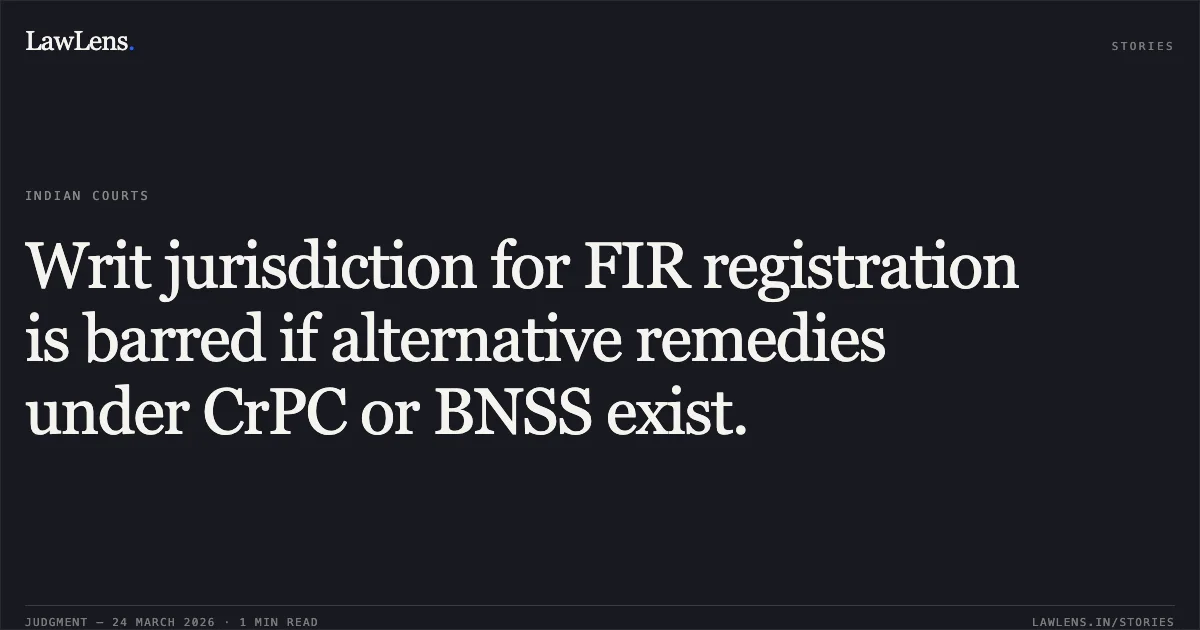
Whether a writ petition under Article 226 is maintainable for seeking the registration of an FIR when alternative statutory remedies under the Cr.P.C. or BNSS have not been exhausted?
Source reference: para. 2, 4Law Applied
The Court relied on the Supreme Court precedents in Sakiri Vasu v. State of U.P. (2008) 2 SCC 409 and Aleque Padamsee v. Union of India (2007) 6 SCC 171, which mandate that aggrieved parties must approach a Magistrate rather than the High Court for the non-registration of an FIR
Source reference: para. 2The Court emphasized the "wide powers" of the Magistrate under Section 156(3) Cr.P.C. (corresponding to Section 175(3) BNSS) to order registration and monitor investigations
Source reference: para. 3It also noted the hierarchy of alternative remedies: approaching the Superintendent of Police under Section 154(3) Cr.P.C./Section 36 Cr.P.C., and if unsuccessful, filing an application under Section 156(3) or a criminal complaint under Section 200 Cr.P.C.
Source reference: para. 3 (sub-paras 25, 26)Reasoning
The Court analyzed the settled legal position that High Courts should discourage the practice of entertaining writ petitions or Section 482 petitions for FIR registration when alternative remedies exist
Source reference: para. 3Citing Sakiri Vasu, the Court noted that Section 156(3) Cr.P.C. is "wide enough" to include all incidental powers necessary to ensure a proper investigation, including the power to order an FIR
Source reference: para. 3 (sub-paras 17, 18)The Court reasoned that although an alternative remedy is not an absolute bar to a writ petition, the High Court should not ordinarily interfere when the petitioner has a direct statutory path through the jurisdictional Magistrate
Source reference: para. 3 (sub-para 28)Consequently, the Court found no justification to exercise its extraordinary jurisdiction under Article 226 in the present facts
Source reference: para. 4Holding
The Court dismissed the petition, holding that the petitioner must first exhaust the alternative remedies provided by law
However, the Court granted the petitioner liberty to approach the jurisdictional Magistrate by filing an application under Section 156(3) Cr.P.C. or Section 175(3) of the Bharatiya Nagarik Suraksha Sanhita (BNSS)
Source reference: para. 5Acts & Sections Cited
2 provisions across 2 statutes referred to in this judgment. Each provision opens on LawLens.
Bharatiya Nyaya Sanhita, 20231
Bharatiya Nagarik Suraksha Sanhita, 20231
Original Court PDF
Brajesh Singh RaghuvanshivsThe State Of Madhya Pradesh
Click to open original judgment
Original judgment, available to read, download and summarize on LawLens.in