Facts
The petitioner, who operates R.O. plants, challenged a letter dated 23.12.2025 and a supplementary bill dated 22.12.2025 for Rs. 54,04,788.24 issued by Dakshin Gujarat Vij Company Limited (DGVCL) for alleged electricity theft
Source reference: p. 2, para. 4Following an inspection of the petitioner's premises on 22.12.2025, the respondent concluded that an offense under Section 135 of the Electricity Act, 2003, had been committed and subsequently registered an FIR
Source reference: para. 4The petitioner contended that the inspection and the resulting bill were illegal, violated the principles of natural justice, and misapplied Sections 135(2) and 135(3) of the Act
Source reference: para. 3, 6Issues
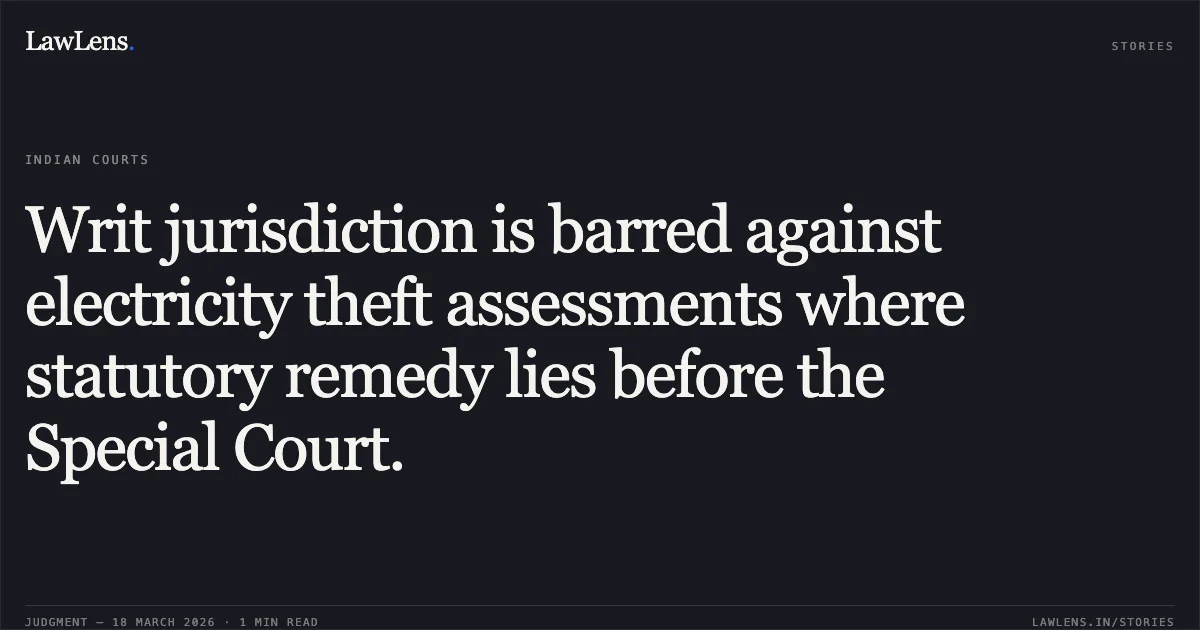
1. Whether a writ petition under Article 226 of the Constitution is maintainable against a supplementary bill issued for alleged electricity theft under Section 135 of the Electricity Act, 2003
Source reference: para. 72. Whether the petitioner is required to exhaust the statutory remedy of approaching a Special Court to determine civil liability in matters involving electricity theft
Source reference: para. 7, 8Law Applied
The court primarily applied Section 135 of the Electricity Act, 2003, regarding the offense of electricity theft, and Section 154, which details the procedure and power of Special Courts to determine civil liability
Source reference: para. 6, 7It relied on the precedent set by the Hon’ble Supreme Court in Uttar Pradesh Power Corporation Limited v. Anis Ahmad (2013) 8 SCC 491, which held that cases involving Sections 135 to 140 of the Act must be tried by Special Courts constituted under Section 153
Source reference: para. 8Further, the court applied the principle from Mukeshbhai Laljibhai Nashit v. Dakshin Gujarat Vij Company Limited (2020), affirming that Article 226 jurisdiction should not be invoked when the Special Court has the statutory power to determine civil liability for theft of energy
Source reference: para. 7Reasoning
The respondent argued that the petition was not maintainable because the dispute arose from an allegation of theft under Section 135, for which the Special Court has exclusive jurisdiction to determine civil liability
Source reference: para. 7The High Court observed that when civil liability arises from electricity theft, the statutory framework of the Electricity Act provides a specific remedy via the Special Court under Section 154
Source reference: para. 7Following the settled legal principles in Anis Ahmad, the court noted that the petitioner must seek recourse through a special civil suit rather than a writ petition
Source reference: para. 8, 10The court emphasized that the existence of an alternative statutory remedy precludes the exercise of extraordinary jurisdiction under Article 226
Source reference: para. 7Holding
The court did not rule on the merits of the case
Instead, it granted the petitioner permission to withdraw the petition to pursue the appropriate legal recourse
Source reference: para. 9The petition was disposed of as withdrawn with liberty to the petitioner to file appropriate proceedings before the Special Court constituted under the Electricity Act, 2003
Source reference: para. 10Rule was discharged
Source reference: para. 10Acts & Sections Cited
5 provisions across 1 statute referred to in this judgment. Each provision opens on LawLens.
Electricity Act, 20035
Original Court PDF
LAHERI SALIM YUSUFvsDEPUTY ENGINEER
Click to open original judgment
Original judgment, available to read, download and summarize on LawLens.in


