Facts
Respondent No. 1 initiated maintenance enhancement proceedings under Section 127(1) of the Cr.P.C. against the petitioner in the Family Court, Durg
Source reference: para 3Pursuant to the guidelines in Rajnish v. Neha, the respondent submitted an affidavit of assets and liabilities
Source reference: para 3The petitioner alleged that the respondent suppressed material facts regarding her income, educational qualifications, and receipt of government benefits, thereby committing fraud upon the court
Source reference: para 4The petitioner moved an application under Section 379 of the BNSS (Bharatiya Nagarik Suraksha Sanhita) seeking the registration of an FIR for offenses related to fabricated evidence under Sections 227, 228, 229, 236, 237, 242, 246, and 248 of the BNS (Bharatiya Nyaya Sanhita)
Source reference: para 1-2The Family Court rejected this application on January 8, 2026
Source reference: para 1The petitioner challenged this order via a writ petition under Article 226 of the Constitution
Source reference: para 1Issues
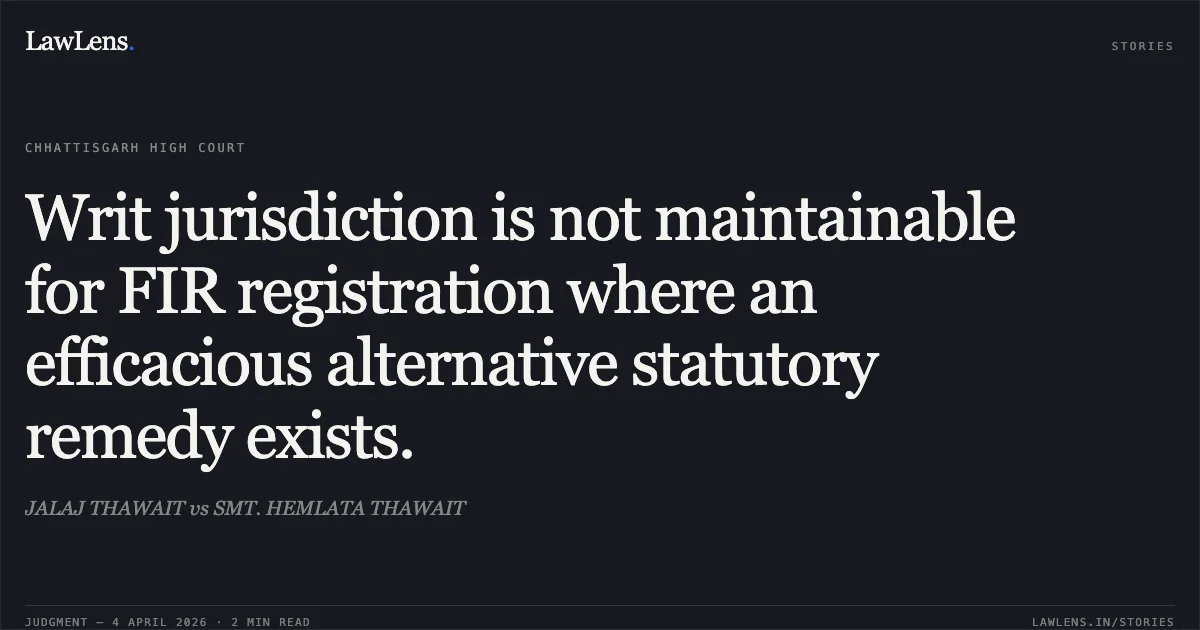
1. Whether the High Court should exercise its extraordinary writ jurisdiction under Article 226 to direct the registration of an FIR when an application for false evidence is rejected by a trial court.
Source reference: para 62. Whether the petitioner has an efficacious alternative remedy to address the alleged submission of false evidence.
Source reference: para 6Law Applied
The court applied the principle that writ jurisdiction is not maintainable when an efficacious alternative remedy is available to the litigant
Source reference: para 6It relied on Section 379 of the BNSS and various provisions of the BNS, 2023
Source reference: para 1-2The court adhered to the precedents set in Waseem Haider Vs. State of U.P. (Misc. Bench No. 24492 of 2020) and Akhilesh Agrawal v. State of Chhattisgarh (WPCR No. 333 of 2020), which established that grievances regarding the registration of FIRs or false evidence should be addressed before a competent Magistrate under statutory provisions rather than through a writ petition
Source reference: para 6Reasoning
The High Court held that the legal controversy regarding the appropriate forum for such grievances is no longer res integra
Source reference: para 6The court reasoned that the petitioner’s request for the registration of an FIR based on alleged perjury or fabrication of evidence in a Family Court proceeding is governed by specific statutory procedures
Source reference: para 6By applying the ratio in Waseem Haider and Akhilesh Agrawal, the court determined that the petitioner is legally required to approach a competent Magistrate for redressal
Source reference: para 6The court found that because a settled and efficacious alternative statutory remedy exists, the invocation of writ jurisdiction under Article 226 of the Constitution was unwarranted and improper in this context
Source reference: para 6-7Holding
The High Court declined to interfere with the Family Court's order, holding that the petitioner must exhaust statutory remedies before the appropriate forum
The writ petition was dismissed, but the court granted liberty to the petitioner to avail himself of the appropriate remedy before the competent Magistrate or relevant forum
Source reference: para 7Acts & Sections Cited
10 provisions across 3 statutes referred to in this judgment. Each provision opens on LawLens.
Bharatiya Nagarik Suraksha Sanhita, 20231
Bharatiya Nyaya Sanhita, 20238
Code of Criminal Procedure, 19731
Original Court PDF
JALAJ THAWAITvsSMT. HEMLATA THAWAIT
Click to open original judgment
Original judgment, available to read, download and summarize on LawLens.in


