Facts
The Petitioner challenged the Order-in-Original dated 17 March 2026, issued in Form GST DRC-07 under Rules 100(1), 100(2), 100(3) and 142(5) of the CGST Rules, 2017.
Source reference: para. 1The Petitioner alleged that, following search and seizure proceedings under Section 67 of the CGST Act commencing on 10 February 2021, documents, books of account, business records and electronic devices were seized without a proper inventory.
Source reference: paras. 4–5A subsequent show-cause notice dated 26 June 2025 proposed disallowance of input tax credit and recovery of IGST, CGST, SGST and other dues, including penalty of approximately Rs. 6.50 crore.
Source reference: para. 5The Petitioner contended that the relied-upon documents had not been supplied before adjudication, thereby violating natural justice.
Source reference: para. 6The Respondents disputed this contention, stating that the show-cause notice and relied-upon documents had been sent to the Petitioner’s registered and other email addresses, and that the Petitioner had been given a personal hearing opportunity.
Source reference: paras. 7–8The Respondents also raised a preliminary objection that the Order-in-Original was appealable under Section 107 of the CGST Act and that the writ petition was therefore not maintainable.
Source reference: para. 3Issues
Whether the writ petition under Article 226 was maintainable when the impugned Order-in-Original was appealable under Section 107 of the CGST Act.
Source reference: paras. 3, 10, 14, 19Whether the alleged non-supply of relied-upon documents constituted a violation of natural justice warranting interference by the High Court despite the available statutory appellate remedy.
Source reference: paras. 4–6, 11–15Whether the Petitioner had established an exceptional case justifying departure from the rule requiring exhaustion of an alternate and efficacious remedy.
Source reference: paras. 14, 18–19Law Applied
Section 107 of the Central Goods and Services Tax Act, 2017 provides a statutory appellate remedy against an Order-in-Original.
Source reference: para. 10The High Court reiterated the general rule that writ jurisdiction under Article 226 should not ordinarily be exercised where an alternate and efficacious statutory remedy is available, except in exceptional circumstances supported by proper pleadings and material.
Source reference: para. 14The Court relied on Rikhab Chand Jain v. Union of India, Civil Appeal No. 6719 of 2012, and the Bombay High Court decision in Nikhil Garg S/o Vishnu Prasad Garg v. Union of India, Writ Petition No. 14616 of 2025, on exhaustion of alternate remedies.
Source reference: para. 14It also referred to Ascensia Diabetes Care India Pvt. Ltd. v. Union of India regarding attempts to bypass the statutory appellate remedy and mandatory pre-deposit.
Source reference: para. 16It also referred to Shaik Arif v. Commissioner of Customs, SLP (Civil) Diary No. 48495 of 2025, where the Supreme Court declined writ interference and permitted the petitioner to pursue the statutory appeal even where violation of natural justice and lack of jurisdiction had been alleged.
Source reference: para. 17A mere invocation of natural justice, unsupported by particulars demonstrating actual prejudice, does not by itself justify writ intervention.
Source reference: paras. 15, 18Reasoning
The Court held that the impugned order was appealable before the Commissioner (Appeals) under Section 107 of the CGST Act.
Source reference: para. 10It found that the alleged denial of documents had been specifically addressed in paragraph 24 of the impugned order, which recorded that the show-cause notice and relied-upon documents had been emailed to the Petitioner on 28 June 2025 and again on 4 February 2026 at another email address requested by the Petitioner.
Source reference: para. 11The Petitioner had also received a hearing notice and submitted a detailed reply.
Source reference: para. 12Since the Petitioner neither identified the specific documents allegedly withheld nor produced material contradicting the adjudicating authority’s findings, the Court found that no concrete prejudice or exceptional violation of natural justice had been demonstrated.
Source reference: paras. 12, 15Applying the rule favouring exhaustion of alternate remedies, and noting that writ proceedings should not routinely be used to avoid the statutory pre-deposit requirement, the Court declined to exercise its extraordinary jurisdiction.
Source reference: paras. 16, 18–19Holding
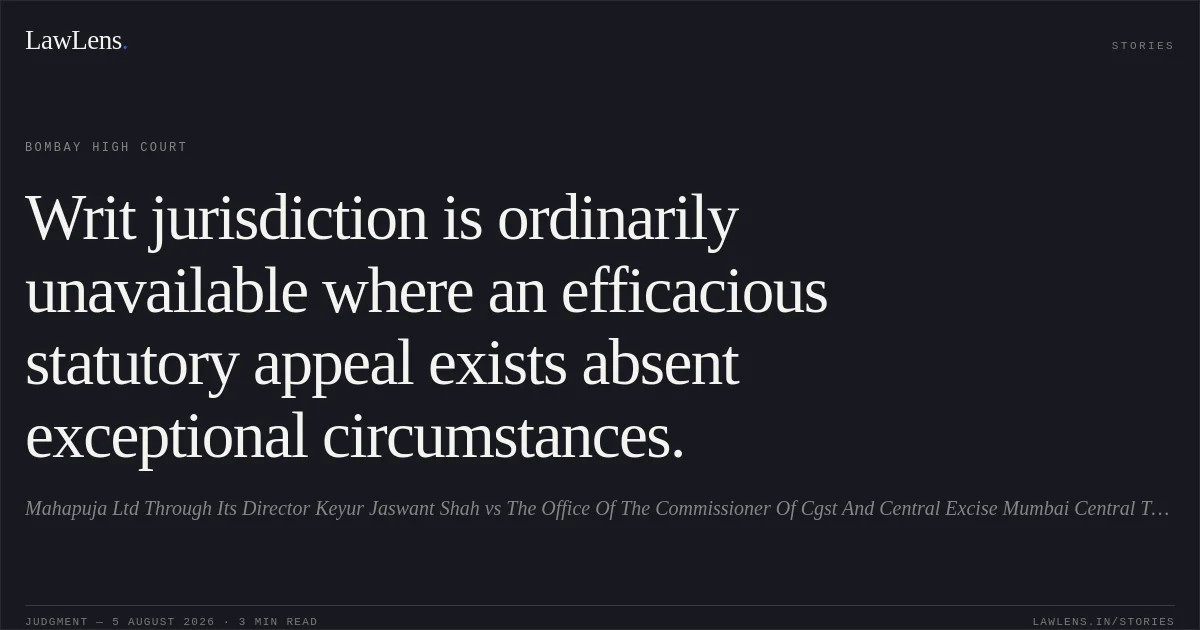
The writ petition was held to be not maintainable because the Petitioner had an efficacious statutory appeal under Section 107 of the CGST Act and had not established any exceptional ground for writ interference.
The Court granted liberty to the Petitioner to file an appeal before the Appellate Authority within four weeks from uploading of the judgment; the appeal was to be considered on its merits subject to compliance with all statutory requirements, including the mandatory pre-deposit.
Source reference: para. 20The Court expressly left all merits open for consideration in the appropriate appellate proceedings, disposed of the writ petition, and made no order as to costs.
Source reference: paras. 21–22Original Court PDF
Mahapuja Ltd Through Its Director Keyur Jaswant ShahvsThe Office Of The Commissioner Of Cgst And Central Excise Mumbai Central Through Additional Commissi
Click to open original judgment
Original judgment, available to read, download and summarize on LawLens.in