Facts
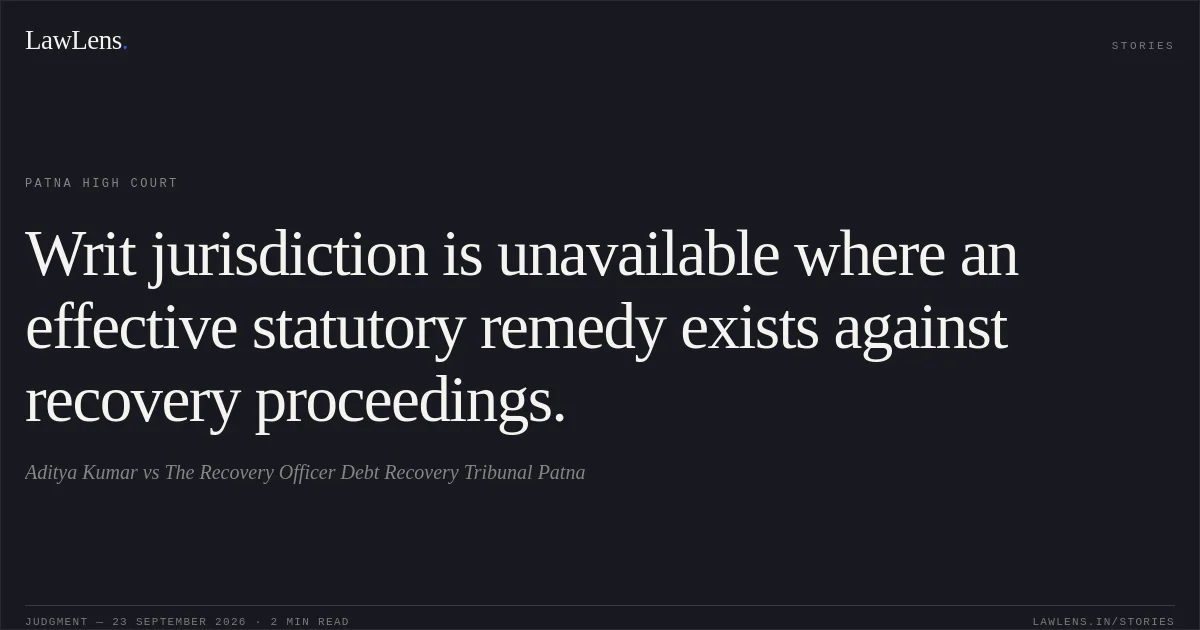
The petitioner, Aditya Kumar, proprietor of M/s Karan Tractors, filed a writ petition under Article 226 of the Constitution challenging the order dated 9 May 2023 and the notice for attachment of immovable property issued in Recovery Proceeding No. 280 of 2016.
Source reference: p.1–2The property was described as belonging to Certificate Debtor No. 2, Meena Devi, and was identified by reference to the relevant sale deed, khata, khesra, holding and area particulars.
Source reference: p.1–2The petitioner sought setting aside of the attachment order and notice.
Source reference: p.1–2The High Court considered whether the writ petition should be entertained when an alternative statutory remedy was available.
Source reference: p.2–4Issues
Whether the High Court should exercise its writ jurisdiction under Article 226 to examine the challenge to the attachment order and warrant issued in recovery proceedings when an alternative and effective statutory remedy was available.
Source reference: p.2–4Whether the petitioner should be permitted to approach the appropriate statutory forum, including with respect to any issue of limitation.
Source reference: p.4Law Applied
The Court applied the principle that a writ petition under Article 226 is ordinarily not maintainable where an effective alternative statutory remedy is available, particularly in matters concerning recovery of public dues, bank dues and proceedings under specialised recovery legislation.
Source reference: p.2–3Relying on United Bank of India v. Satyawati Tondon, (2010) 8 SCC 110, the Court held that statutory recovery enactments constitute a complete code and that aggrieved parties must ordinarily exhaust the remedies provided under the relevant statute.
Source reference: p.2–3The Court further relied on Celir LLP v. Bafna Motors (Mumbai) (P) Ltd., (2024) 2 SCC 1, reiterating that High Courts should not entertain Article 226 petitions where an effective remedy exists under the SARFAESI Act.
Source reference: p.3The Court further relied on PHR Invent Educational Society v. UCO Bank, 2024 INSC 297, which reaffirmed the same principle.
Source reference: p.3Reasoning
The petitioner’s challenge related to an attachment order and warrant issued during recovery proceedings before the Recovery Officer, which fell within the framework of a specialised statutory recovery mechanism.
Source reference: p.1–2Applying the alternative-remedy rule stated in Satyawati Tondon, Celir LLP and PHR Invent Educational Society, the Court held that the existence of an effective statutory forum prevented the High Court from ordinarily exercising its writ jurisdiction.
Source reference: p.2–4The Court did not adjudicate the validity of the attachment on merits; instead, it directed the petitioner to pursue the appropriate statutory remedy.
Source reference: p.4It also clarified that the concerned authority would consider any question of limitation in accordance with law.
Source reference: p.4Holding
The writ petition was held not maintainable because an alternative and effective statutory remedy was available to the petitioner.
The petition was accordingly disposed of, with liberty to the petitioner to approach the appropriate forum.
Source reference: p.4The concerned authority was directed to consider the issue of limitation while examining the petitioner’s remedy.
Source reference: p.4Original Court PDF
Aditya KumarvsThe Recovery Officer Debt Recovery Tribunal Patna
Click to open original judgment
Original judgment, available to read, download and summarize on LawLens.in