Facts
The Appellants, retired Government employees, booked apartments in the ‘NBCC Green View Apartments’ project in 2012 and received possession in 2017-2018
Source reference: p. 3In 2021, IIT Delhi declared the structures unsafe for habitation
Source reference: p. 3Consequently, the District Disaster Management Authority (DDMA) ordered Respondent No. 1 (NBCC) to refund the total consideration with interest
Source reference: p. 3Although NBCC initially promised a uniform settlement policy, it subsequently issued a ‘Buy Back Offer’ for principal amounts only
Source reference: p. 4Facing financial hardship and cessation of rent payments by NBCC, the Appellants executed an ‘Acceptance-cum-Declaration Memorandum’ (Memorandum) as a "One-Time Full and Final Settlement"
Source reference: p. 5Later, NBCC offered other allottees the option of re-allotment in a reconstructed project
Source reference: p. 5The Appellants filed Writ Petitions seeking parity and re-allotment, which were dismissed by the learned Single Judge on the grounds that the dispute was contractual and involved disputed questions of fact regarding coercion
Source reference: p. 6Issues
1. Whether the High Court should exercise its writ jurisdiction under Article 226 of the Constitution to adjudicate a dispute arising from a settlement memorandum alleged to be signed under coercion
Source reference: p. 8, para 25; p. 10, para 312. Whether the Appellants, having accepted a full and final settlement, can challenge a subsequent policy change as being discriminatory and arbitrary
Source reference: p. 9, para 29; p. 10, para 30Law Applied
The Court applied the principles of Article 226 of the Constitution of India regarding the discretionary nature of writ jurisdiction
Source reference: p. 7, para 18It relied on the settled doctrine that writ courts generally do not adjudicate "disputed questions of fact," particularly allegations of fraud or coercion in the execution of private contracts
Source reference: p. 6, para 17; p. 10, para 31The Court further considered the principle of "Full and Final Settlement," whereby a party who voluntarily accepts a settlement is precluded from resiling unless the underlying agreement is proved to be vitiated by law
Source reference: p. 9, para 27Reasoning
The Court reasoned that once the Appellants executed the Memorandum and accepted the settlement amount, the relationship became primarily contractual
Source reference: p. 8-9The Appellants did not protest or allege coercion immediately after receiving payment; grievances only arose after NBCC introduced a more favorable policy for other residents
Source reference: p. 9, para 29The Court held that to challenge NBCC’s subsequent "Uniform Settlement Policy" or claim "Promissory Estoppel," the Appellants must first invalidate the initial Memorandum
Source reference: p. 10, para 31Determining whether the Memorandum was signed under "helplessness" or "coercion" requires an examination of evidence, which is outside the scope of summary writ proceedings
Source reference: p. 10, para 31The Court found that the Respondents’ status as "State" does not automatically convert a dispute over a signed settlement into a constitutional matter if the underlying facts regarding the validity of that settlement are contested
Source reference: p. 9-10Holding
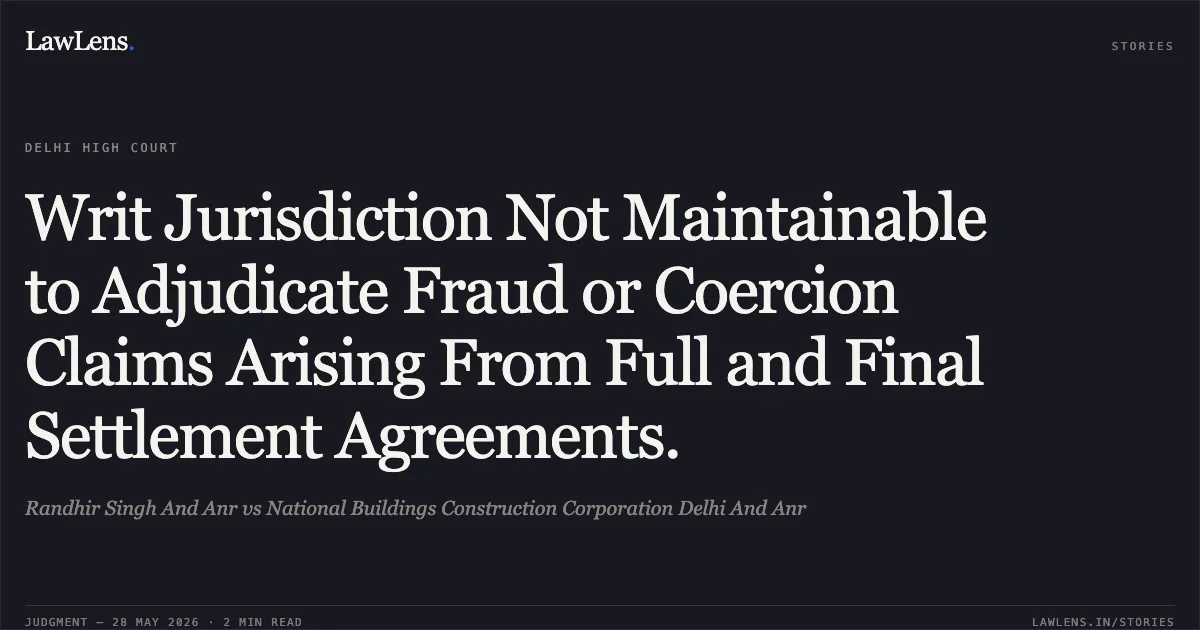
the Court answered that writ jurisdiction is not the appropriate remedy for disputes involving signed settlements and allegations of coercion
The Division Bench upheld the Single Judge's order, finding no infirmity in the decision to relegate the parties to a Civil Court. The Appeals were dismissed, while preserving the Appellants' liberty to pursue alternate remedies (such as a civil suit) where evidence can be led regarding the alleged fraud or coercion
Source reference: p. 10, para 32Acts & Sections Cited
1 provisions across 1 statute referred to in this judgment. Each provision opens on LawLens.
Limitation Act, 19631
Original Court PDF
Randhir Singh And AnrvsNational Buildings Construction Corporation Delhi And Anr
Click to open original judgment
Original judgment, available to read, download and summarize on LawLens.in