Facts
The petitioners, tenants of a ground-floor shop in Guwahati under a lease agreement with Respondents 3 and 4, alleged that an iron kiosk and a brick wall were illegally erected in front of their shop, blocking ingress and egress.
Source reference: p. 3-4The lease agreement (Clause 8) stipulated that the space between the footpath and shop remained under the exclusive ownership of the landlords.
Source reference: p. 5Following a dispute and a pending eviction suit filed by the landlords, the petitioners filed a representation with the Guwahati Municipal Corporation (GMC) for the removal of the obstruction.
Source reference: p. 6-9When the GMC failed to act, the petitioners filed this writ petition alleging a violation of their fundamental right to carry out business under Article 19(1)(g).
Source reference: p. 17During the proceedings, GMC dismantled the kiosk, and Respondent 5 (another tenant) replaced it with a temporary structure.
Source reference: p. 16Issues
1. Whether the Writ Court should exercise jurisdiction under Article 226 of the Constitution in respect of a property dispute primarily involving private individuals.
Source reference: p. 4, para 42. Whether the alleged inaction of the Municipal Authority in a landlord-tenant dispute constitutes a ground for a public law remedy.
Source reference: p. 11, para 15Law Applied
The Court primarily applied the principle that a writ of mandamus does not lie against private individuals unless they are acting in collusion with the State or performing a public duty.
Source reference: p. 21, para 38It relied on the Constitution Bench decision in Sohan Lal v. Union of India, which established that rival claims of title or possession are more appropriate for a Civil Court.
Source reference: p. 21-22It further applied the doctrine from Mohan Pandey v. Usha Rani Rajgaria, stating that Article 226 is not available for enforcing private property rights against individuals unless a violation of a statutory duty by an authority is clearly alleged.
Source reference: p. 24-26Finally, it cited Shalini Shyam Shetty v. Rajendra Shankar Patil, which cautioned against entertaining writ petitions in pure landlord-tenant disputes.
Source reference: p. 27-29Reasoning
The Court noted that the core of the dispute was a private landlord-tenant conflict, as evidenced by the petitioners' police complaints and the pending civil suit for eviction.
Source reference: p. 19-20The Court observed that the petitioners’ representation to the GMC was strategic and vague, failing to allege specific violations of the GMC Act or building bye-laws by the landlords.
Source reference: p. 19-20The Court reasoned that the GMC lacked competence to adjudicate rights within private land unless a statutory violation occurred.
Source reference: p. 20The Court found that the petitioners were attempting to use the extraordinary jurisdiction of Article 226 as a shortcut to bypass the Civil Court for a declaration of their rights of ingress and egress.
Source reference: p. 21, 30The Court emphasized that mere impleadment of a statutory authority (GMC) does not transform a private property row into a public law matter, especially when factual disputes regarding the "designated entrance" remained unresolved.
Source reference: p. 29-30Holding
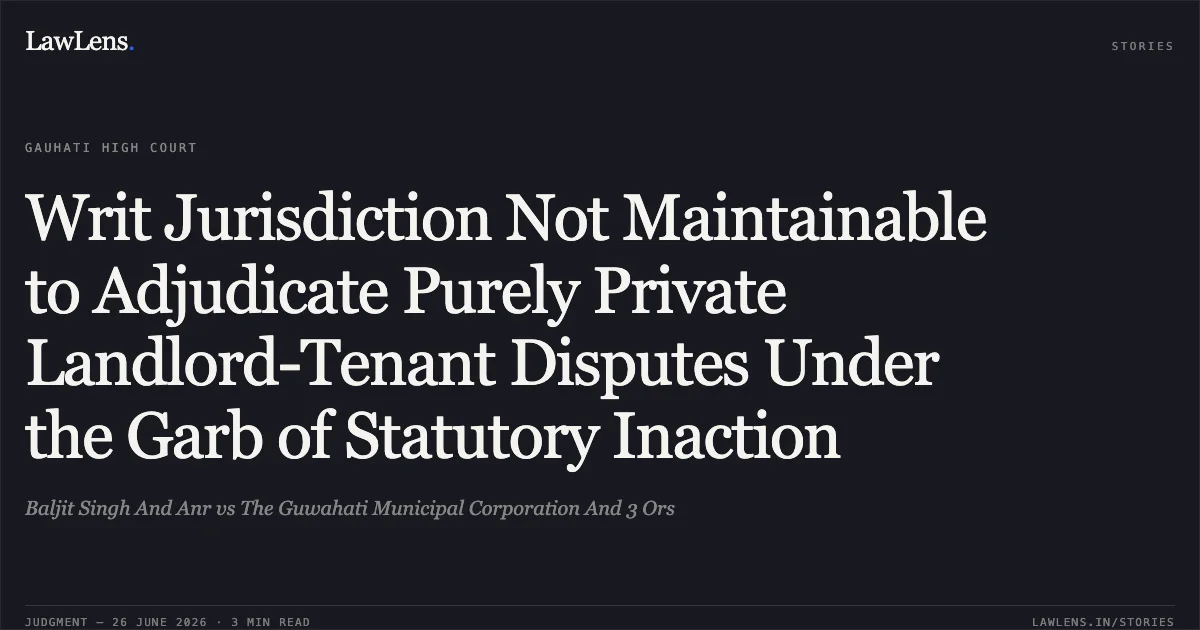
The Court held that the writ petition was not maintainable as it involved a pure private dispute over immovable property for which remedies under general civil law are available.
The Court vacated all previous interim orders, noting that directions issued to private parties (Respondents 3 and 4) to remove walls were contrary to established law.
Source reference: p. 31, para 50The petition was dismissed, leaving the petitioners at liberty to approach a competent Civil Court for relief.
Source reference: p. 32, para 51-52Acts & Sections Cited
2 provisions across 2 statutes referred to in this judgment. Each provision opens on LawLens.
Assam Urban Areas Rent Control (Amendment) Act, 19721
Public Premises (Eviction of Unauthorised Occupants) Act, 19711
Original Court PDF
Baljit Singh And AnrvsThe Guwahati Municipal Corporation And 3 Ors
Click to open original judgment
Original judgment, available to read, download and summarize on LawLens.in