Facts
The petitioners, owners of a 10-bedded lodging house, challenged a show-cause notice dated 31.08.2018 and a subsequent assessment order dated 31.01.2019 passed under Section 45A of the Employees’ State Insurance Act, 1948 ("the Act"), which determined contributions payable for ten employees.
Source reference: para. 2-4The assessment was based on a 2010 survey report.
Source reference: para. 4The petitioners appealed the assessment under Section 45AA, but the appeal was dismissed on 18.06.2019.
Source reference: para. 5The petitioners then approached the High Court under Article 226, contending that the initiation of proceedings was without jurisdiction as the foundational preconditions under Sections 44 and 45A were absent.
Source reference: para. 6-7The respondents raised a preliminary objection regarding the maintainability of the writ petition due to the availability of an alternative statutory remedy under Section 75 of the Act.
Source reference: para. 10Issues
1. Whether the writ petition is maintainable under Article 226 of the Constitution of India notwithstanding the availability of an efficacious statutory remedy under Section 75 of the ESI Act.
Source reference: para. 152. Whether the dispute regarding the number of employees, coverage of the establishment, and the reliability of the survey report constitutes a "patent lack of jurisdiction" allowing for the bypass of statutory remedies.
Source reference: para. 25 & 31Law Applied
Section 75 of the ESI Act, 1948, vests exclusive jurisdiction in the Employees’ Insurance Court to adjudicate disputes concerning contribution liability, employee status, and employer identity.
Source reference: para. 20The principle from Whirlpool Corporation v. Registrar of Trade Marks permits writ jurisdiction despite alternative remedies only in cases of fundamental right violations, breach of natural justice, patent lack of jurisdiction, or challenge to vires.
Source reference: para. 24The doctrine that "jurisdictional facts" involving disputed questions of evidence must be resolved by specialized statutory forums rather than Writ Courts.
Source reference: para. 29Reasoning
The Court reasoned that the ESI Act provides a comprehensive statutory code for both assessment and dispute resolution.
Source reference: para. 21The Court distinguished between a "total absence of jurisdiction" and an "erroneous assumption of facts".
Source reference: para. 27The petitioners’ challenge—revolving around whether they employed ten people and whether the survey report was stale—required an evidentiary examination of disputed facts.
Source reference: para. 31 & 40The Court observed that the petitioners were afforded a hearing and had already utilized the Section 45AA appellate route.
Source reference: para. 35 & 59Given that Section 75(1)(g) specifically covers "any other matter" in dispute regarding contributions, the Court found no exceptional circumstances to bypass the specialized Employees’ Insurance Court.
Source reference: para. 43 & 58The Court maintained consistency with prior Bench decisions, such as Hotel Radha International v. ESIC, which held that coverage and liability disputes under Section 45A must be heard by the Insurance Court.
Source reference: para. 45Holding
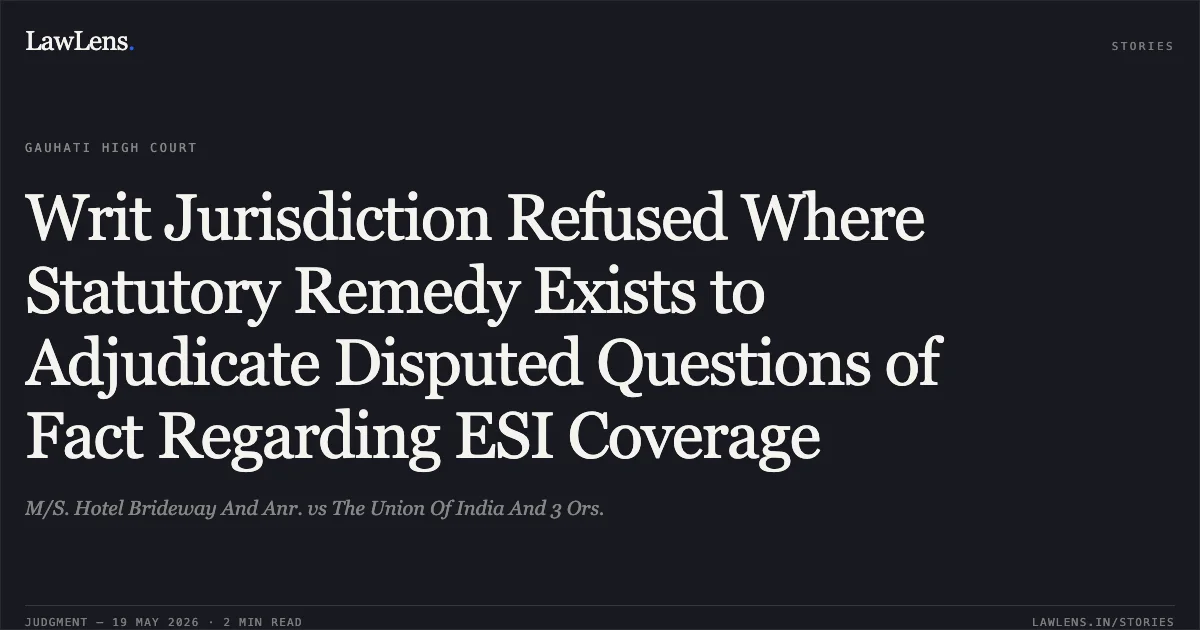
The Court dismissed the writ petition on the grounds of the availability of an efficacious statutory remedy under Section 75 of the Act.
The Court held that factual disputes regarding statutory coverage do not constitute a patent lack of jurisdiction.
Source reference: para. 50The Court granted the petitioners liberty to approach the competent statutory forum, clarifying that the time spent bona fide in prosecuting the writ petition may be considered for limitation purposes, keeping all merits-based contentions open.
Source reference: para. 61, 63 & 64Acts & Sections Cited
13 provisions across 1 statute referred to in this judgment. Linked provisions open on LawLens.
Employees
Original Court PDF
M/S. Hotel Brideway And Anr.vsThe Union Of India And 3 Ors.
Click to open original judgment
Original judgment, available to read, download and summarize on LawLens.in