Facts
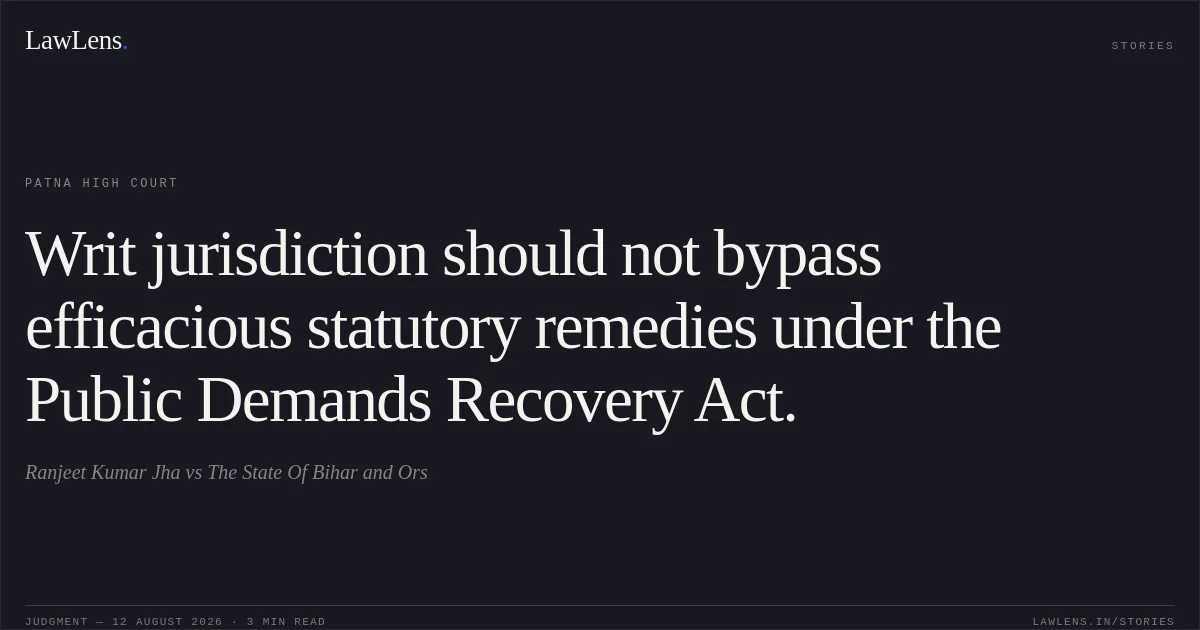
The petitioner, proprietor of M/s Om Rice Mill, challenged Certificate Case No. 20 of 2014–15 initiated against him under Section 7 of the Bihar and Orissa Public Demands Recovery Act, 1914 (“PDR Act”).
Source reference: p. 1–2, para. 1He alleged defects in Form No. 1, absence of proper application of mind and enquiry, non-service of the certificate notice, and that the amount claimed was disputed and therefore not recoverable through certificate proceedings.
Source reference: p. 1–2, para. 1During the writ proceedings, the petitioner placed on record an order in Request Case No. 24 of 2018 and an arbitration award dated 29 August 2019, contending that the demand forming the basis of the certificate proceeding had been rejected or not allowed by the arbitrator.
Source reference: p. 3–4, paras. 2–4The respondents relied upon the availability of statutory remedies under the PDR Act and the Supreme Court’s judgment in Pawapuri Rice Mills v. Bihar State Food and Civil Supplies Corporation Ltd. & Ors., 2024 SCC OnLine SC 3777.
Source reference: p. 4–8, paras. 6–8Issues
Whether the High Court should exercise its writ jurisdiction to examine the petitioner’s objections concerning the maintainability, jurisdictional basis and procedural defects in the certificate proceeding when statutory remedies under the PDR Act are available?
Source reference: p. 8–9, paras. 11–14Whether the petitioner’s reliance on the arbitration award dated 29 August 2019 warranted quashing or discontinuance of the certificate proceeding by the High Court?
Source reference: p. 9–10, paras. 12–15Whether the petitioner should be permitted to raise the arbitration award and other objections before the Certificate Officer under Section 9 of the PDR Act?
Source reference: p. 9–11, paras. 13, 16–18Law Applied
The Court applied the Bihar and Orissa Public Demands Recovery Act, 1914, particularly Section 9, which permits the certificate-debtor to file objections before the Certificate Officer, along with the statutory remedies contemplated under Sections 43 and 44, 60, 62 and 63 of the Act, including remedies before civil courts, appeal, revision and review.
Source reference: p. 6–8, paras. 38–39 of Pawapuri Rice MillsRelying principally on Pawapuri Rice Mills v. Bihar State Food and Civil Supplies Corporation Ltd. & Ors., 2024 SCC OnLine SC 3777, the Court held that the PDR Act is a comprehensive code providing adequate procedural safeguards and that alleged procedural irregularities, disputed questions and objections to recovery should ordinarily be raised before the competent statutory authority rather than through writ jurisdiction.
Source reference: p. 5–8, paras. 37–42The Court also followed the principle that an aggrieved party should ordinarily exhaust an efficacious alternative statutory remedy before invoking the extraordinary jurisdiction under Article 226 of the Constitution.
Source reference: p. 8–9, paras. 11–14Reasoning
The petitioner’s grounds—including defects in Form No. 1, alleged non-service of notice, absence of proper enquiry, and the contention that the amount was not a recoverable public demand—involved disputed factual and legal questions concerning the validity of the certificate proceeding.
Source reference: p. 9, para. 12In light of Pawapuri Rice Mills, the Court declined to adjudicate those issues directly in writ jurisdiction because the PDR Act provides a specific mechanism for filing objections and pursuing further statutory remedies.
Source reference: p. 8–10, paras. 11–14The subsequent arbitration award did not, by itself, justify quashing the certificate proceeding at the writ stage; instead, the Court directed that the award be placed before the Certificate Officer, who could consider it along with all other permissible objections in accordance with law.
Source reference: p. 9–10, para. 13The Court therefore refrained from expressing any opinion on the merits of the parties’ competing claims.
Source reference: p. 10, para. 15Holding
The writ petition was disposed of without adjudication on merits.
The petitioner was granted liberty to file objections under Section 9 of the PDR Act, together with the arbitration award dated 29 August 2019 and other relevant documents, before the concerned Certificate Officer within one month from receipt or communication of the order.
Source reference: p. 10, para. 16If filed within that period, the Certificate Officer was directed to entertain and decide the objections in accordance with law by passing a reasoned and speaking order after affording the parties an opportunity of hearing.
Source reference: p. 10–11, para. 17The Court consequently declined to quash the certificate proceeding or the arrest warrant at that stage.
Source reference: p. 1–2, 10–11, paras. 1, 15–18Acts & Sections Cited
7 provisions across 1 statute referred to in this judgment. Linked provisions open on LawLens.
Bihar and Orissa Public Demands Recovery Act, 19147
Original Court PDF
Ranjeet Kumar JhavsThe State Of Bihar and Ors
Click to open original judgment
Original judgment, available to read, download and summarize on LawLens.in