Facts
The appellant purchased land in Khasra Nos. 256 and 257 via registered sale deeds, leading to mutation in revenue records
Source reference: para. 2, 6Following a 2024 SDO order adjudicating disputes over mutation and acquisition, a fresh enquiry report was submitted on 14.08.2025
Source reference: para. 6Despite a clarification from the Public Works Department (PWD) on 08.12.2025 stating only a limited portion (0.199 hectares) was acquired for road construction, the SDO passed a new order on 15.12.2025
Source reference: para. 7The appellant challenged this order via W.P. No. 10171/2026, which the Writ Court dismissed on the grounds that the matter involved disputed questions of fact regarding the extent of land remaining after acquisition
Source reference: para. 1-2, 8The appellant filed this intra-court appeal asserting violations of natural justice and statutory procedure
Source reference: para. 3Issues
1. Whether the Writ Court erred in dismissing the petition on the grounds of "disputed questions of fact" regarding the ownership and physical extent of the remaining land in Survey No. 256
Source reference: para. 8-92. Whether the SDO’s order dated 15.12.2025 was passed in violation of the principles of natural justice and constituted an impermissible review of its earlier order
Source reference: para. 3Law Applied
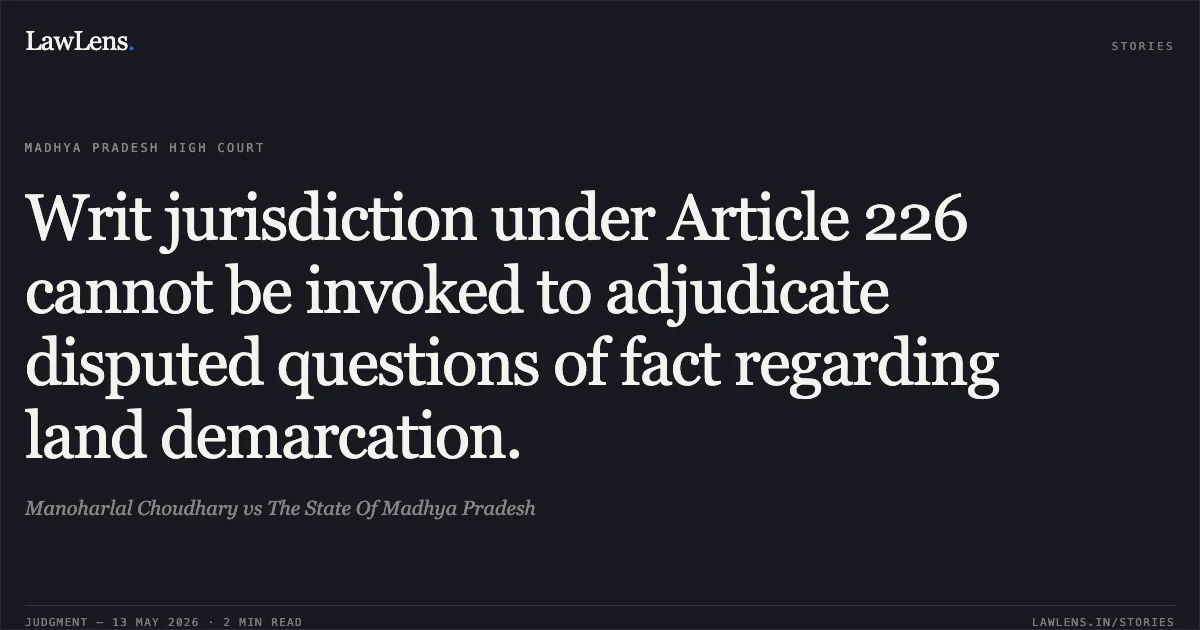
The Court applied the principle of judicial restraint under Article 226 of the Constitution of India, which dictates that High Courts should generally refrain from adjudicating matters involving complex disputed questions of fact in writ jurisdiction
Source reference: para. 9It also considered the statutory procedures governing mutation and demarcation under the relevant Land Revenue Code, emphasizing that a party must establish a foundational factual basis—such as the original dimensions of land versus acquired portions—before claiming a violation of rights
Source reference: para. 8Reasoning
The Court observed that while the PWD clarified that only 0.199 hectares were acquired, the appellant failed to provide material evidence to prove that Survey No. 256 originally comprised a larger area or that he retained possession of any specific surplus portion
Source reference: para. 8The Bench reasoned that determining the exact boundaries and subsisting private rights over the land requires a physical demarcation and factual inquiry, which are functions of the revenue authorities rather than the Writ Court
Source reference: para. 8Consequently, the Court found that the SDO's subsequent order dated 15.12.2025 arose from an enquiry report and PWD communication that introduced new factual complexities which could not be resolved without a full evidentiary assessment
Source reference: para. 6-7, 9Holding
The High Court dismissed the appeal, holding that no interference was warranted in the Single Judge’s order
The Court affirmed that because the dispute centered on physical land dimensions and possession, it fell within the realm of "disputed questions of fact" unsuitable for Article 226
Source reference: para. 9The Court granted the appellant the liberty to seek proper demarcation in accordance with statutory procedures to establish his claims before the competent revenue authority
Source reference: para. 8Original Court PDF
Manoharlal ChoudharyvsThe State Of Madhya Pradesh
Click to open original judgment
Original judgment, available to read, download and summarize on LawLens.in