Facts
In 1991, the Town Improvement Trust, Damoh, issued an advertisement for the allotment of plots under the Rashtriya Awas Bank Yojana.
Source reference: para. 2The petitioner’s father was selected, deposited the registration fee and agreement charges, and was allotted Plot No. 16 with a promise of possession within 15 days.
Source reference: para. 2Despite fulfilling all formalities by 1998, possession was never delivered.
Source reference: para. 10The petitioner’s father passed away on May 27, 2025, without challenging the inaction during his lifetime.
Source reference: para. 10The petitioner filed this writ petition on August 26, 2025, seeking a mandamus for delivery of possession and a decision on pending representations.
Source reference: paras. 1, 10Issues
1. Whether a writ petition seeking enforcement of rights after a delay of over 27 years can be entertained under the discretionary jurisdiction of Article 226 of the Constitution of India.
Source reference: para. 102. Whether the filing of representations or the death of the original allottee provides a sufficient explanation to overcome the doctrine of laches.
Source reference: para. 10Law Applied
The court applied the equitable doctrine of "delay and laches," establishing that discretionary relief under Article 226 cannot be granted to a "sleeping litigant" who fails to assert rights within a reasonable time.
Source reference: paras. 3, 9High Courts may refuse extraordinary powers if negligence or lapse of time causes prejudice to the opposite party as held in Karnataka Power Corpn. Ltd. v. K. Thangappan (2006).
Source reference: para. 4"Delay defeats equity" and subsequent judgments in similar cases or mere representations do not furnish a valid explanation for stale claims as per State of Orissa v. Mamata Mohanty (2011) and S.S. Balu v. State of Kerala (2009).
Source reference: paras. 6, 7Reasoning
The court found that while the allotment proceedings were initiated in 1991 and completed by the petitioner's father in 1998, no legal action was taken for nearly three decades.
Source reference: para. 10The court noted that the petitioner's father was well aware of the proceedings during his lifetime but chose not to challenge them.
Source reference: para. 3Applying the principles from A.P. SRTC v. N. Satyanarayana, the court observed that the petition lacked any plausible explanation for the delay.
Source reference: paras. 5, 10It further scrutinized the submitted representations (Annexure P/6) and found them deficient as they lacked dates and acknowledgments.
Source reference: para. 10Consistent with the ruling in NDMC v. Pan Singh, the court reasoned that exercising discretionary jurisdiction in favor of those who approach the court after a long lapse of time would be unjust and inequitable.
Source reference: para. 6Holding
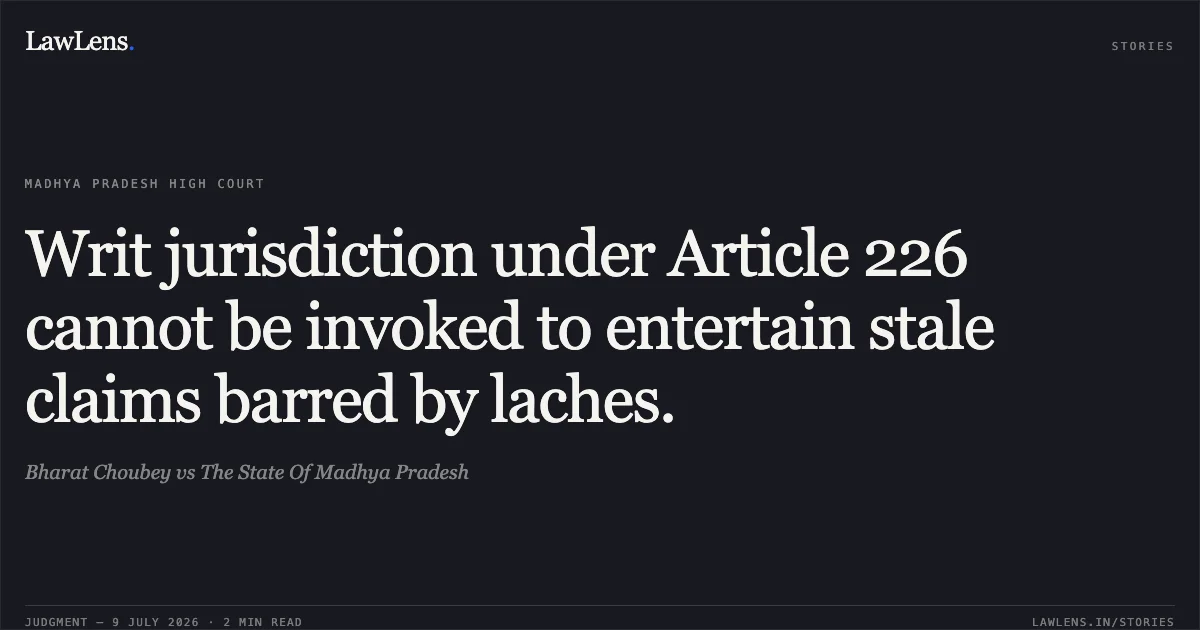
The court answered that stale claims cannot be entertained under writ jurisdiction and held that the petitioner is a "sleeping litigant" not entitled to relief.
The High Court dismissed the petition solely on the grounds of delay and laches. No order as to costs was made.
Source reference: para. 11Original Court PDF
Bharat ChoubeyvsThe State Of Madhya Pradesh
Click to open original judgment
Original judgment, available to read, download and summarize on LawLens.in