Facts
The Petitioner challenged an order dated 27.05.2025 passed by Respondent No. 1 (MSEFC), which referred a dispute to the Delhi International Arbitration Centre (DIAC) under Section 18(3) of the MSMED Act, 2006
Source reference: para. 1The Petitioner alleged that mandatory conciliation proceedings under Sections 18(1) and 18(2) were bypassed without notice
Source reference: para. 2Following the referral, a Sole Arbitrator was appointed.
Source reference: no citationThe Petitioner filed an application under Section 16 of the Arbitration and Conciliation Act, 1996, challenging the tribunal's jurisdiction based on the alleged failure of the conciliation stage; however, the Arbitrator dismissed this application on 13.10.2025
Source reference: paras. 2, 4, 7The Petitioner subsequently sought a Writ of Certiorari to quash the referral and initiate fresh conciliation
Source reference: para. 1Issues
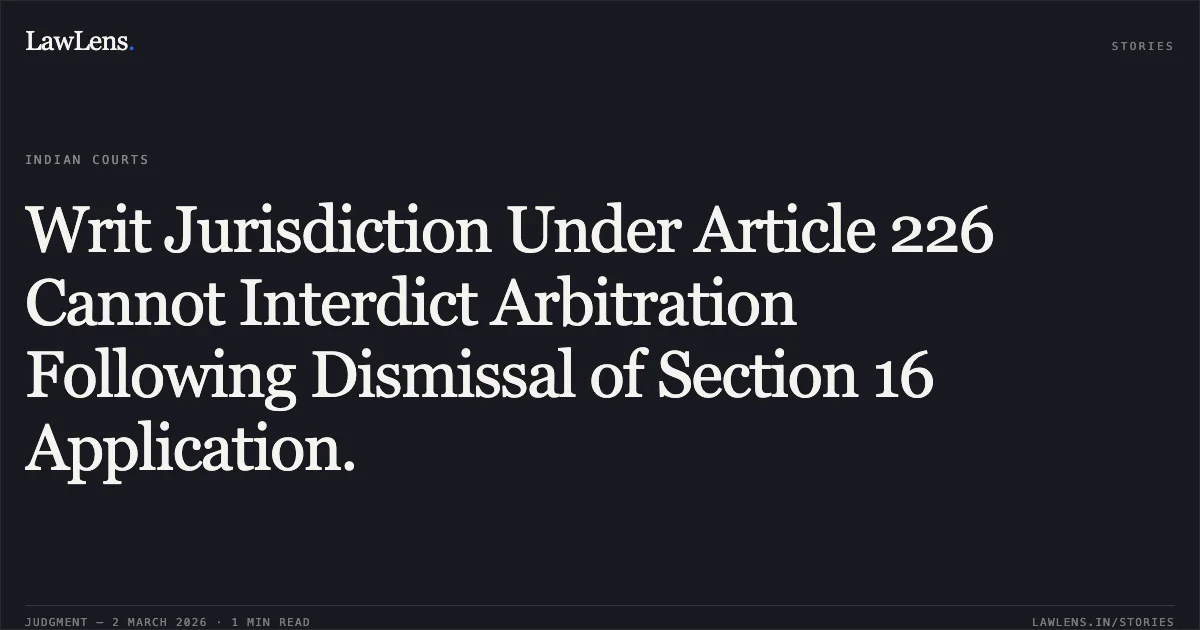
Whether the High Court should exercise its writ jurisdiction under Article 226 to interdict ongoing arbitration proceedings when a Section 16 application has already been dismissed by the Arbitrator.
Source reference: para. 9-11Whether the failure to conduct formal conciliation proceedings under the MSMED Act renders the subsequent arbitral reference void.
Source reference: para. 6-7Law Applied
The Court applied Section 18 of the Micro, Small and Medium Enterprises Development (MSMED) Act, 2006, regarding the procedure for dispute resolution
Source reference: para. 1It relied on Section 16 of the Arbitration and Conciliation Act, 1996, which empowers an Arbitral Tribunal to rule on its own jurisdiction (Competence-Competence principle)
Source reference: para. 8The Court followed the precedent in Corrtech International Pvt. Ltd. v. DIAC, which held that grievances regarding jurisdictional errors must be raised under Section 34 after the final award is passed
Source reference: para. 8Further, it applied the doctrine from Bhaven Construction v. Executive Engineer, Sardar Sarovar Narmada Nigam Ltd., establishing that judicial interference under Article 226/227 in arbitral matters is restricted to "exceptional circumstances" like patent lack of jurisdiction or manifest bad faith
Source reference: para. 10Reasoning
The Court observed that the MSEFC had recorded the Petitioner’s apparent lack of interest in conciliation on 27.05.2025 before making the reference
Source reference: para. 6It noted that the Arbitrator had already adjudicated upon the Petitioner’s jurisdictional objections via a Section 16 application, finding the challenge to the conciliation stage non-maintainable after termination of Section 18(2) proceedings
Source reference: para. 7The Court reasoned that since the Arbitration Act is a complete code, the Petitioner is not "remediless"; any grievance regarding the dismissal of the Section 16 application must await the final award and be challenged under Section 34
Source reference: para. 8The Court found no "exceptional circumstances" or "patent lack of jurisdiction" to justify bypassing the statutory machinery provided in the 1996 Act
Source reference: para. 9-10Holding
The Court dismissed the writ petition, holding that there was no ground to interdict the arbitral proceedings
It ruled that the Arbitral Tribunal is competent to decide its own jurisdiction and that High Courts must exercise restraint to ensure minimal judicial interference
Source reference: para. 10The Court granted the Petitioner liberty to agitate all jurisdictional issues at the appropriate stage under Section 34 of the Act
Source reference: para. 11Acts & Sections Cited
7 provisions across 2 statutes referred to in this judgment. Each provision opens on LawLens.
Arbitration and Conciliation Act, 19966
Micro, Small and Medium Enterprises Development Act, 20061
Original Court PDF
M/S Jindal Habitat Solutions Pvt. Ltd. v. Micro and Small Enterprises Facilitation Council & Ors. W.P.(C) 2631/2026
Click to open original judgment
Original judgment, available to read, download and summarize on LawLens.in