Facts
The petitioner was appointed by Opposite Party No. 3, a private limited company, pursuant to an offer letter dated 22 June 2012 and an appointment letter dated 9 July 2012. The appointment was governed by the company’s contractual terms, rules and disciplinary norms.
Source reference: para. 9Following an allegation of non-performance, the petitioner was issued a show-cause notice on 8 May 2016 and was thereafter terminated by order dated 15 May 2017.
Source reference: paras. 9.1–9.2He invoked Articles 226 and 227 of the Constitution seeking quashing of the termination order and reinstatement.
Source reference: paras. 4–6The respondents raised a preliminary objection that Opposite Party No. 3 was a private limited company, neither “State” under Article 12 nor otherwise amenable to writ jurisdiction in a purely contractual service dispute.
Source reference: paras. 4–6, 8–8.5The petitioner argued that Opposite Party No. 3 was subject to substantial governmental control because Bank of Baroda and Andhra Bank allegedly held 44% and 30% shares respectively, and that the company performed public functions by providing insurance coverage.
Source reference: paras. 7–7.1Issues
Whether Opposite Party No. 3, being a private limited company in which public-sector banks allegedly held substantial shares, was an instrumentality or agency of the Government and therefore “State” under Article 12 of the Constitution?
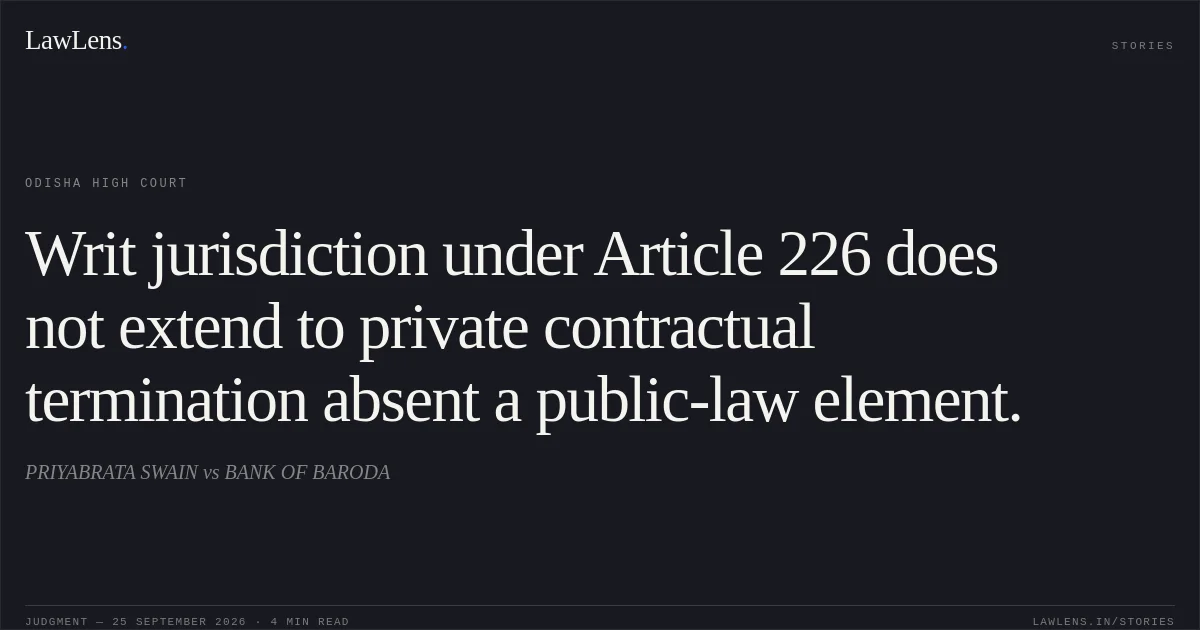
Source reference: paras. 5, 7–7.1, 9.3Whether a writ petition under Article 226 was maintainable against Opposite Party Nos. 3 and 4 in respect of the petitioner’s termination from employment under a private contract?
Source reference: paras. 4–6, 8.1–8.5, 9.2–9.4Law Applied
Article 226 confers a wider jurisdiction than Article 12 and permits writs against “any person or authority,” including a private body performing a public duty; however, mandamus remains a public-law remedy and cannot ordinarily be used to enforce a purely private contract.
Source reference: Andi Mukta Sadguru v. V.R. Rudani, paras. 17–20; Binny Ltd. v. V. Sadasivan, paras. 29, 32Under Ajay Hasia v. Khalid Mujib Sehravardi, Ramana Dayaram Shetty v. International Airport Authority of India, and Pradeep Kumar Biswas, the determination of whether a body is “State” depends cumulatively upon factors such as governmental ownership, financial assistance, monopoly status, deep and pervasive governmental control, public importance of its functions, and transfer of governmental functions; mere regulatory control or some governmental nexus is insufficient.
Source reference: paras. 7.2, 8.8, 8.11Balmer Lawrie & Co. Ltd. v. Partha Sarathi Sen Roy similarly requires financial, functional and administrative domination by the Government, with control that is particular, deep and pervasive rather than merely regulatory.
Source reference: para. 7.5The Court also relied on Federal Bank Ltd. v. Sagar Thomas, holding that private commercial entities are ordinarily not amenable to writ jurisdiction in employment disputes absent violation of a statutory obligation or the existence of a public-law element.
Source reference: para. 8.12St. Mary’s Education Society and Dillip Kumar Pandey distinguish public functions generally performed by an institution from private contractual service disputes involving its employees.
Source reference: para. 8.11Reasoning
The Court held that the petitioner’s employment originated solely from the offer and appointment letters issued by Opposite Party No. 3 and was governed by the company’s own contractual rules and disciplinary norms.
Source reference: paras. 9–9.2Although the petitioner relied on the shareholding of Bank of Baroda and Andhra Bank and asserted that the company performed a public function, the Court found no material establishing governmental control over the company’s management, employment decisions, payroll, funds or disciplinary proceedings.
Source reference: paras. 8.1–8.5, 9.1The company retained operational independence, and the termination was an internal employment action based on alleged non-performance after issuance of a show-cause notice.
Source reference: paras. 8.1–8.5, 9.1Applying the cumulative-control test under Ajay Hasia, Ramana Dayaram Shetty, Pradeep Kumar Biswas and Balmer Lawrie, the Court concluded that Opposite Party No. 3 was not financially, functionally or administratively dominated by the Government and was not an instrumentality or agency of the State.
Source reference: para. 9.3Further, even assuming that the company’s business involved a public-facing or socially relevant activity, the impugned termination had no direct public-law element and concerned only a private contract of employment.
Source reference: paras. 8.13, 9.2–9.4Consequently, Article 226 could not be invoked to challenge the termination.
Source reference: paras. 8.13, 9.2–9.4Holding
The Court answered both issues against the petitioner.
Opposite Party No. 3 was held to be a private limited company, not “State” under Article 12, and not subject to writ jurisdiction in relation to the petitioner’s contractual termination.
Source reference: para. 9.3Since the termination order was issued pursuant to the private employment contract and did not involve breach of any statutory or public-law obligation, no writ could be issued against Opposite Party Nos. 3 and 4 under Article 226.
Source reference: para. 9.4The maintainability issue was accordingly decided against the petitioner, and the matter was directed to be listed for orders in the week commencing 28 September 2026.
Source reference: para. 10Acts & Sections Cited
6 provisions across 4 statutes referred to in this judgment. Each provision opens on LawLens.
Air (Prevention and Control of Pollution) Act, 19811
General Insurance Business (Nationalisation) Act, 19723
Banking Regulation Act, 19491
Indian Contract Act, 18721
Original Court PDF
PRIYABRATA SWAINvsBANK OF BARODA
Click to open original judgment
Original judgment, available to read, download and summarize on LawLens.in