Facts
The Petitioner, a proprietorship firm, was awarded four contracts via the GeM portal by the Water Resources Department, Chhattisgarh, for works in District Bemetara.
Source reference: para 3The Petitioner claims to have completed all works by March 2025, which were subsequently verified and certified as satisfactory by the Collector/DMFT Bemetara.
Source reference: para 4Despite completion and internal departmental communications acknowledging the requirement to release funds (Memorandums dated 14.05.2025 and 05.01.2026), the Respondents failed to pay the balance amount of ₹2,09,34,955.20.
Source reference: paras 5-6The Petitioner approached the High Court under Article 226 of the Constitution seeking a writ of mandamus for the release of admitted dues and interest.
Source reference: para 2Issues
1. Whether a writ petition under Article 226 is maintainable for the recovery of money and enforcement of contractual rights against the State when an alternative remedy exists.
Source reference: para 9-102. Whether the non-payment of certified contractual dues by the State constitutes an administrative lapse actionable under extraordinary jurisdiction.
Source reference: para 11Law Applied
The Court applied the established principle that disputes arising out of the enforcement of contractual rights and the recovery of monetary dues are essentially civil disputes.
Source reference: para 10Relying on the doctrine of alternative remedy, the Court held that Article 226 is intended for the enforcement of statutory or constitutional rights rather than the adjudication of contractual claims requiring evidentiary examination.
Source reference: para 10The Court further noted that for a writ to lie in contractual matters, there must be a breach of a statutory duty distinct from the contract itself.
Source reference: para 11Reasoning
The Court reasoned that the Petitioner’s claim is founded entirely on contractual terms, GeM guidelines, and the physical completion of work.
Source reference: para 9Although the Petitioner alleged the liability was "admitted" due to internal departmental correspondence, the Court observed that the determination of the extent of liability and the impact of GeM contractual terms are matters requiring a detailed examination of evidence.
Source reference: para 11The Court found that the Petitioner failed to demonstrate any "exceptional circumstance" or a breach of a public law duty that would warrant bypassing the civil courts.
Source reference: para 11The mere allegation of financial hardship or administrative delay in fund allocation does not transform a private law contractual dispute into a public law issue amenable to writ jurisdiction.
Source reference: para 11Holding
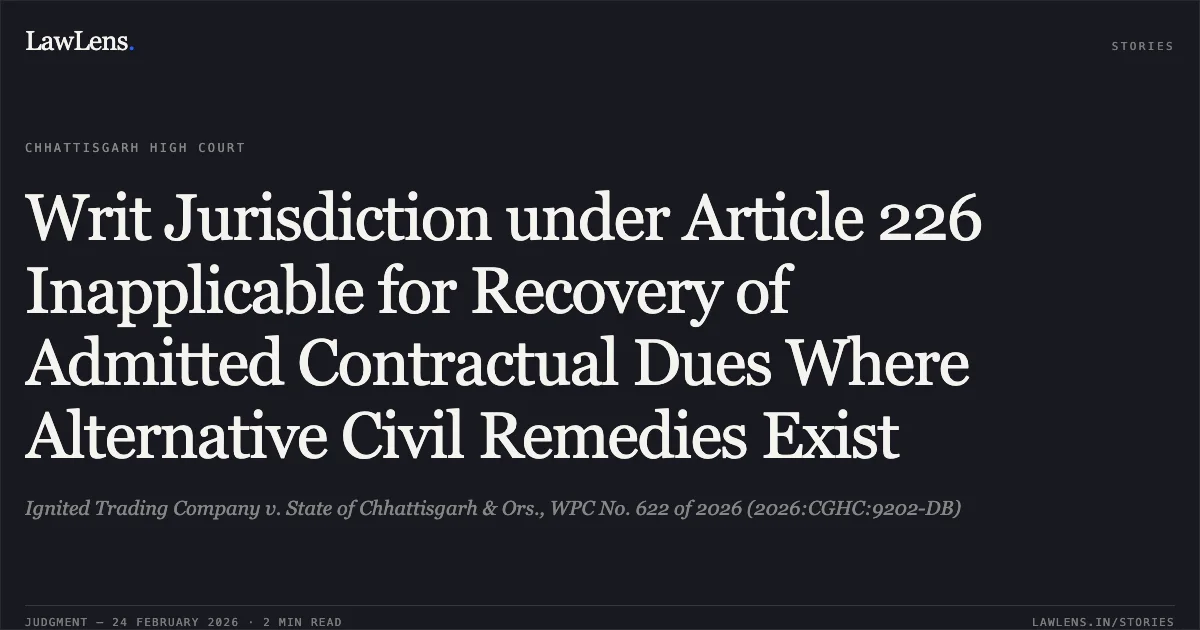
The Court held that the writ petition is not maintainable due to the availability of an efficacious alternative remedy.
The petition was dismissed, granting the Petitioner liberty to approach the competent civil court or appropriate forum for recovery of dues.
Source reference: para 13The Court clarified that it expressed no opinion on the merits of the Petitioner's claim.
Source reference: para 14No order as to costs.
Source reference: para 14Acts & Sections Cited
1 provisions across 1 statute referred to in this judgment. Linked provisions open on LawLens.
the contract (alias, unresolved)1
Original Court PDF
Ignited Trading Company v. State of Chhattisgarh & Ors., WPC No. 622 of 2026 (2026:CGHC:9202-DB)
Click to open original judgment
Original judgment, available to read, download and summarize on LawLens.in