01Facts
The petitioner, an LED lighting manufacturer and GeM vendor, received an order on 14.02.2026 from Respondent No. 2 for supply, installation and commissioning of high mast lighting in a hazardous area of a Maharashtra pipeline network, valued at ₹61,36,000.
¶ 2The contract provided an eight-month completion period: material delivery within five months, followed by installation, testing and commissioning.
¶ 2Respondent No. 2 terminated the contract by letter dated 26.09.2026, citing non-submission of engineering drawings, incomplete soil bearing capacity investigations, and failure to meet supply and execution milestones despite reminders.
¶ 2 · ¶ 5Respondent No. 2 then raised an incident on the GeM portal for non-delivery following a contract exceeding ₹10 lakh, and Respondent No. 1 imposed a temporary moratorium on the petitioner's account from 17.11.2026 to 16.01.2027.
¶ 2The petitioner contended that the stipulated completion date was 14.10.2026, that termination was premature, and that over 75% of the work had been executed.
¶ 3Respondent No. 2 disputed this, asserting that physical progress stood at 0% and that the petitioner had not submitted structural drawings or completed mandatory soil testing at one location.
¶ 5The petitioner sought quashing of the termination and of the suspension order.
¶ 102Issues
i.1. Whether the High Court should exercise its writ jurisdiction under Article 226 to adjudicate the legality of the contract termination, where the dispute turns on contractual interpretation, performance and disputed questions of fact.
¶ 4 · ¶ 6 · ¶ 8ii.2. Whether the consequential temporary moratorium imposed by Respondent No. 1 under the Incident Management Policy warrants interference in writ jurisdiction, given that it derives from the contractual dispute and the policy provides its own remedies.
¶ 7 · ¶ 903Law Applied
The court relied on Article 226 of the Constitution of India, which confers discretionary writ jurisdiction. It held that this jurisdiction is not ordinarily exercised to adjudicate disputes arising out of contractual obligations, particularly where resolution requires disputed factual findings or appreciation of evidence.
¶ 8The court relied on the GeM Incident Management Policy, which provides that administrative action taken thereunder does not curtail the contractual remedies available to buyers and sellers, and which prescribes a rectification mechanism and, subject to conditions, an appeal against temporary moratoriums.
¶ 7No precedent was cited in the judgment.
04Reasoning
The court held that the dispute involved multiple contested questions: the actual extent of work executed, whether completing soil testing at three of four locations amounted to substantial compliance, whether non-submission of drawings constituted contractual default, and whether any delay was attributable to the petitioner or to external factors such as site access and clearances.
¶ 6Resolving these questions required examination of contractual documents, correspondence, technical records and evidence, which the court deemed unsuitable for Article 226 review.
¶ 6The court noted that the petitioner's claim of over 75% progress and a 14.10.2026 completion date was directly contested by the respondent's assertion of 0% progress.
¶ 5On the suspension, the court observed that the moratorium arose from the alleged non-delivery and cancellation of the same contract, so it could not be assessed independently of the contractual dispute.
¶ 7Because the Incident Management Policy provides a rectification process and an appeal against moratoriums, the petitioner had an effective alternative remedy.
¶ 705Holding
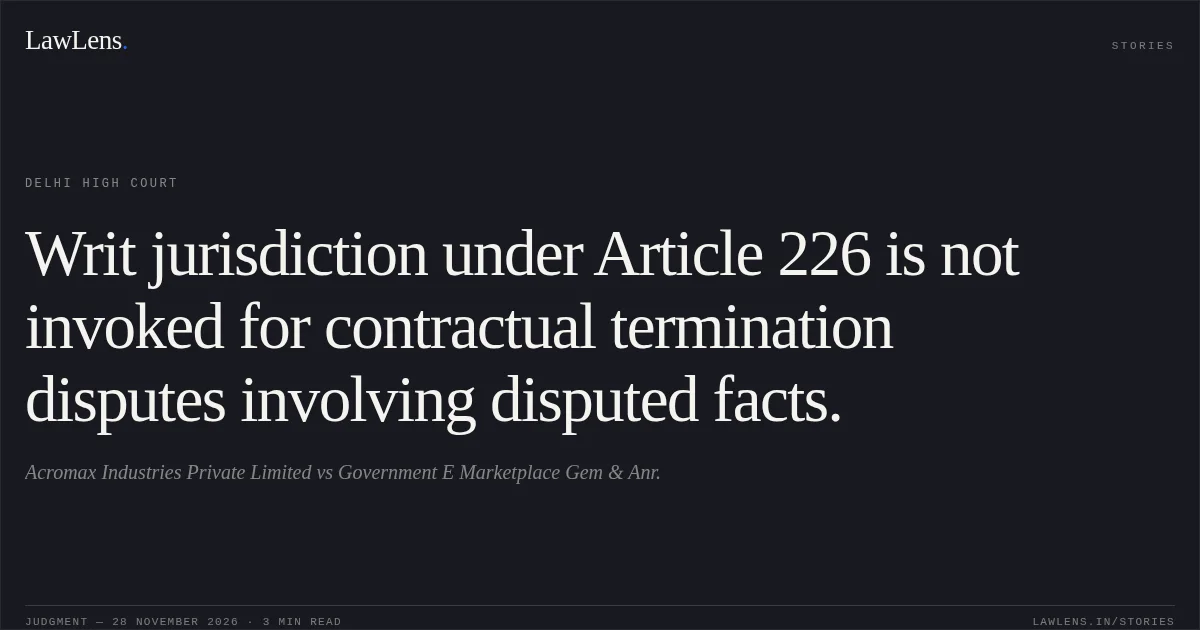
The court held that the petition, which raises disputed contractual and factual questions, does not warrant writ jurisdiction under Article 226.
¶ 8 · ¶ 9The petition is dismissed. The petitioner is at liberty to pursue appropriate remedies in accordance with law, including the policy-based rectification and appeal mechanism. The court expressly clarified that nothing in the order constitutes an adjudication on the merits, and pending applications are disposed of.
¶ 7 · ¶ 9 · ¶ 10 · ¶ 11 · ¶ 12Original Court PDF
Acromax Industries Private LimitedvsGovernment E Marketplace Gem & Anr.
Click to open original judgment
Original judgment, available to read, download and summarize on LawLens.in