Facts
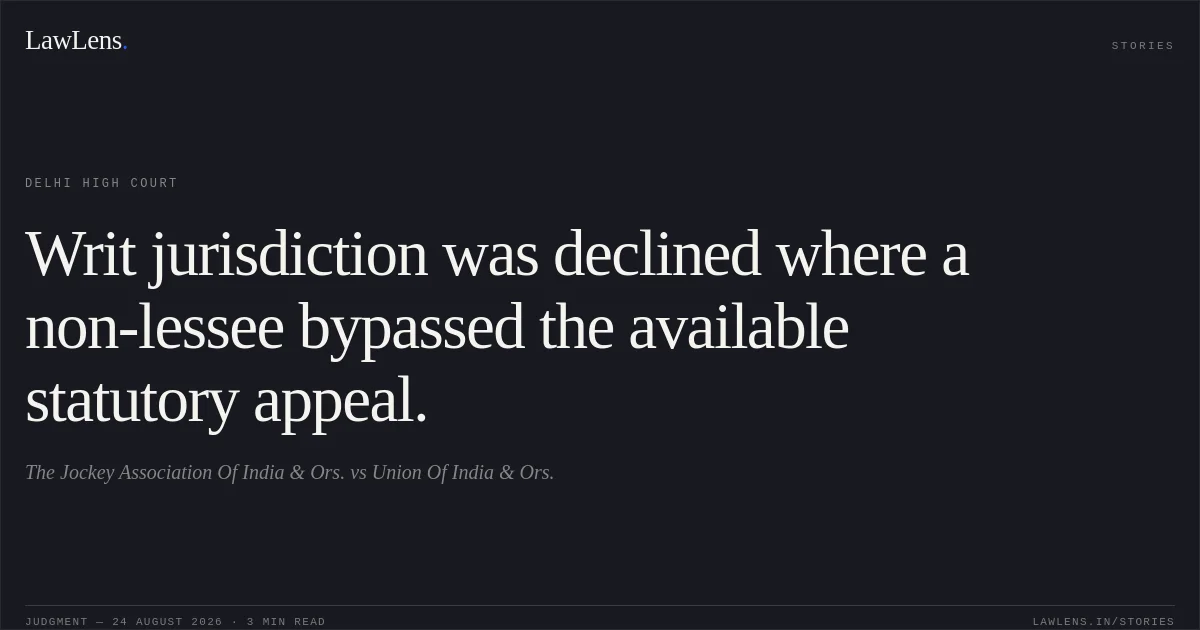
The Petitioners filed a writ petition under Article 226 of the Constitution challenging an eviction order dated 11.08.2026 passed by Respondent No. 2 under Section 5(1) of the Public Premises (Eviction of Unauthorised Occupants) Act, 1971 (“the Act”).
Source reference: p.1, para. 1The challenge principally concerned the eviction order, while the remaining reliefs were stated to be consequential.
Source reference: p.2, paras. 2–5The Petitioners relied on the alleged impact of the order on the welfare and care of horses, jockeys, and staff, and contended that the writ petition was maintainable despite the statutory appellate remedy.
Source reference: p.2, paras. 3–6The Union of India and Respondent No. 2 objected that the Petitioners lacked locus because the order had been passed against Delhi Race Club, Respondent No. 3, which was the original lessee.
Source reference: p.3, paras. 7–8They further submitted that Delhi Race Club had already filed an appeal under Section 9 of the Act.
Source reference: p.3, paras. 7–8The Petitioners were given liberty, if otherwise permissible in law, to avail themselves of the Section 9 remedy.
Source reference: p.5, para. 18Issues
Whether the High Court should exercise its extraordinary jurisdiction under Article 226 when the Act provides a specific statutory appellate remedy against an order under Section 5, and that remedy has already been invoked by the original lessee.
Source reference: p.4, paras. 12–16Whether the Petitioners, not being the original lessee against whom the eviction order was passed, had the requisite locus to maintain the writ petition.
Source reference: p.5, para. 17Law Applied
The Court applied Article 226 of the Constitution, recognising that the existence of an alternative remedy is not an absolute bar to writ jurisdiction.
Source reference: p.2, para. 4; p.4, para. 15It relied on the principle stated in Whirlpool Corporation v. Registrar of Trade Marks, Mumbai, (1998) 8 SCC 1, that the High Court may exercise writ jurisdiction notwithstanding an alternative remedy where the circumstances warrant interference.
Source reference: p.2, para. 4; p.4, para. 15However, the Court held that such jurisdiction should not ordinarily be invoked to bypass an available statutory mechanism absent a compelling circumstance.
Source reference: p.4, para. 16Under Sections 5(1) and 9 of the Public Premises (Eviction of Unauthorised Occupants) Act, 1971, an eviction order may be passed against an unauthorised occupant and is subject to a statutory appeal, respectively.
Source reference: p.1, para. 1; p.3, para. 8Reasoning
The Court found that the eviction order was directed against Delhi Race Club, the original lessee, and not against the Petitioners.
Source reference: p.4, para. 13Delhi Race Club had already invoked the statutory appellate remedy under Section 9, demonstrating that the statutory mechanism was available and operative.
Source reference: p.4, paras. 13–14Although the Court acknowledged that Article 226 jurisdiction could be exercised despite an alternative remedy, the Petitioners failed to show any compelling circumstance justifying intervention.
Source reference: p.4, paras. 15–17The Petitioners’ asserted concerns regarding horses, jockeys, and staff did not overcome the availability of the statutory appeal.
Source reference: no citationFurther, as the Petitioners were not the lessees, they prima facie lacked locus to challenge the eviction order, and any dispute between the Petitioners and Delhi Race Club could not properly be converted into a writ challenge to that order.
Source reference: p.5, para. 17Holding
The Court declined to exercise its writ jurisdiction and dismissed the petition, along with the pending applications.
It held, prima facie, that the Petitioners lacked locus to maintain the writ petition and that no compelling circumstance existed to bypass the statutory appellate remedy.
Source reference: p.5, para. 17The Petitioners were granted liberty, if so advised and otherwise permissible in law, to pursue the remedy under Section 9 of the Act; the question of their locus or entitlement to maintain such an appeal was left open for determination by the competent appellate authority.
Source reference: p.5, para. 18The Court expressly clarified that it had not adjudicated the merits of the underlying dispute.
Source reference: p.5, para. 19Acts & Sections Cited
3 provisions across 1 statute referred to in this judgment. Linked provisions open on LawLens.
Public Premises (Eviction of Unauthorised Occupants) Act, 19713
Original Court PDF
The Jockey Association Of India & Ors.vsUnion Of India & Ors.
Click to open original judgment
Original judgment, available to read, download and summarize on LawLens.in