Facts
The petitioner, a permanent employee of LIC Housing Finance Ltd. (“LICHFL”), was appointed in 2004 and was serving as Cluster Head, Guwahati Cluster. He alleged that, owing to his whistle-blower complaints concerning corruption and irregularities, he was subjected to victimisation, including punitive transfers and adverse service remarks.
Source reference: para. 2–3By transfer order dated 24 May 2025, the petitioner was transferred from Cluster Head, Guwahati, to Credit Manager, Kolkata Cluster, with the remark “Non-performance”. He contended that the transfer violated the company’s transfer guidelines and that the remark was stigmatic and punitive.
Source reference: para. 4The petitioner initially approached the High Court, withdrew the writ petition, and then instituted proceedings before the Labour Court under Sections 2A and 33 of the Industrial Disputes Act, 1947. The Labour Court stayed the transfer order.
Source reference: para. 5LICHFL challenged that order before the High Court in W.P.(C) No. 4693/2025, which was allowed on 29 January 2026; the Labour Court proceedings were quashed and the petitioner was directed to approach the competent civil court, with status quo being directed for ten days.
Source reference: para. 6, 20Instead of approaching the civil court, the petitioner filed the present writ petition challenging the original transfer order and the subsequent order dated 25 June 2025, by which he was redesignated and posted as Credit Manager, Guwahati Cluster.
Source reference: para. 7He alleged that this amounted to reduction in rank and a punitive demotion without disciplinary proceedings or an opportunity of hearing. LICHFL disputed both the maintainability of the writ petition and the alleged demotion, contending that the petitioner remained in the same cadre and pay scale and had only ceased to receive an in-charge allowance.
Source reference: para. 8, 22–24Issues
Whether LIC Housing Finance Ltd. is amenable to the writ jurisdiction of the High Court under Article 226, either as “State” under Article 12 or as a private entity discharging public duties.
Source reference: para. 11, 19, 24–26Whether the transfer and posting orders, including the “Non-performance” remark and alleged reduction from Cluster Head to Credit Manager, were punitive, stigmatic, arbitrary, or contrary to the petitioner’s legally protected rights.
Source reference: para. 7, 25–26Whether the High Court ought to interfere with the impugned service orders when the petitioner had already been directed by a Coordinate Bench to approach the competent civil court.
Source reference: para. 20–23, 25–27Law Applied
The Court applied the principle that Article 226 is wider than Article 32 and is not confined to entities falling within Article 12; a writ may issue against a private body where it performs public functions or is subject to a public duty involving a public-law element.
Source reference: para. 17–19Relying on Ajay Hasia v. Khalid Mujib Sehravardi, (1981) 1 SCC 722, and the instrumentalities-of-State doctrine, the Court noted that State control, ownership, financial assistance, and functional character are relevant to Article 12 status, although Article 12 status does not automatically attract Articles 309–311.
Source reference: para. 15–16The Court relied on Board of Control for Cricket in India v. Cricket Association of Bihar, (2015) 3 SCC 251, and Zee Telefilms Ltd. v. Union of India, (2005) 4 SCC 649, for the proposition that even a non-State body may be subject to judicial review where it performs public functions.
Source reference: para. 17The Court further applied Federal Bank Ltd. v. Sagar Thomas, (2003) 10 SCC 733, and S. Shobha v. Muthoot Finance Ltd., 2025 SCC OnLine SC 177, holding that a private company is ordinarily not amenable to mandamus in service matters unless a statutory or public duty and a public-law element are established.
Source reference: para. 18–19The Court also considered Vivek V. v. LIC Housing Finance Ltd., 2025 KER 67382, where LICHFL was held amenable to writ jurisdiction, and Rajasthan SRTC v. Krishna Kant, (1995) 5 SCC 75, concerning the appropriate civil forum for service-related disputes.
Source reference: para. 14, 20Reasoning
The Court held that the question of writ amenability must be decided by applying the “function test”, considering the nature of the entity’s functions, the source of the power exercised, and the effect of the impugned action on legally protected rights.
Source reference: para. 19, 24–25It was therefore not sufficient to reject the petition merely because LICHFL might not strictly qualify as “State” under Article 12.
Source reference: para. 19, 24–25However, the transfer guidelines were internal company guidelines and were not derived from any government notification, statutory rule, or RBI directive.
Source reference: para. 25The alleged demotion also required factual examination of the respective duties, responsibilities, salary structure, cadre position, and status of Cluster Head and Credit Manager; the fact that both posts carried the same cadre or pay scale was not, by itself, conclusive.
Source reference: para. 25Such factual adjudication and evidentiary assessment were more appropriately undertaken by a civil court.
Source reference: para. 25Further, the Coordinate Bench had already quashed the Labour Court proceedings and expressly directed the petitioner to approach the competent civil court. The petitioner neither challenged that order nor explained his failure to follow that direction.
Source reference: para. 21–26Although the Court accepted that a writ petition against LICHFL could be maintainable in principle, the petitioner failed to establish a public duty or infringement of a legally protected right warranting constitutional intervention in the present service dispute.
Source reference: para. 26–27Holding
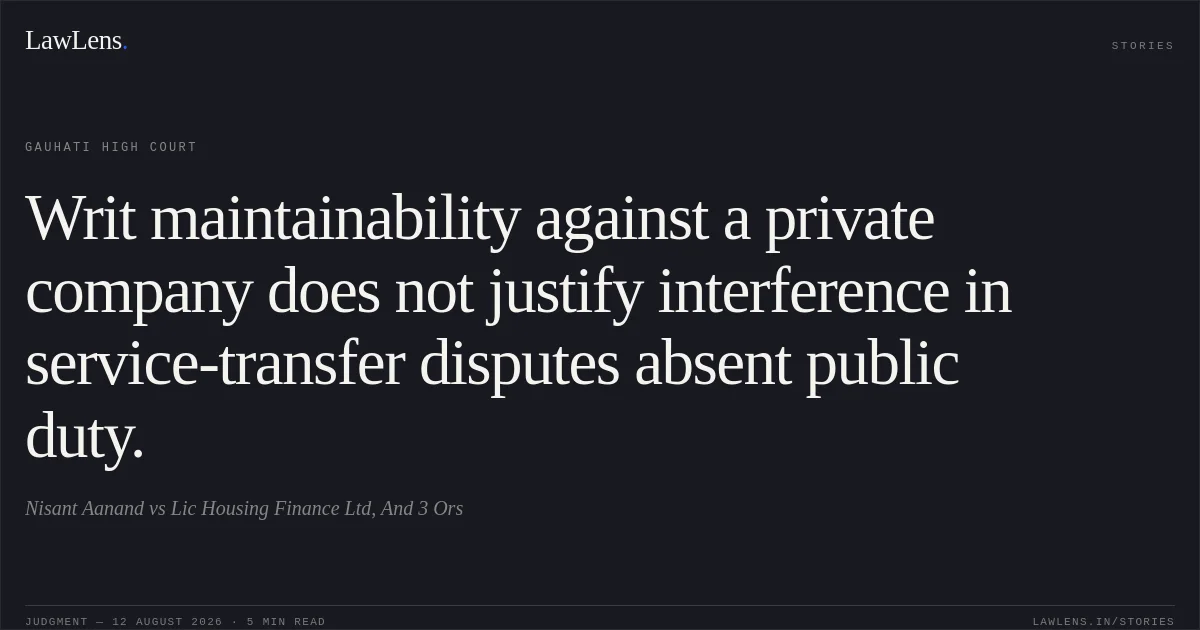
The Court held that a writ against LICHFL is maintainable in principle under Article 226 where the requisite public-law element is shown, notwithstanding the dispute regarding its status under Article 12.
Nevertheless, it declined to interfere with the transfer and posting orders because the petitioner’s claims involved disputed questions of fact, an alleged breach of internal service guidelines, and issues requiring evidence before the competent civil court.
Source reference: para. 27The writ petition was disposed of, with liberty to the petitioner to approach the civil court.
Source reference: para. 27–28The interim protection granted by the High Court was extended for fifteen days from the date of judgment, and no order as to costs was made.
Source reference: para. 27–28Acts & Sections Cited
4 provisions across 1 statute referred to in this judgment. Linked provisions open on LawLens.
Industrial Disputes Act, 19474
Original Court PDF
Nisant AanandvsLic Housing Finance Ltd, And 3 Ors
Click to open original judgment
Original judgment, available to read, download and summarize on LawLens.in