Facts
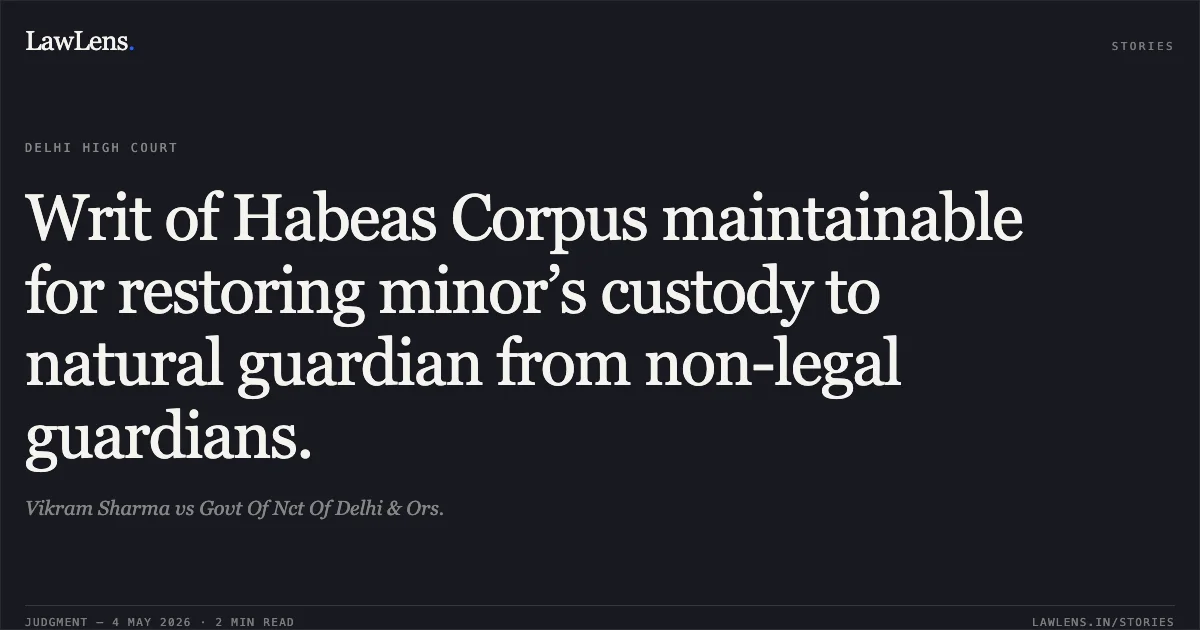
The Petitioner, father of a minor girl (Ms. XXX, aged 1.5 years), sought a Writ of Habeas Corpus for her custody from the maternal grandparents and uncle (Respondents 4-6)
Source reference: p. 1-2The child’s mother committed suicide on 24.09.2025, leading to an FIR against the Petitioner under Section 80/3(5) of the Bharatiya Nyaya Sanhita (BNS)
Source reference: p. 2The Petitioner was arrested and later released on bail on 13.01.2026
Source reference: p. 2Following his release, he attempted to regain custody through police complaints and applications under Section 100/175(3) of the Bharatiya Nagarik Suraksha Sanhita (BNSS) before the Magistrate, but eventually approached the High Court
Source reference: p. 2-3Respondents contended that a writ is not a substitute for regular custody proceedings and argued that the Petitioner's involvement in the criminal case rendered him unfit
Source reference: p. 3-4Issues
1. Whether a Writ of Habeas Corpus is maintainable for the restoration of a minor's custody when the detention is by a non-natural guardian
Source reference: p. 4, para. 82. Whether the pendency of a criminal case involving the mother's suicide automatically disqualifies the father from obtaining custody of the child under the principles of welfare of the child
Source reference: p. 5-8Law Applied
The court applied Section 6 of the Hindu Minority and Guardianship Act, 1956, which designates the father as the natural guardian
Source reference: p. 8, para. 15It relied on Tejaswini Gaud v. Shekhar Jagdish Prasad Tewari (2019), establishing that Habeas Corpus is maintainable in exceptional cases where child custody is illegally held by someone not entitled to it
Source reference: p. 4, para. 8The court further applied the parens patriae jurisdiction principle from Nil Ratan Kundu v. Abhijeet Kundu (2008), emphasizing that the "welfare of the child" is the paramount consideration, overriding statutory rights
Source reference: p. 5-6Reasoning
The Court observed that the Petitioner is the natural and legal guardian under personal law
Source reference: p. 8Regarding maintainability, it held that while alternate remedies exist under the Guardians and Wards Act, a writ court can act in summary nature in exceptional circumstances
Source reference: p. 4-5On the merits, the Court analyzed the bail order which noted that the deceased had pre-existing suicidal thoughts and that "general allegations" of dowry were not supported by specific evidence "soon before death"
Source reference: p. 7-8Unlike the precedents cited by Respondents (Shaurya Gautam), where fathers faced murder charges, here the Petitioner had a prima facie favorable judicial observation regarding his character and the circumstances of the suicide
Source reference: p. 8The Court determined that since the child was too young to express a preference, "nature’s law" and the Petitioner’s status as a natural guardian made him better suited for her welfare
Source reference: p. 9Holding
The Court allowed the petition, holding that the Petitioner is entitled to custody as the natural guardian
The Court directed Respondents 4-6 to hand over the child forthwith
Source reference: p. 9It granted the Respondents "unrestricted visitation rights" every Saturday between 11 AM and 6 PM as an interim arrangement
Source reference: p. 9Liberty was reserved for the Respondents to seek modification if the FSL report or criminal trial reveals new incriminating evidence, such as the forgery of the deceased's diary
Source reference: p. 8-9Acts & Sections Cited
1 provisions across 1 statute referred to in this judgment. Each provision opens on LawLens.
Hindu Minority and Guardianship Act, 19561
Original Court PDF
Vikram SharmavsGovt Of Nct Of Delhi & Ors.
Click to open original judgment
Original judgment, available to read, download and summarize on LawLens.in