Facts
The petitioner, representing a society of 15 refugee fisherman families (Lal Saraiya Fishermen Refugees Co-operative Society) settled from East Pakistan in 1956, sought preferential settlement of the "Karmawa Man Jalkar".
Source reference: para. 2-3While the families historically held the Jalkar without rent, the State later imposed a "reserved jama" (rent) from 1985 onwards.
Source reference: para. 4In 2010, following the amendment of Section 11-B of the Bihar Cooperative Societies Act, 1933, the State mandated that all block-level fisheries societies merge into a single entity.
Source reference: para. 17-18The Department subsequently began settling the Jalkar with the "Majhaulia Prakhand Matsyajivi Sahyog Samiti Ltd." (Respondent Nos. 8 9) under the Bihar Fish Jalkar Water Management Act, 2006.
Source reference: para. 14, 21The petitioner challenged this, claiming a legitimate expectation based on their status as refugees and their 50-year history of fishing the Jalkar.
Source reference: para. 12, 22Issues
1. Whether the petitioner possesses an enforceable legal right to demand the settlement of the Jalkar in their favor based on historic refugee status and past executive communications.
Source reference: para. 25, 272. Whether an expired contractual settlement creates a vested right for renewal or fresh settlement.
Source reference: para. 29, 333. Whether the State’s decision to settle the Jalkar with a block-level cooperative society instead of the refugee society was arbitrary or contrary to law.
Source reference: para. 15, 34Law Applied
A writ of mandamus requires a subsisting legal right and a corresponding statutory duty, as established in Union of India v. S.B. Vohra.
Source reference: para. 27Lease renewal is a fresh grant and not a vested right unless provided by statute, as held in State of U.P. v. Lalji Tandon.
Source reference: para. 33The distribution of State property (largesse) must be fair, equitable, and governed by transparent policies under Article 14, as emphasized in Akhil Bhartiya Upbhokta Congress v. State of Madhya Pradesh.
Source reference: para. 34-35Executive instructions cannot override statutory rules or create enforceable rights, as established in Sant Ram Sharma v. State of Rajasthan.
Source reference: para. 37Reasoning
The court reasoned that the petitioner’s claim rested solely on executive communications from 1995 and 2001 and a 1956 settlement, none of which create a perpetual or statutory right to the Jalkar.
Source reference: para. 28The court noted that any settlement granted in 2008 had expired by "efflux of time," meaning the petitioner had no legal basis to demand a renewal.
Source reference: para. 29, 33The court observed that statutory changes in 2010 (Section 11-B of the Bihar Cooperative Societies Act) reorganized societies into single block-level entities, effectively making the petitioner's specific refugee society ineligible for exclusive settlement over the block-level society.
Source reference: para. 17-18Since the Jalkar is government property, its settlement must strictly follow the Bihar Fish Jalkar Water Management Act and Article 14; the court cannot direct allotment to a specific group based on historical preference when it contradicts current statutory frameworks.
Source reference: para. 34, 38Holding
The court held that the petitioner failed to establish any enforceable legal or statutory right to the settlement of the Jalkar.
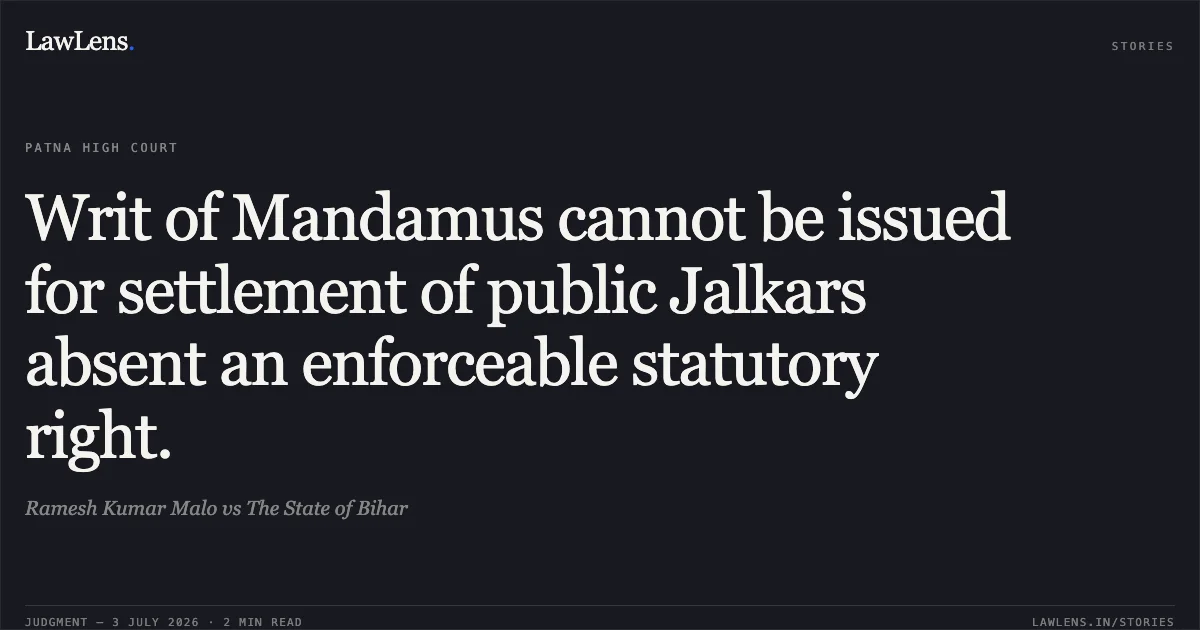
The court dismissed the writ application, affirming that the Department’s actions in settling the Jalkar with the block-level society (Respondent No. 8) were in accordance with the law.
Source reference: para. 38-39Acts & Sections Cited
1 provisions across 1 statute referred to in this judgment. Linked provisions open on LawLens.
Bihar Fish Jalkar Management Act, 20061
Original Court PDF
Ramesh Kumar MalovsThe State of Bihar
Click to open original judgment
Original judgment, available to read, download and summarize on LawLens.in