Facts
The Petitioner, a life member of the Indian Sociological Society (ISS) [Respondent No. 1], contested the 2025 election for the post of Secretary.
Source reference: p. 3During the online voting process managed by Respondent No. 5, a technical audit identified "malicious actors" attempting multiple voting using automated scripts.
Source reference: p. 3, 18Although preliminary data shared in a Zoom meeting on 19th November 2025 showed the Petitioner had the highest votes, the Election Committee withheld the results and constituted an Enquiry Committee.
Source reference: p. 4, 16The Enquiry Committee found the Petitioner guilty of using malicious bots to cast fraudulent votes.
Source reference: p. 18Consequently, the Managing Committee cancelled the Petitioner’s candidature, debarred him from contesting elections for ten years, and removed him as a Research Committee Convenor.
Source reference: p. 4These decisions were ratified by the General Body. The Petitioner challenged these actions via a writ petition.
Source reference: p. 1, 5, 19Issues
1. Whether the Respondent No. 1 society is "State" or an instrumentality thereof under Article 12, or performs public functions making it amenable to writ jurisdiction under Article 226 of the Constitution.
Source reference: p. 6 / para. 122. Whether the constitution of the Enquiry Committee and the subsequent punitive actions (debarment and cancellation of candidature) were arbitrary, ultra vires the Society’s Constitution, or in violation of natural justice.
Source reference: p. 5 / para. 9-10Law Applied
The court applied the "Public Function" test and the "Substantial Funding" test to determine amenability under Article 226.
Source reference: no citationS.D. Siddiqui v. University of Delhi, establishing that private bodies working for member welfare without deep State control are not "State".
Source reference: p. 10K.K. Saksena v. International Commission on Irrigation and Drainage, which requires substantial financing—typically more than the 7.92% received in this case.
Source reference: p. 11-12Ram Chandra Choudhary v. Roop Nagar Dugdh Utpadak Sahakari Samiti, holding that internal management and electoral disputes of societies do not attract writ jurisdiction.
Source reference: p. 13The Society's Bye-Laws (Rule 6 and 13), which grant the Election Committee final authority over the validity of votes.
Source reference: p. 17Reasoning
The court first determined that Respondent No. 1 is a private, self-funded autonomous body whose objects (promoting Sociology) do not constitute public functions or involve imparting education.
Source reference: p. 10Since government funding was negligible (7.92% ending in 2018-19), the society failed the "substantial finance" test.
Source reference: p. 12-13On merits, the court found the Petitioner's claim that results were "declared" on 19th November 2025 factually incorrect; only raw data was shared before formal examination of vote validity.
Source reference: p. 16-17The technical audit by Respondent No. 5 provided a forensic basis for finding the Petitioner used "malicious bots," which the Petitioner failed to rebut with expert evidence.
Source reference: p. 18The Court reasoned that the power to "conduct elections" under the Bye-Laws inherently includes the power to investigate malpractices.
Source reference: p. 18Finally, it held that the show cause notice adequately warned of "further disciplinary action," thus the 10-year debarment did not violate natural justice.
Source reference: p. 20Holding
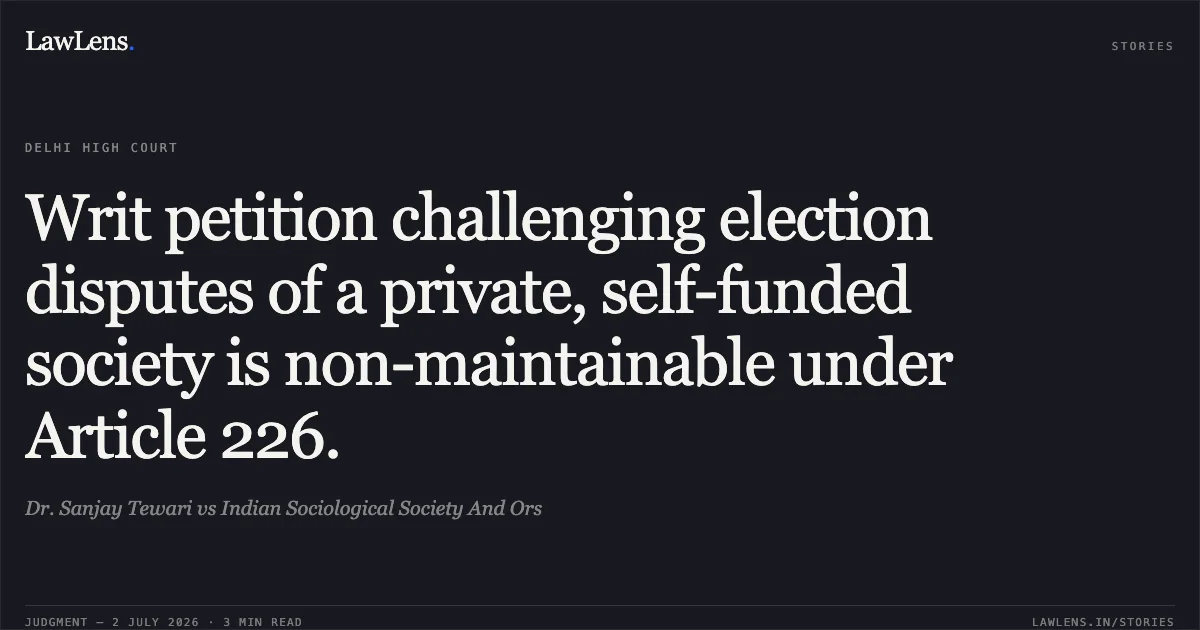
The Court dismissed the writ petition on grounds of both maintainability and merits.
It held that the ISS is not amenable to writ jurisdiction as it performs no public duty and lacks substantial State funding.
Source reference: p. 16The court upheld the cancellation of the Petitioner's candidature and his 10-year debarment, finding the actions were based on credible forensic evidence of election fraud and were within the administrative powers of the Society’s Managing and Election Committees. All interim orders were vacated.
Source reference: p. 18-20, 21Acts & Sections Cited
1 provisions across 1 statute referred to in this judgment. Each provision opens on LawLens.
Maharashtra Public Trusts Act.1
Original Court PDF
Dr. Sanjay TewarivsIndian Sociological Society And Ors
Click to open original judgment
Original judgment, available to read, download and summarize on LawLens.in