Facts
The petitioner filed a writ petition seeking to restrain Respondent No. 5 from performing the duties of President of the Municipal Council, Amarwada, and to declare all actions taken by said respondent since their election as non est
Source reference: para 1The challenge was predicated on the alleged lack of a mandatory Gazette Notification required for the President to legally assume office.
Source reference: para 1The petition was filed in 2026, approximately four years after the cause of action regarding the assumption of office first arose in 2022
Source reference: para 2-3Issues
1. Whether the writ petition is maintainable despite an inordinate delay of four years in approaching the Court
Source reference: para 3-42. Whether the principles of delay and laches apply to a challenge seeking a writ of quo warranto in the context of municipal elections
Source reference: para 3Law Applied
The extraordinary jurisdiction under Article 226 of the Constitution is discretionary and intended for diligent litigants rather than those who sleep over their rights
Source reference: para 2Vijay Singh vs. State of MP and others (W.P. No. 13156 of 2026), which established that even in matters concerning statutory mandates under the M.P. Municipalities Act, 1961 (Sections 19, 20, and 45), a petition can be dismissed if the delay leads to administrative chaos or the unsettling of established positions
Source reference: para 2Reasoning
The Court observed that the petitioner waited nearly four years to challenge the respondent's authority, during which time the respondent had already exercised significant administrative and financial powers
Source reference: para 2The Court reasoned that entertaining such a stale claim would cause significant prejudice to the functioning of the local body and lead to administrative instability
Source reference: para 2Although the petitioner argued that delay is not fatal in a writ of quo warranto, the Court rejected this distinction by aligning with the Gwalior Bench’s view that the discretionary nature of writ jurisdiction must account for the lapse of time and the resulting impact on public administration
Source reference: para 3Holding
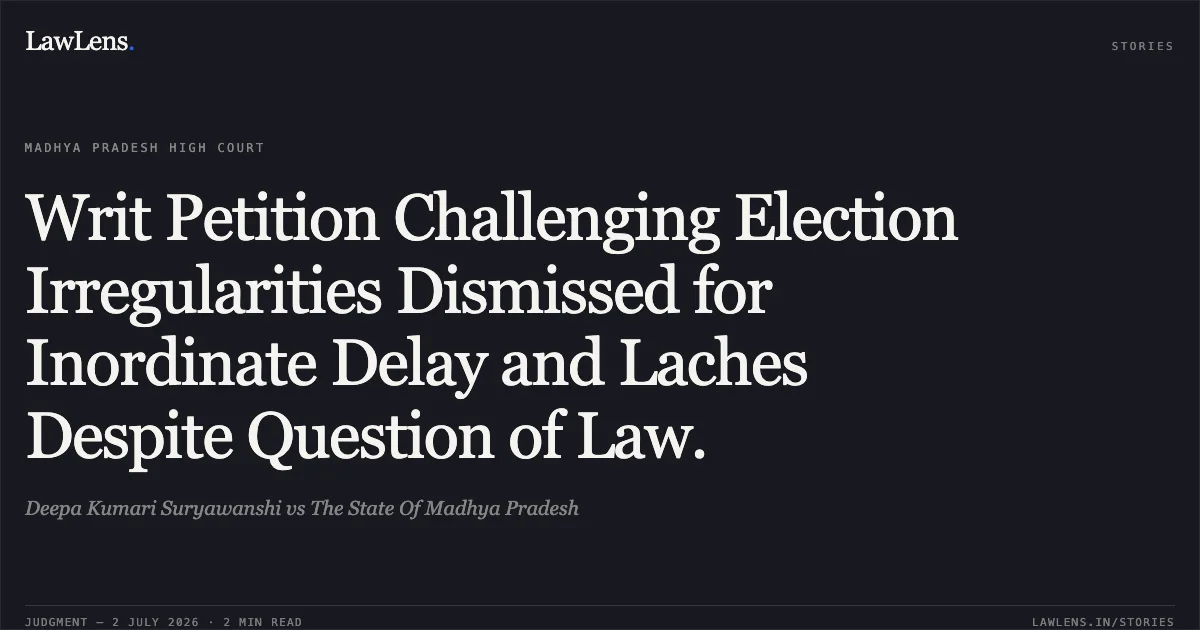
The Court held that the petition was barred by delay and laches and found no cogent explanation for the four-year lapse.
The writ petition was dismissed without an adjudication on the merits of the appointment.
Source reference: para 4Acts & Sections Cited
3 provisions across 1 statute referred to in this judgment. Linked provisions open on LawLens.
M.P. Municipalities Act, 19613
Original Court PDF
Deepa Kumari SuryawanshivsThe State Of Madhya Pradesh
Click to open original judgment
Original judgment, available to read, download and summarize on LawLens.in


