Facts
The petitioner, widow of Late Sita Ram Das, challenged allegedly excessive electricity bills issued in her deceased husband’s name. She asserted that electricity consumption at the premises was not commensurate with the substantially inflated bills, that her husband had paid approximately ₹35,000 per month from his pension towards the bills, and that she had paid more than ₹13 lakhs in total. She sought correction of the bills, action against responsible officials, and compensation with 8% interest.
Source reference: p. 1–2, para. 1During the proceedings, the respondents objected to the maintainability of the writ petition on the ground that the petitioner had an alternative and efficacious statutory remedy before the Consumer Grievances Redressal Forum under Section 42(5) of the Electricity Act, 2003.
Source reference: p. 2–3, paras. 2–4Issues
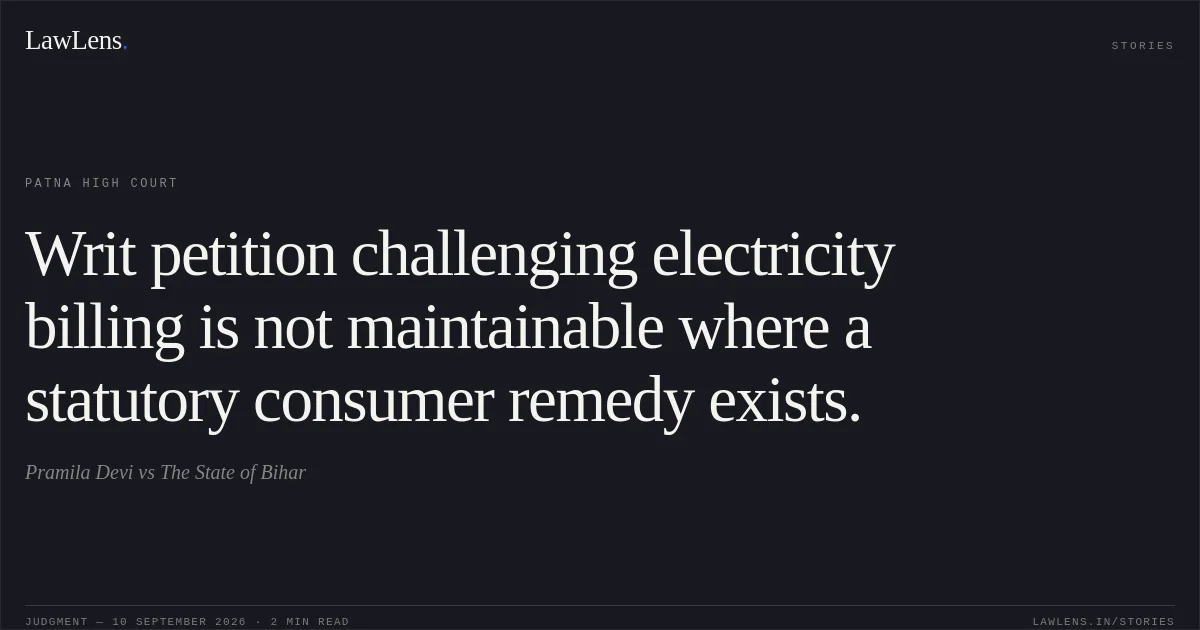
Whether the writ petition concerning disputed electricity bills was maintainable when the petitioner had an alternative and efficacious statutory remedy before the Consumer Grievances Redressal Forum under Section 42(5) of the Electricity Act, 2003.
Source reference: p. 3–4, paras. 6–7Whether the Court should examine the merits of the petitioner’s claims for bill correction, compensation, and action against officials in exercise of its writ jurisdiction.
Source reference: p. 4, paras. 7–8Law Applied
The Court applied Section 42(5) of the Electricity Act, 2003, which provides a statutory mechanism for an electricity consumer to approach the Consumer Grievances Redressal Forum for redressal of grievances.
Source reference: p. 2–4, paras. 2–7The Court followed the established principle that the High Court ordinarily should not entertain a writ petition where an alternative and efficacious statutory remedy is available, particularly in matters involving disputed electricity billing. It also relied on the orders of coordinate Benches in Shashi Bhushan Singh v. The State of Bihar & Ors., CWJC No. 4670 of 2023, and Ayodhya Nath Rai v. The State of Bihar & Ors., CWJC No. 7317 of 2026, where similar petitions were disposed of with liberty to pursue the statutory remedy.
Source reference: p. 2–4, paras. 2–7Reasoning
The Court considered the nature of the reliefs sought—correction of allegedly inflated electricity bills, compensation, and consequential action against officials—and held that these grievances fell within the jurisdiction of the Consumer Grievances Redressal Forum under Section 42(5) of the Electricity Act, 2003.
Source reference: p. 3–4, paras. 6–7Since the statutory remedy was available and efficacious, the Court declined to exercise writ jurisdiction. It did not adjudicate the correctness of the bills, the alleged payments, or the claim for compensation, and expressly left the merits open.
Source reference: p. 4, para. 8Holding
The writ petition was disposed of without examining its merits. The petitioner was granted liberty to approach the Consumer Grievances Redressal Forum within one month from the date of the order.
If such an application was filed within that period, the Forum was directed to decide it on its own merits and in accordance with law, without raising limitation, preferably within three months of filing. The petitioner was to be afforded an opportunity of hearing, and the decision was to be communicated to her. Any pending interlocutory applications were also disposed of.
Source reference: p. 4–5, paras. 9–12Acts & Sections Cited
1 provisions across 1 statute referred to in this judgment. Each provision opens on LawLens.
Electricity Act, 20031
Original Court PDF
Pramila DevivsThe State of Bihar
Click to open original judgment
Original judgment, available to read, download and summarize on LawLens.in