Facts
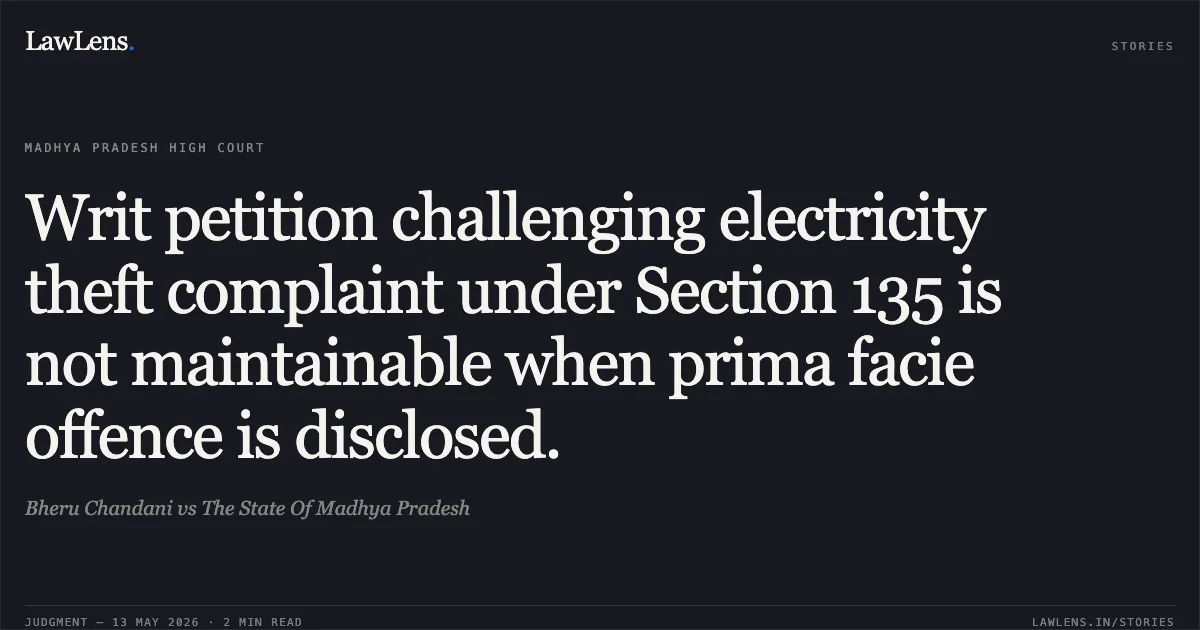
The petitioners, domestic electricity consumers, challenged a private complaint dated 25.05.2016 filed by the Respondent Board (Case No. 03/16) for electricity theft and a demand of Rs. 1,63,530/-
Source reference: p. 1The petitioners alleged they had reported a defective meter in 2014 and claimed an inspection on 26.04.2016 found the meter running and seals intact
Source reference: p. 2Conversely, the respondents asserted that the inspection revealed the petitioners were consuming electricity by by-passing the meter from the LT line and connecting neutral wires directly
Source reference: p. 3, 4A Panchnama and spot map were prepared, indicating a loss of Rs. 1,63,530/- due to illegal consumption
Source reference: p. 4The petitioners sought quashment of the proceedings under Article 226 of the Constitution, alleging a violation of natural justice
Source reference: p. 2Issues
1. Whether the private complaint filed under Section 135 of the Electricity Act, 2003, should be quashed on the ground that the action was arbitrary or contrary to the procedural requirements of Section 126.
Source reference: p. 2, 42. Whether the High Court, in its writ jurisdiction, should interfere with criminal proceedings where the material on record prima facie discloses the commission of an offence.
Source reference: p. 8, 9Law Applied
The court primarily applied Section 135 of the Electricity Act, 2003, which governs the offence of electricity theft and tampering with meters
Source reference: p. 3, 4It distinguished this from Section 126, which pertains to unauthorized use of electricity and provisional assessments
Source reference: p. 2Regarding the scope of quashing criminal proceedings, the court relied on the principles established in State of Haryana v. Bhajan Lal, State of Karnataka v. M. Devendrappa, and Preeti Gupta v. State of Jharkhand, which dictate that inherent powers under Section 482 CrPC (now Section 528 BNSS) or Article 226 should be used sparingly and only when the allegations, taken at face value, do not constitute an offence or amount to an abuse of process
Source reference: p. 4-8Reasoning
The court found that the respondents had conducted a valid investigation on 26.04.2016, which revealed that incoming and outgoing wires were burnt and neutral wires were connected directly to consume electricity without legal permission
Source reference: p. 4While the petitioners relied on a Panchnama claiming no violation, the court noted that the materials filed with the complaint (Annexure P/8), including the determination of loss and spot maps, established a prima facie case of theft under Section 135 rather than mere unauthorized use under Section 126
Source reference: p. 4The court reasoned that under Article 226, it cannot embark upon the appreciation of evidence or consider a defense that requires trial
Source reference: p. 8, 9Since the uncontroverted allegations in the complaint disclosed the ingredients of the offence, there was no legal bar to the prosecution
Source reference: p. 9Holding
The court answered the issues in the negative and held that no case for interference was made out as the action of the respondents was neither without jurisdiction nor contrary to law
The court dismissed the writ petition, holding that the defense raised by the petitioners must be proved before the competent trial court and not at the quashing stage
Source reference: p. 9Acts & Sections Cited
7 provisions across 3 statutes referred to in this judgment. Each provision opens on LawLens.
Electricity Act, 20032
Code of Criminal Procedure, 19734
Bharatiya Nagarik Suraksha Sanhita, 20231
Original Court PDF
Bheru ChandanivsThe State Of Madhya Pradesh
Click to open original judgment
Original judgment, available to read, download and summarize on LawLens.in


