Facts
The respondent was appointed as a daily wager in March 2010 and his services were terminated on 8 April 2013 without notice or notice pay.
Source reference: para. 3.1; p. 2He instituted Reference Case No. 37 of 2014 before the Labour Court, which directed his reinstatement.
Source reference: para. 3.1; p. 2Alleging non-compliance with the reinstatement order, he filed Recovery Application No. 11 of 2020.
Source reference: para. 3.1; p. 2The Labour Court allowed the application and directed the petitioners to pay ₹1,06,854 to him.
Source reference: para. 3.1; p. 2The State challenged that recovery order before the Gujarat High Court, contending that the respondent had not completed 240 days of service in the preceding 12 calendar months and that Section 25B of the Industrial Disputes Act, 1947 had been incorrectly interpreted.
Source reference: para. 4; p. 3Issues
1. Whether the Labour Court’s order directing payment of ₹1,06,854 in the recovery proceedings was liable to be quashed on the ground that the respondent had not completed 240 days of continuous service under Section 25B of the Industrial Disputes Act, 1947.
Source reference: para. 4; p. 32. Whether the High Court should interfere with the impugned order in exercise of its writ jurisdiction, having regard to the relatively small amount involved.
Source reference: para. 6; p. 4Law Applied
Section 25B of the Industrial Disputes Act, 1947 defines “continuous service” for purposes of the Act, including the statutory requirement concerning 240 days of service raised by the petitioners.
Source reference: para. 4; p. 3The High Court, however, did not finally determine the merits of the Section 25B contention.
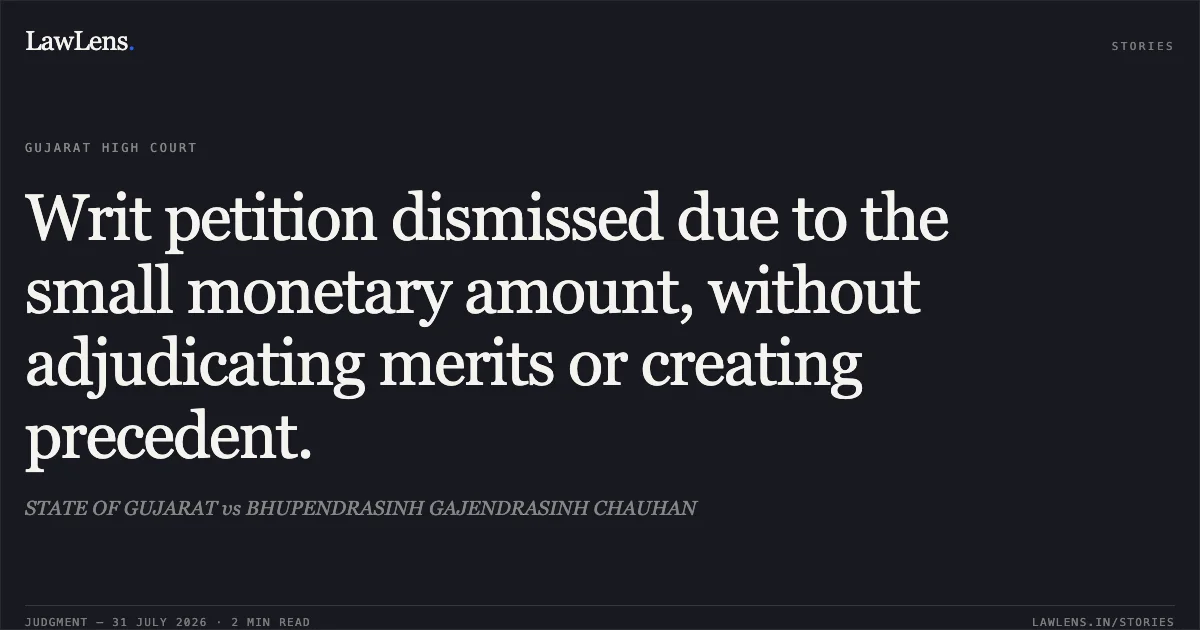
Source reference: para. 6; p. 4It applied the discretionary principle that writ interference may be declined where the amount involved is small and the circumstances do not justify examination of the merits; all grounds raised by the petitioners were expressly kept open.
Source reference: para. 6; p. 4The decision was confined to the facts of the case and was directed not to be treated as a precedent.
Source reference: para. 7; p. 5Reasoning
The petitioners challenged the recovery order primarily on the basis that the respondent had not completed 240 days of service and that the Labour Court had misapplied Section 25B.
Source reference: para. 4; p. 3The High Court consciously refrained from adjudicating those substantive questions.
Source reference: para. 6; p. 4Instead, it considered that the amount awarded was only ₹1,06,854 and exercised restraint in writ jurisdiction by declining to examine the merits in view of the smallness of the amount.
Source reference: para. 6; p. 4The Court therefore dismissed the petition while preserving the petitioners’ legal contentions for any appropriate future consideration.
Source reference: para. 6; p. 4Holding
The High Court dismissed the writ petition and discharged the Rule.
Any interim relief stood vacated forthwith.
Source reference: para. 6; p. 4The Court did not decide whether the respondent had completed 240 days of continuous service or whether Section 25B had been correctly applied; those grounds were kept open.
Source reference: para. 6; p. 4The petitioners were directed to pay/deposit the Labour Court’s awarded compensation of ₹1,06,854 with the respondent within six weeks from the date of judgment, if not already paid.
Source reference: para. 8; p. 5The order was declared non-precedential and confined to the facts of the case.
Source reference: para. 7; p. 5Acts & Sections Cited
1 provisions across 1 statute referred to in this judgment. Linked provisions open on LawLens.
Industrial Disputes Act, 19471
Original Court PDF
STATE OF GUJARATvsBHUPENDRASINH GAJENDRASINH CHAUHAN
Click to open original judgment
Original judgment, available to read, download and summarize on LawLens.in