01Facts
The petitioner sought, among other reliefs, directions concerning privacy protections, removal or masking of his late father’s name in specified High Court digital records, and restrictions on media publication of content relating to criminal proceedings against his father.
pp. 8–9By order dated 17 August 2026, the Court had directed compliance with office objections. The petitioner had not complied with those objections or carried out the required amendment.
p. 1002Issues
i.Whether the petition should remain pending when the petitioner had not complied with the Court’s order to address office objections and amend the petition.
p. 10ii.Whether the petitioner’s requested substantive reliefs should be determined despite that non-compliance.
pp. 8–1003Law Applied
The petition invoked Articles 226 and 227 of the Constitution and sought relief based on the right to privacy under Article 21, the Supreme Court’s decision in Justice K.S. Puttaswamy (Retd.) v. Union of India, and Section 19 of the Cable Television Networks (Regulation) Act, 1995, read with Rule 6 of the Cable Television Networks Rules, 1994.
pp. 7–9However, the Court did not state or apply any substantive rule concerning those provisions. It dismissed the petition on the procedural ground of non-prosecution following the petitioner’s failure to comply with the Court’s direction.
p. 10Provisions in the judgment · 1
The Cable Television Networks (Regulation) Act, 1995 Section 19
04Reasoning
The Court noted that, despite its order of 17 August 2026, the office objections remained unaddressed and the required amendment had not been made.
p. 10From this non-compliance, the Court inferred that the petitioner was not interested in prosecuting the matter and dismissed the petition without examining the merits of the privacy, media-publication, or record-masking claims.
p. 1005Holding
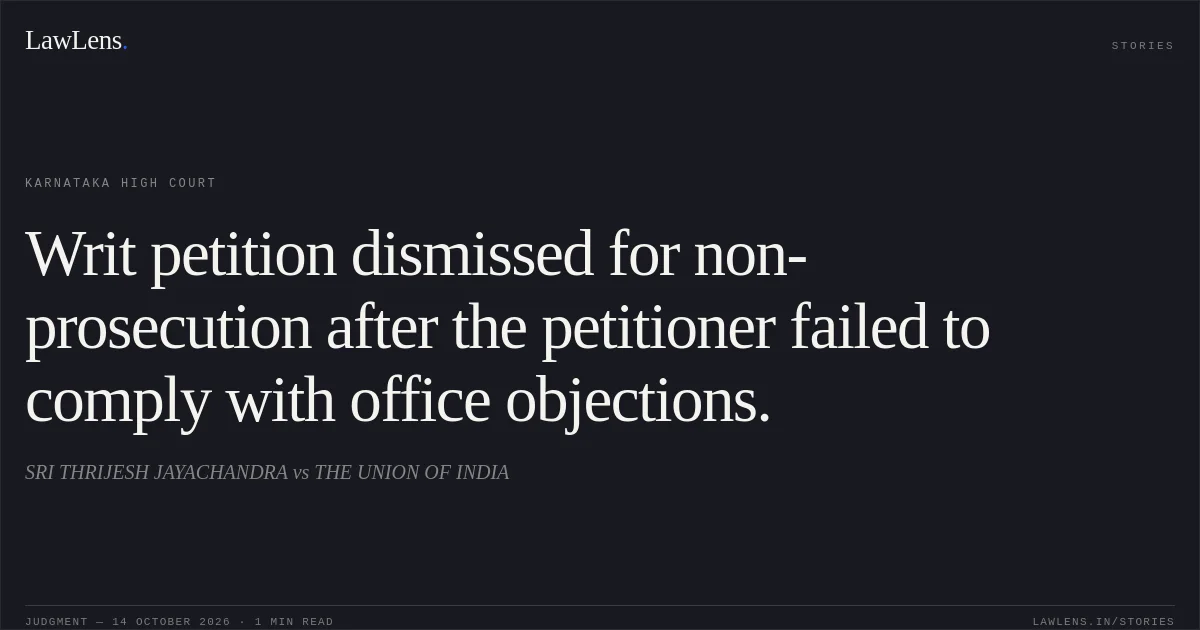
The petition was dismissed for non-prosecution because the petitioner had not complied with the office objections or carried out the amendment directed by the Court.
p. 10The substantive reliefs sought were not adjudicated on their merits.
p. 10Original Court PDF
SRI THRIJESH JAYACHANDRAvsTHE UNION OF INDIA
Click to open original judgment
Original judgment, available to read, download and summarize on LawLens.in



