Facts
The petitioner, a PDS dealer holding License No. 91/2016, challenged three successive administrative orders: the initial cancellation of his license by the Sub-Divisional Officer, Jehanabad, dated 31.08.2017; the dismissal of his appeal by the District Magistrate on 26.11.2018; and the dismissal of his revision petition by the Divisional Commissioner, Magadh Division, on 27.04.2023.
Source reference: p. 1-2The petitioner sought a writ of certiorari to quash these orders and a mandamus to restore his license.
Source reference: p. 2During the hearing, the petitioner’s counsel directed the court’s attention to the statutory remedy available under the Bihar Targeted Public Distribution System (Control) Order, 2016.
Source reference: p. 2-3Issues
1. Whether the petitioner has an alternative and effective statutory remedy available under the Control Order of 2016 despite the dismissal of his revision
Source reference: p. 4, para 52. Whether the court should exercise its extraordinary writ jurisdiction when a departmental representation route remains open
Source reference: p. 4, para 5Law Applied
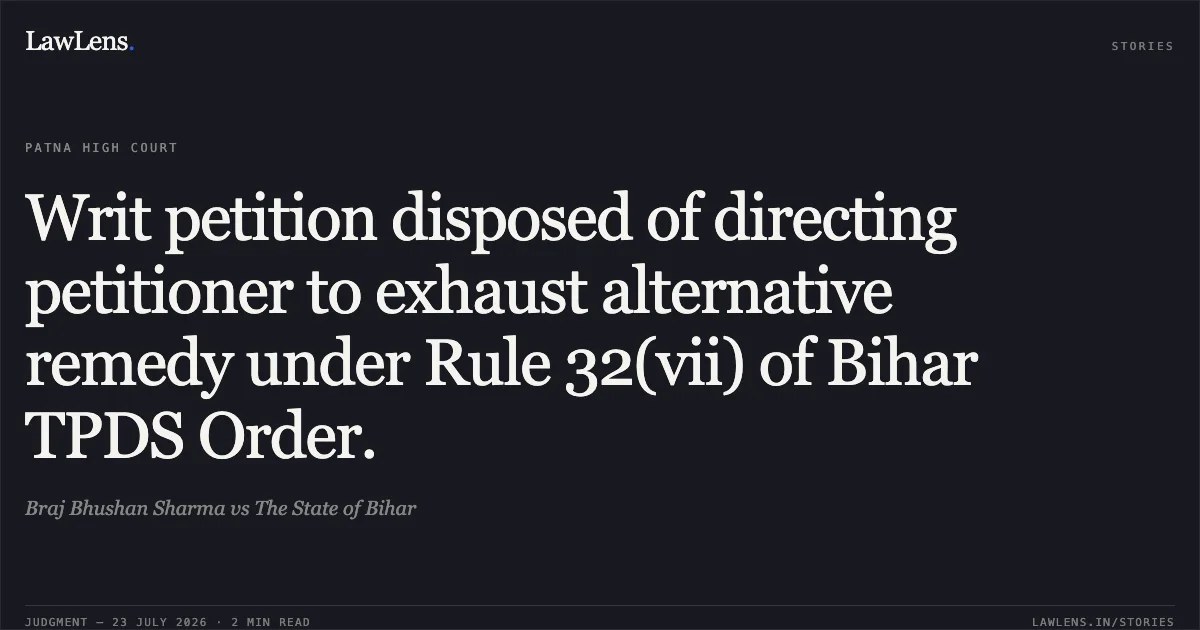
The court primarily applied Rule 32(vii) of the Bihar Targeted Public Distribution System (Control) Order, 2016.
Source reference: p. 3This rule empowers the Principal Secretary/Secretary of the Department to call for records from subordinate authorities (Divisional Commissioner, District Officer, or Licensing Authority) either suo moto or upon representation.
Source reference: para 3The Secretary is authorized to interfere if the subordinate authority exceeded its entrusted power, acted illegally without considering facts, or failed to exercise its power.
Source reference: p. 3, Rule 32(vii)(a)-(c)Reasoning
The court did not adjudicate on the merits or demerits of the license cancellation. Instead, it focused on the principle of exhaustion of alternative remedies.
Source reference: p. 4, para 5By identifying Rule 32(vii) as an "effective remedy," the court determined that the petitioner could still seek relief through a formal representation to the Principal Secretary.
Source reference: p. 4, para 5To ensure equity, the court reasoned that the delay in filing such a representation should be treated leniently by the authorities since the petitioner was actively pursuing the matter in the High Court.
Source reference: p. 4, para 6The court further emphasized procedural fairness by directing that the petitioner must be granted a notice and an opportunity to be heard during this administrative process.
Source reference: p. 5, para 7Holding
The court disposed of the writ petition without setting aside the impugned orders, instead granting the petitioner liberty to file a representation before the Principal Secretary within one month.
The Principal Secretary was directed to pass a speaking order in accordance with the law within three months of receipt.
Source reference: p. 5, para 7The court further held that the authority shall liberally construe the limitation period in favor of the petitioner.
Source reference: p. 4, para 6All interlocutory applications were disposed of accordingly.
Source reference: p. 5, para 9Original Court PDF
Braj Bhushan SharmavsThe State of Bihar
Click to open original judgment
Original judgment, available to read, download and summarize on LawLens.in