Facts
The petitioner, a Public Distribution System (PDS) dealer holding Licence No. 158/2001 and operating at Panchayat Lodipur, Block Rajgir, Nalanda, challenged the cancellation of her licence by the Sub-Divisional Officer, Rajgir, through Memo No. 650 dated 3 September 2020.
Source reference: pp. 1–3, paras. 1–2The cancellation was based on allegations of irregularities in the distribution of food grains and charging beneficiaries higher prices. Her statutory appeal under Rule 32(1) of the Bihar Targeted Public Distribution System (Control) Order, 2016 was rejected by the Collector-cum-Appellate Authority, Nalanda, on 4 February 2021. Her subsequent revision before the Divisional Commissioner, Patna, was also rejected on 15 June 2023.
Source reference: pp. 1–3, paras. 1–2Issues
Whether the writ petition challenging the cancellation of the petitioner’s PDS licence and the orders of the appellate and revisional authorities was maintainable when an alternative remedy of representation was available under Rule 32(vii) of the Bihar Targeted Public Distribution System (Control) Order, 2016?
Source reference: pp. 3–4, paras. 2–5Whether the petitioner was entitled to a direction for restoration of her PDS licence at the writ stage without the High Court examining the merits of the cancellation proceedings?
Source reference: p. 4, para. 5Law Applied
The Court applied Rule 32(vii) of the Bihar Targeted Public Distribution System (Control) Order, 2016, which empowers the Principal Secretary/Secretary of the Food and Consumer Protection Department to call for records relating to orders passed by the Divisional Commissioner, District Officer, licensing authority, or Sub-Divisional Officer, either suo motu or upon representation.
Source reference: pp. 3–4, para. 3Where such authority has exercised powers not vested in it, acted illegally without considering the facts, or failed to exercise its jurisdiction, the Principal Secretary may pass an appropriate order.
Source reference: pp. 3–4, para. 3The Court also applied the principle that a writ petition may ordinarily be declined where an effective alternative statutory remedy is available.
Source reference: p. 4, para. 5Reasoning
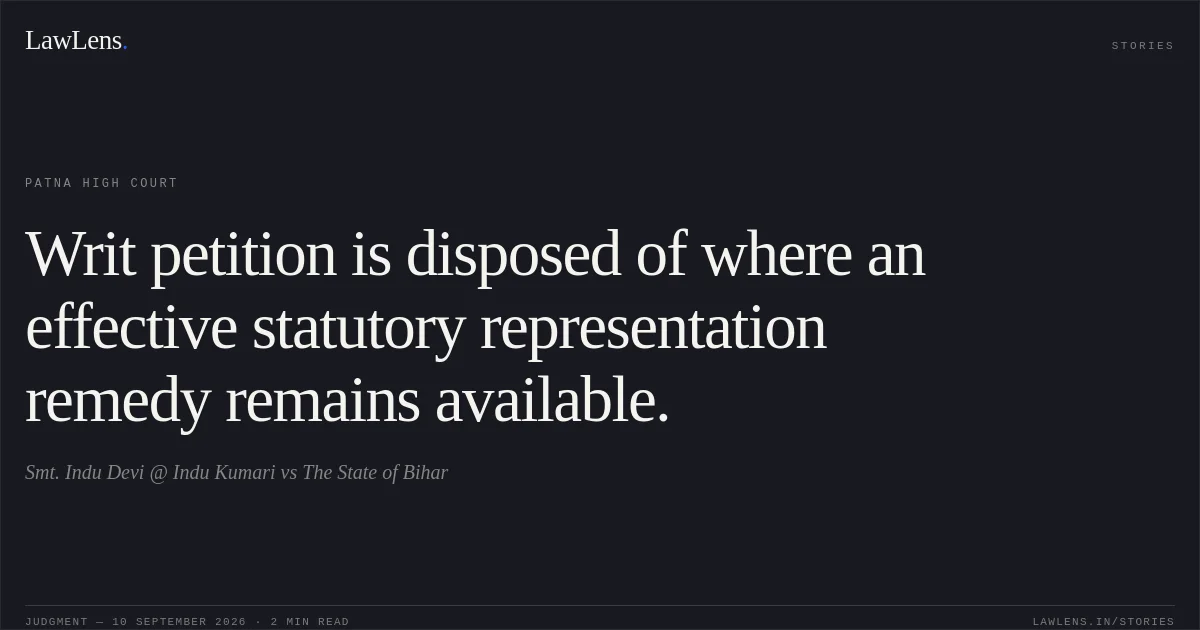
Without entering into the merits of the allegations or the legality of the cancellation orders, the Court held that Rule 32(vii) provided the petitioner with an alternative and effective remedy before the Principal Secretary.
Source reference: p. 4, para. 5Since the statutory mechanism permitted scrutiny of orders passed by the licensing, appellate, and revisional authorities, the Court considered it appropriate to direct the petitioner to pursue that remedy instead of adjudicating the merits in writ jurisdiction.
Source reference: p. 4, para. 5The Court further protected the petitioner against technical delay, observing that any delay in filing the representation should be liberally construed because she had approached the High Court within time.
Source reference: p. 4, para. 6It also required compliance with natural justice by directing that the petitioner be given notice and an opportunity of hearing before any decision was taken.
Source reference: p. 5, para. 7Holding
The writ petition was disposed of without examination of the merits.
The petitioner was granted liberty to file a representation before the Principal Secretary under Rule 32(vii) challenging the revisional/appellate order and the cancellation order within one month from receipt of the judgment.
Source reference: p. 4, para. 5Any delay was to be considered liberally, and the Principal Secretary was directed to provide notice and an opportunity of hearing and conclude the proceedings within three months from receipt of the representation. The decision was to be communicated to the petitioner.
Source reference: pp. 4–5, paras. 5–8Original Court PDF
Smt. Indu Devi @ Indu KumarivsThe State of Bihar
Click to open original judgment
Original judgment, available to read, download and summarize on LawLens.in