Facts
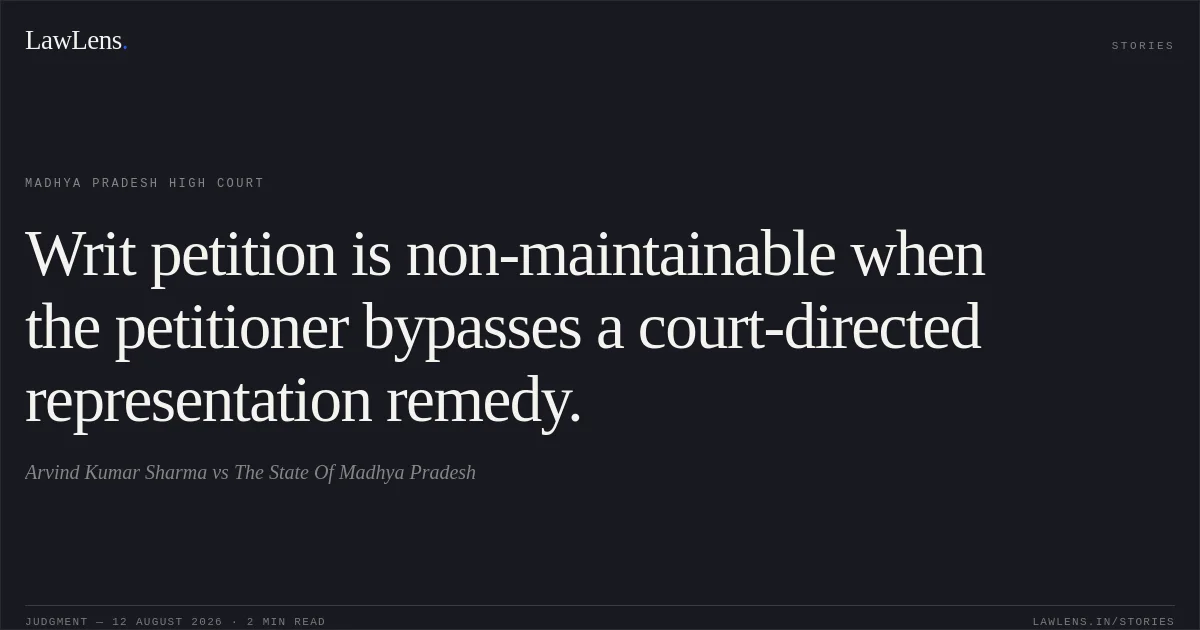
The petitioner was appointed as a Sub-Engineer in the Municipal Council, Umariya, on 1 November 1995 and was promoted as an Assistant Engineer on 22 January 2016. He claimed that, under Schedule IV of the Madhya Pradesh State Engineering Service (Recruitment & Conditions of Service) Rules, 2015, he had completed the requisite six years’ service as Assistant Engineer by 31 December 2020 and possessed the required ACR benchmark, with no pending departmental or disciplinary proceedings. He challenged the promotion order dated 12 July 2026 insofar as it promoted private respondents to the post of Executive Engineer while excluding him.
Source reference: para. 2The petitioner had previously filed W.P. No. 26093 of 2026 seeking substantially the same relief. By order dated 14 July 2026, the High Court directed him to submit a fresh representation, along with relevant documents and a copy of that order, to the competent authority within fifteen days, and directed the authority to decide it within two months. Instead of submitting the directed representation, the petitioner filed the present writ petition.
Source reference: para. 3; para. 5Issues
Whether the present writ petition challenging the promotion of the private respondents was maintainable when the petitioner had already been directed, in an earlier writ petition, to submit a representation raising the same grievance?
Source reference: paras. 3, 5Whether the petitioner could directly challenge the promotion order without first complying with the directions issued in the earlier writ petition?
Source reference: para. 5Whether the petitioner was a “person aggrieved” having locus to seek quashing of the promotions granted to the private respondents?
Source reference: para. 3Law Applied
The Court exercised jurisdiction under Article 226 of the Constitution of India, but applied the principle that a writ petition is not maintainable where the petitioner has failed to comply with directions issued in an earlier proceeding concerning the same grievance.
Source reference: para. 3In this context, the State relied on Ayaaubkhan Noorkhan Pathan v. State of Maharashtra, (2013) 4 SCC 465, concerning the requirement of locus and legal injury.
Source reference: para. 3Reasoning
The Court found that the present petition substantially sought the same relief as W.P. No. 26093 of 2026. In the earlier proceedings, the petitioner had been specifically directed to submit a representation containing all relevant documents and grievances to the competent authority. Rather than complying with that direction and awaiting a decision, he directly challenged the promotion order in the present petition.
Source reference: para. 5The Court held that he could approach the High Court again only if his representation remained undecided or was decided contrary to law. Since he had bypassed the remedy expressly directed in the earlier order, the challenge was premature and impermissible. The Court consequently did not adjudicate the petitioner’s substantive entitlement to promotion or the legality of the promotions granted to the private respondents.
Source reference: para. 5Holding
The High Court held that the petition was not maintainable because the petitioner had failed to comply with the directions issued in the earlier writ petition requiring submission of a fresh representation.
The writ petition was accordingly dismissed as not maintainable.
Source reference: para. 6Original Court PDF
Arvind Kumar SharmavsThe State Of Madhya Pradesh
Click to open original judgment
Original judgment, available to read, download and summarize on LawLens.in